

Do Something: Part II
Does exercise work for depression?

Fifty-one million Americans currently have depression or are being treated for it. That’s one in five adults, and it’s nearly double the rate we had a decade ago.
Let’s say you’re one of those people who feel down. So you go to a doctor. Chances are, you’ll leave with a prescription, a referral for therapy, or both.
You probably won’t be told to try exercise.
Two psychiatrists just spent a day arguing online about whether that’s a good or bad thing.
It all started when Dr. Nicholas Fabiano, a psychiatrist and researcher at the University of Ottawa, tweeted the following:
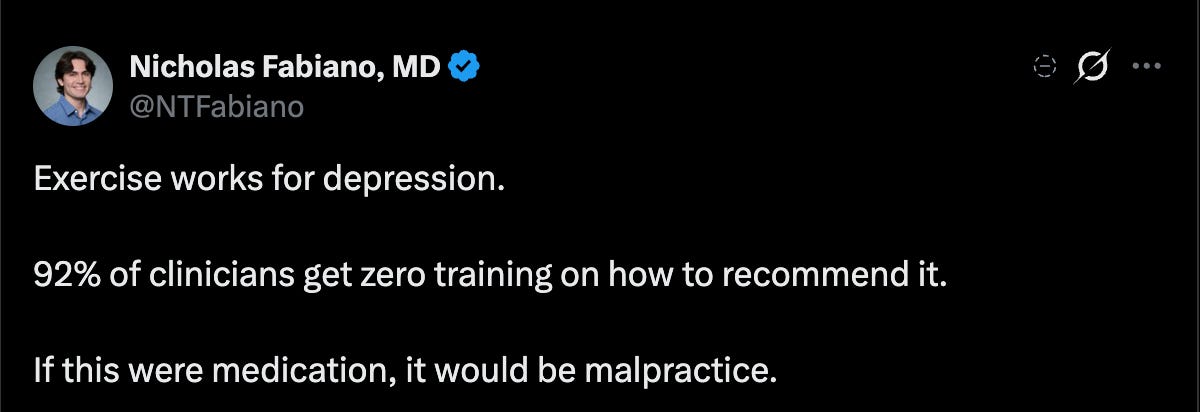
And because the internet is the internet, he got pushback. Specifically from Dr. Tyler Black, pediatric emergency psychiatrist and suicidologist at the University of British Columbia.
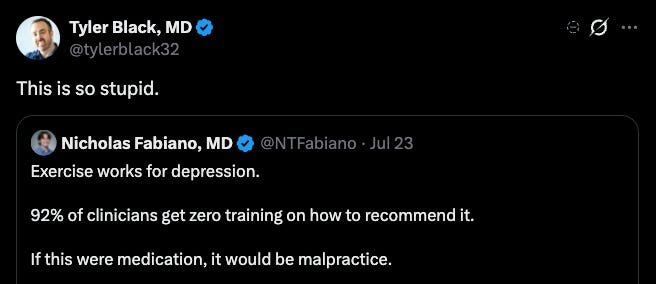
Tyler followed up with another Tweet, explaining:
18 to 38% of elite athletes have depression, and have a risk of depression 2x the rate of the general population. So, like, maybe exercise isn’t a panacea.
So here we have one MD, Nick, suggesting that exercise helps for depression and should be talked about more often. Then we have another MD, Tyler, suggesting the idea is questionable and that exercise is “not a panacea.”
Two MDs. Two people who have both spent far too long in school studying mental health, both working with patients, both looking at the same evidence—yet drawing opposite conclusions.
Debating 280 characters at a time is limiting, so I looked at the research and spoke with an outside expert.
The two arguments
Nick’s point is that psychiatry overlooks recommending exercise as a way to improve patient mental health. Exercise is free. It improves physical health and the side effects are minimal. Psychiatrists not recommending it leads to more suffering.
He wrote a whole paper titled, “Could not prescribing exercise for depression be psychiatric malpractice?” in the British Journal of Sports Medicine1.
Tyler works in emergency psychiatry. He sees the worst cases, many of whom can hardly get out of bed, much less go to a gym. His argument: exercise is being oversold, and overselling it has real costs. Telling depressed people to exercise only prevents them from getting more effective care.
So who’s right?
Today’s post unpacks the nuances in exercise and mental health: whether it works. And if it does, for who, when, what, and why.
Quick Housekeeping
This post, like all Monday posts, is free to all subscribers. But only members get full access to Wednesday and Friday posts. Become a Member here:
In case you missed it:
On Wednesday, we took an evolutionary view on elite fitness, covering four movement patterns humans are designed to do and why they can help you.
Friday’s Burn the Ships took the info from Wednesday’s post and put it into one of our more epic workouts.
Last week on the Two Percent podcast we had Dr. Lucy McBride talking about how to get better healthcare, and The Humane League CEO Dan Shannon talking about his new and radical vision to reduce animal factory farming. Listen here.
Check out our partners:
💪 David Protein Bars have the highest amount of protein per calorie of all protein bars. They’re a great option for anyone who wants protein on the go without the excess sugar and fat of most bars. Visit DavidProtein.com.
🧪 Function Health offers 5x deeper insights into your health than typical bloodwork. The info can guide you into feeling better every day. It helped me identify a mineral insufficiency—and was cheaper than my insurance. Go to my page here to sign up, receive a discount, and pay just $340.
What the studies show
On to the research. The somewhat messy, nuanced research.
Nick pointed to studies showing that exercise helps with depression. Tyler fired off a few studies showing that exercise doesn’t help.
Science is messy. Findings depend on many factors.
For example, the study Tyler referenced about elite athletes having double the depression risk looked at retired elite athletes. We don’t know if those athletes still exercised, and we don’t know if their depression arose from retiring2.
So then the question is, where should we look?
Cochrane reviews and meta-analyses are considered “gold-standard” for high-quality, reliable information3. They’re used to inform healthcare policy and how doctors practice.
This year, Cochrane updated their review of exercise for depression4.
They looked at 73 studies that involved roughly 5,000 adults with depression.
Their conclusion: “Exercise may be moderately more effective than a control intervention for reducing symptoms of depression.”
That is to say: For many people with mild to moderate depression, exercise can help. That doesn’t mean it will help all people with depression. It seems to depend on the person and situation.
Exercise vs. therapy or medication
You might think: meh. “Moderately more effective” than a control sounds a bit weak.
But here’s the thing: That effect was about the same as therapy and medication.
The Cochrane authors wrote:
There is probably little to no difference in depressive symptoms between people undertaking exercise and those receiving psychological therapy. There may be little to no difference in depressive symptoms between people doing exercise and those taking antidepressants.
That all said, the scientists noted that there aren’t many studies that directly compare medication or therapy to exercise, and they’re small and imperfect.
You can’t blind an exercise study the way you can a drug trial—nobody finishes a set of squats wondering if they got the sugar pill/placebo.
Tyler pointed out that when researchers look at the most rigorously designed trials, the benefit of exercise shrinks. (These studies use blinded assessors, concealed group assignments, and full accounting of dropouts.)
In the 2013 version of that Cochrane review, six studies met all three of those standards. Their combined effect was rather weak.
That might sound like it destroys the case for exercise, but it turns out to be one of the more interesting findings in this field—more on why below.
And remember, Tyler is a suicidologist in emergency psychiatry. He’s working with the worst cases.
People with severe depression often can’t bring themselves to exercise. It’s totally irresponsible to tell someone who has severe biological depression to just go for a run or do some pushups.
For example, one meta-analysis found that depression severity predicts the likelihood that someone will drop out of an exercise study. The sicker you are, the less likely you are to actually exercise.
And for some people with mild to moderate depression, it may not help (for a variety of reasons). But so it is with standard treatments like therapy and medication.
Two types of depression
The modern mental health system largely sees depression as biological: I.e., your brain chemicals are out of whack. But that’s likely not true for all cases.
I spoke to Dr. Randolph Nesse, who’s considered the founder of Evolutionary Psychiatry. He told me there are basically two types of depression5:
Life circumstances depression: This comes from things not working out in your life the way you want them to. Bad job, bad relationship, or any other bad circumstances.
Biological depression: This is largely driven by your biology rather than circumstances. Everything in your life can be going great, but you still find yourself depressed.
He estimates about 1/3 of depression cases are biological, 1/3 are purely life circumstances, and another 1/3 have a mix of both.
Nesse views mental health from an evolutionary point of view. He sees low mood as an ancient adaptation that helped us conserve energy when our circumstances weren’t working.
Think of it this way: if we’re out hunting and can’t find any animals, our mood drops. Those feelings cause us to mope back into camp, sit around, and think. Classic signs of depression are less movement, lower energy, loss of interest.
What else improves depression? Do something.
As we just learned, low moods may have helped our ancestors save energy.
But today, energy isn’t scarce, so those feelings are not always helpful. For mild and moderate depression, forcing yourself to do something often helps counter those symptoms.
This isn’t unique to exercise. The following have also been shown to improve depression:
Dancing6
Going outside7
Singing8
Gardening9
Interaction with dogs and horses10
Meditation11
Gratitude journaling12
Performing acts of kindness13
You get the point.
Which brings us back to those rigorous studies where exercise didn’t show a clear benefit.
When researchers compare exercise against people doing nothing—sitting on a waitlist—exercise looks great. But when studies compare exercise to something—e.g. stretching, meditation, relaxation—exercise shows less of an advantage.
This sounds like bad news for exercise. And in a narrow sense, it is. Exercise is probably not a unique, all-powerful antidepressant.
But look at what those control groups were doing: stretching, meditation, relaxing. They were doing something.
This same pattern shows up in therapy. One meta-analysis14 compared seven different psychotherapies and seven different theories of what depression is. Every single one beat being placed on a waitlist for treatment. The effects were all moderate-to-large, and the differences between them were small.
TL;DR: Every decent treatment for depression is a different recipe. But they share a common ingredient: doing something.
An Example: The Hot Yoga Study
Consider recent research15 conducted by scientists at MIT, Harvard, Brown, and Mass General Hospital.
They had a group of 65 people with moderate-to-severe depression do hot yoga (105 F) at least twice a week for eight weeks. The scientists discovered a clear pattern: the more hot yoga classes people attended, the more their depression symptoms decreased.
A few explanations why:
Depressed people did something new. Some depression benefits from action and changes in environment.
Hot yoga is generally community oriented—they did something with other people.
Heating the brain—which happens in a sauna or hot yoga class—may increase serotonin production (the same mechanism that SSRI’s target) and reduce brain inflammation, which is linked to depression. Bill Gifford talked about how heat health impacts our physical and mental health on the Two Percent Podcast. Listen here.
Takeaway
This saga of Twitter disagreement involves a unicorn: an eventual agreement.
Nick and Tyler went back and forth on their perspectives, culminating in Tyler writing:
Where we actually agree: Exercise is a reasonable adjunct, well tolerated, worth offering. Guidelines already say that. And sure, more physicians could follow guidelines and learn better to do so.
He continued:
If [exercise] works for you: great.
If you can do it: go ahead and try.
However most people with significant depression are beyond any point of being able to exercise their depression away.
The takeaway for us: When you’re feeling low, do something. See if it helps. If it doesn’t, try something else.
The reason exercise is a good “something” is simple. Therapy is expensive and takes time. Medication helps some people and carries side effects. Exercise is free, and its main costs are time and discomfort. Critically—and this is where it’s unique—it also improves physical health.
When it comes to exercise, even a little goes a long way. One study in JAMA Psychiatry16 found 75 minutes of brisk walking a week was associated with an 18% lower depression risk. One hour a week, at any intensity, was associated with enough lower risk that researchers17 estimated 12% of future cases could have been prevented.
Have fun, don’t die, do something.
-Michael
Fabiano N, Puder D, Stubbs B. Could not prescribing exercise for depression be psychiatric malpractice? Br J Sports Med. 2025 Oct 10;59(20):1388-1389. doi: 10.1136/bjsports-2025-110405. PMID: 40925654.
Being an elite athlete (which make up about 0.1% of the population) might also select for people prone to depression. And in that study, the two groups with highest rates of depression were football players and jockeys: two sports that involve head trauma and weight cutting.
Seidler AL, Hunter KE, Cheyne S, Berlin JA, Ghersi D, Askie LM. Prospective meta-analyses and Cochrane’s role in embracing next-generation methodologies. Cochrane Database Syst Rev. 2020 Oct 30;10(10):ED000145. doi: 10.1002/14651858.ED000145. PMID: 33284462; PMCID: PMC9414316.
Clegg AJ, Hill JE, Mullin DS, et al. Exercise for depression. Cochrane Database Syst Rev. 2026 Jan 8;1(1):CD004366.
Psychiatry abandoned this distinction, which Nesse and many other researchers argue was a mistake.
Xing Z. Effects of dance movement therapy and other dance-related interventions on depressive symptoms: a meta-analysis of evidence in the past decade. Eur Arch Psychiatry Clin Neurosci. 2026 Jun;276(4):1505-1519. doi: 10.1007/s00406-026-02205-1. Epub 2026 Mar 13. PMID: 41824034; PMCID: PMC13234077.
Liang Y, Wei DY, Min S. Comparative efficacy of green exercise versus indoor exercise for depression and anxiety: a systematic review and network meta-analysis. Front Public Health. 2026 May 28;14:1831073. doi: 10.3389/fpubh.2026.1831073. PMID: 42293588; PMCID: PMC13253268.
Williams E, Dingle GA, Clift S. A systematic review of mental health and wellbeing outcomes of group singing for adults with a mental health condition. Eur J Public Health. 2018 Dec 1;28(6):1035-1042. doi: 10.1093/eurpub/cky115. PMID: 29982515.
Chen L, Sun Y, Pan Y, Chen R, Liu C. How duration and frequency influence horticultural therapy’s effect on depressive symptoms: evidence from a meta-analysis. Front Psychol. 2025 May 16;16:1575441. doi: 10.3389/fpsyg.2025.1575441. PMID: 40453999; PMCID: PMC12124316.
Shih CY, Arifin H, Kustanti CY, Chang WJ, Huang CH, Fitryasari R, Tsai MC, Ye JY. Animal-assisted therapy on psychological and physical outcomes: a meta-analysis of randomised controlled trials. J Glob Health. 2026 Jul 17;16:04236. doi: 10.7189/jogh.16.04236. PMID: 42466625; PMCID: PMC13377760.
Wang YY, Li XH, Zheng W, Xu ZY, Ng CH, Ungvari GS, Yuan Z, Xiang YT. Mindfulness-based interventions for major depressive disorder: A comprehensive meta-analysis of randomized controlled trials. J Affect Disord. 2018 Mar 15;229:429-436. doi: 10.1016/j.jad.2017.12.093. Epub 2018 Jan 3. PMID: 29331704.
Diniz G, Korkes L, Tristão LS, Pelegrini R, Bellodi PL, Bernardo WM. The effects of gratitude interventions: a systematic review and meta-analysis. Einstein (Sao Paulo). 2023 Aug 11;21:eRW0371. doi: 10.31744/einstein_journal/2023RW0371. PMID: 37585888; PMCID: PMC10393216.
Naclerio M, Lazar L, Hornstein EA, Eisenberger NI. Exploring the effects of prosocial and self-kindness interventions on mental health outcomes. Emotion. 2026 Feb;26(1):14-24. doi: 10.1037/emo0001577. Epub 2025 Aug 28. PMID: 40875305.
Barth, J., Munder, T., Gerger, H., Nüesch, E., Trelle, S., Znoj, H., Jüni, P., & Cuijpers, P. (2013). Comparative efficacy of seven psychotherapeutic interventions for patients with depression: A network meta-analysis. PLoS Medicine, 10(5), e1001454.
Copeland DI, Mac Giollabhui N, Foster S, Arnold C, Wu Y, Raslan H, Lind S, Nagaswami M, Streeter CC, Uebelacker L, Fisher LB, Dording C, Sylvia L, Yeung A, Cusin C, Jain FA, Pedrelli P, Mason AE, Mehta DH, Miller KK, Anthony B, Fava M, Mischoulon D, Nyer MB. Heated yoga thaws depression: A dose-response analysis from a randomized controlled trial. J Affect Disord. 2026 Jul 15;405:121647. doi: 10.1016/j.jad.2026.121647. Epub 2026 Mar 16. PMID: 41850611.
Pearce, M., Garcia, L., Abbas, A., Strain, T., Schuch, F. B., Golubic, R., Kelly, P., Khan, S., Utukuri, M., Laird, Y., Mok, A., Smith, A., Tainio, M., Brage, S., & Woodcock, J. (2022). Association between physical activity and risk of depression: A systematic review and meta-analysis. JAMA Psychiatry, 79(6), 550–559
Harvey, S. B., Øverland, S., Hatch, S. L., Wessely, S., Mykletun, A., & Hotopf, M. (2018). Exercise and the prevention of depression: Results of the HUNT cohort study. American Journal of Psychiatry, 175(1), 28–36