


Summary of Today’s Post
Back pain is the most common and debilitating pain. More than 80% of people experience it in their life.
It creates downstream effects that lead people to stop moving as much—which limits their life experiences and damages their health and longevity.
A new study looked at all the research on what forms of exercise help back pain.
It found two particularly great options.
You’ll learn how to use one of the winners to bulletproof your back so you can move free now and into old, old age.
Housekeeping:
Full access to this post is for Members, who are people who like to have fun and not die.
Becoming a Member below saves you more time and money than the monthly cost.
Now onto the post …
Back pain is popular in the sense that McDonald’s is popular—over one billion served.
80% of people experience low back pain at some point in their life.
25% of people have had it in the last few months.
It’s the most common place people experience pain, and the most frequent reason people see a doctor and take a sick day at work.
Up to a quarter of patients never fully recover from low back pain.
People with chronic low-back pain are twice as likely to suffer from depression, anxiety, psychosis, and sleep deprivation.
When people experience back pain, they reduce their movement. And that creates all sorts of ill health effects that limit our experience of life and reduce our lifespan and healthspan.
We often try to treat it with pills, surgery, or rest.
That’s an easy, no-effort treatment—but evidence shows it’s usually not a solution.
“Rest, opioids, spinal injections, and surgery … will not reduce back-related disability or its long-term consequences,” wrote a global team of 12 doctors and scientists who studied all the evidence on back pain treatment.
Pills and rest temporarily mute pain rather than treating its underlying cause.
Then there’s surgery. Forget the cost. Researchers at the University of Cincinnati Medical School tracked roughly 1,500 workers who had debilitating back pain that was keeping them from work.
Half of the workers had surgery, and half did not. After two years, roughly 75 percent of those who had surgery were still in debilitating pain and unable to return to work. But 67 percent of those who didn’t have surgery were back to working.
Of the people who went under the knife, 36 percent had complications, and 27 required another surgery. They also had higher rates of opioid use.
Back pain sometimes comes from something a doctor could scan, see on an image, and diagnose. Like an injured disk, tumor, osteoporosis, or fracture.
But 85 percent of it is labeled “non-specific,” which is pain caused by the modern lifestyle (more on that later).
Luckily, exercise seems to be the most powerful way to treat non-specific back pain. It’s not as easy as popping a pill or resting—but it’s cheaper and more effective. Side effects? Looking and feeling better, being happier, living longer, etc, etc, etc.
And yet—there are a lot of ways to exercise.
So a review in Frontiers in Public Health recently investigated exactly what kind of exercise seems to help back pain the most.
Back pain: The magic of movement
The scientists reviewed all the existing research on the topic. They analyzed results from 75 studies that included more than 5,000 people of all different ages and nationalities.
Twenty forms of exercise were included. For example, yoga, cardio, core exercises, swimming and water workouts, Tai chi, Pilates, stretching, and on into a lot of specific clinical and physical therapy methods.
The good news: Doing any exercise at all beat doing nothing.
But yoga and core exercises came out on top compared to traditional rehabilitation.
Yet that doesn’t mean your back pain will disappear if you just start doubling or tripling down on yoga and core exercises.
In fact, people who exercise hard have higher rates of back pain than the average person.
So before we explain the best three back pain exercises, we need to understand the complex relationship between exercise and back pain.
This can help guide all of your exercise and help you avoid injuries of all kinds.
The strength threshold test
Even the best exercise interventions can hurt you if you do too much too soon.
Think of it like medicine: Medicine can help fix a problem, but if you take too much, you cause damage.
The back health expert Stu McGill, who you may remember from The Comfort Crisis, wonderfully explains this concept.
He explains that our backs have a biological tipping point. We get injured when we cross that tipping point by doing too much exercise too soon.
Factors that push you over the tipping point:
Doing too many sets and reps in a single session.
Doing an exercise for too long.
Going too intense, either in weight or speed.
Not having enough recovery/time between the last session.
But when we do the correct dose of exercise and follow it with some rest, we improve our biological tipping point so we can do more exercise safer next time. That improves our fitness.
In short: You want to do enough work to stimulate a response—and then back off. I’ve re-drawn four graphs from Stu to help you visualize this concept.
These show how the intensity/load of an exercise and how long you do it relate to injury. An explanation of each graph is below.
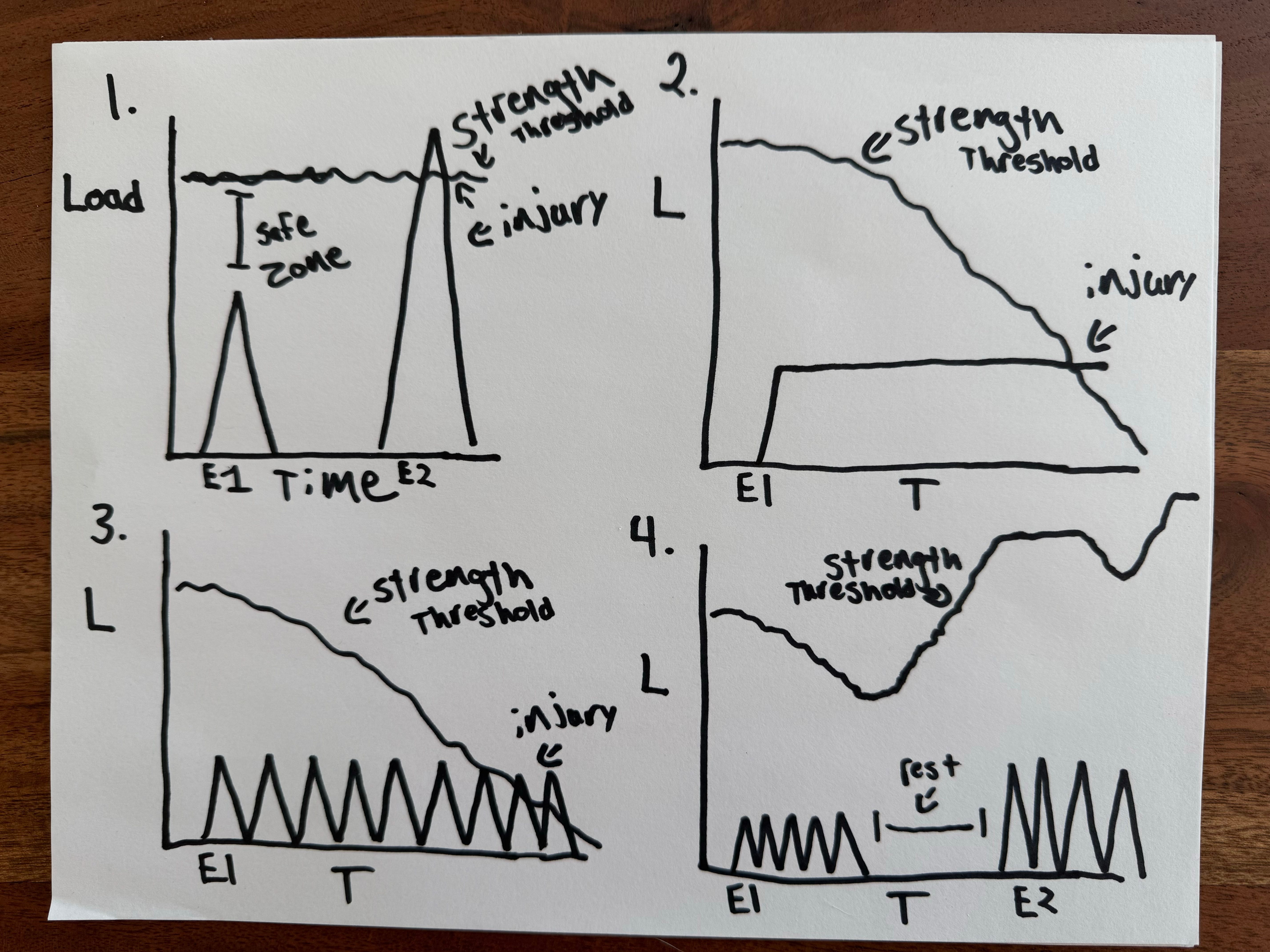
In all four graphs:
The X axis is time (T), and the Y axis is load (L). Load is the intensity of the exercise, or the amount of stress you’re putting on your back.
The spiked lines (or, in the case of graph 2, the elevated flat line) labeled “E” are the exercise.
The slightly squiggly line across the top of each graph, often sloping, is your strength threshold or the load your back/body can handle.
When load goes above your strength threshold, injury occurs.
Here’s a breakdown of each graph:
Graph 1 visualizes how injury occurs.
Example 1 (E1) shows a single exercise that stresses the body but doesn’t cross the strength threshold. It’s safe and the person will become stronger.
Example 2 (E2) shows a single exercise that pushes the body past its strength threshold. Injury occurs.
Graph 2 visualizes why doing an exercise for too long can injure us.
In this example, the exercise continues at the same load/intensity for a long time. The body is fine at first—but as the person becomes fatigued over time, their strength threshold lessens.
The exercise load hasn’t changed, but due to fatigue. their body’s ability to handle the load has. Eventually, they tip over their strength threshold and get injured.
This happens in exercises where we do the same thing for a longer duration: holding yoga poses, running, rucking, rowing, swimming, etc, etc, etc. To avoid injury, you want to rest before you get too fatigued.
Graph 3 visualizes why too many reps of an exercise can injure us.
The body is fine for the first handful of reps. But each rep leads the person to get tired. The strength threshold goes lower and lower—until it drops below the load of the final reps of the exercise. That causes injury.
This happens when we do repeated reps of intense, higher-risk exercises like deadlifts, squats, etc.
Graph 4 illustrates how we improve our resilience and fitness: Exercising within our limits and following it by rest. That increases our strength tolerance.
In this example, the person exercises hard but below their tolerance.
Then they rest, which allows their body to recover and build back more strength. It elevates their future strength tolerance. They then have more strength tolerance to safely go harder in the future.
Three exercises that help back pain
McGill, mentioned above, is arguably the world’s foremost authority on back pain. He studied the topic for decades and racked up tens of thousands of citations.
He’s discovered three particularly effective exercises for preventing and rehabilitating back pain. He’s used them to help everyone from championship athletes to busy office workers.
He calls them “The Big 3.” They are the bird dog, side plank, and curl up.
They’re the type of core stabilization exercises that the study found were so powerful.
McGill said, “The Big 3 came from experimentation converging on the very best exercises to address the mechanisms of pain.”
These exercises “work” by enhancing your core’s stiffness so it can support loads and “eliminate the micro-movements that cause pain.”
How to do and use The Big Three exercises
Do them whenever you can. Even a single set of each a couple of times a week helps.
1. Bird dog
Hold the part where your opposite arm and leg are stretched out for 10 seconds. That’s one “rep.” Do 5 to 10 reps on each side.
2. Side plank
Hold the top position for 5 to 10 seconds. That’s one “rep.” Do 5 to 10 reps on each side.
3. Curl up
Hold the top position for 5 to 10 seconds. That’s one “rep.” Do 5 to 10 reps, then change which knee is “up” and repeat.
These exercises are also great to do before a workout to help prevent injury.
McGill noted, “The Big Three exercises can be performed at the beginning of the workout to establish the stable motor patterns for the rest of the training session. These exercises also enhance core stiffness for a period of time.”
Have fun, don’t die, avoid back pain.
-Michael
Cat/Cow is another good one that's helps me. I am a huge fan of Bird Dogs. Also, for manly men who blanche at the thought of "yoga" Diamond Dallas Page has an amazing program called DDP Yoga which really helped me. I was doing that and rucking, along with watching what I ate and lost 50 pounds.
Great article, thank you! Can’t wait to try these Big 3 exercises… it’s so hard to know what preventative exercises to focus on. It’s gardening season and that always causes me back pain. One thing I have noticed for me is tight hamstrings = low back pain. Stretching them often helps immediately.