

Excellence, Flow States, and Why We Need to Stop Optimizing Everything
A conversation with Brad Stulberg

It’s the last week of the Two Percent New Year Challenge - daily challenges to build a strong foundation for 2026. It’s not too late to start. Become a Member to join.
We live in a strange moment.
On one side, we’re surrounded by hustle culture, optimization porn, and people yelling that you need to wake up at 4 a.m. and do a 19-step morning routine to be “excellent.”
On the other, there’s a growing sense that striving for anything at all is misguided—that wanting to be great at something is naïve, privileged, or pointless.
Both camps miss the point.
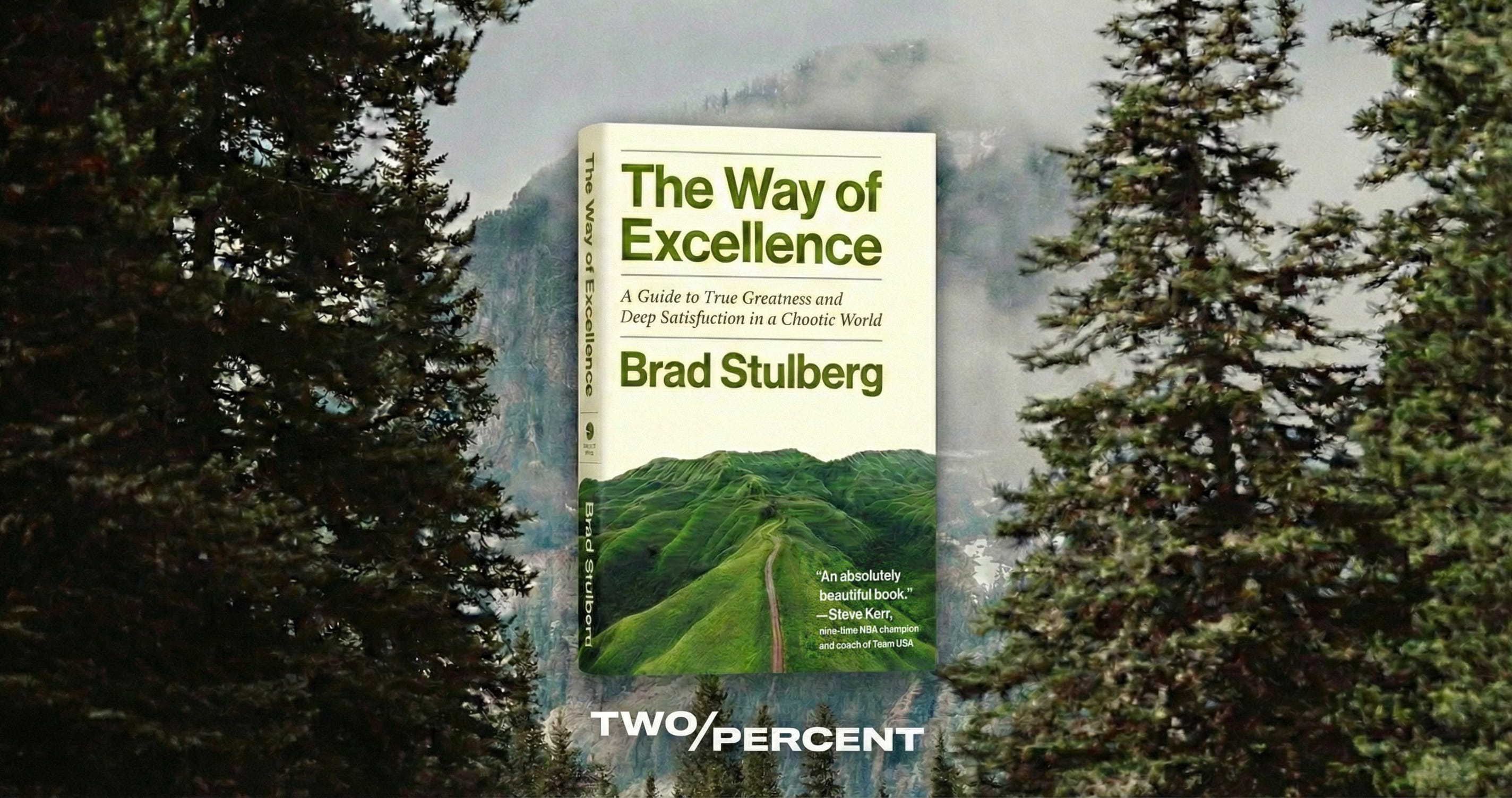
Brad Stulberg’s new book, The Way of Excellence, out tomorrow, tries to reclaim a word that’s been badly abused. Excellence, as Brad defines it, isn’t perfectionism, obsession, or winning at all costs. It’s deep engagement with something worthwhile—caring fully and honestly, and letting that shape who you become. Excellence is available for all of us, and it can open up a new world of performance and wellbeing.
That idea overlaps heavily with what we explore in Two Percent: why modern life leaves many people feeling numb, why deep focus and care are increasingly rare, and why meaning tends to emerge not from balance or comfort, but from commitment.
What follows is a conversation with Brad about The Way of Excellence. Our conversation ranges from bear encounters and biology to identity and completion rituals—but underneath it all is a simple question: What would it look like to rise to the occasion again?
If you’ve felt distracted, dulled, or stuck between burnout and disengagement, Brad’s thoughts are worth your time.
Today we’ll explore:
Optimization vs. Aliveness: Why your perfect morning routine isn’t “excellence”—and might actually be hurting you.
Why “anti-ambition” fights your biology: How even single-cell organisms are hardwired for excellence (and why fighting that drive feels so bad).
Diversifying Identity: Why being “obsessed” with one passion makes you fragile, not strong.
Completion Rituals: Why big achievements often feel empty—and the specific habit you need to fix them.
Quick housekeeping
In case you missed it:
On Wednesday, we covered The Quiet Desperation of the Modern Rich and explored how a 170-year-old idea can help explain why anxiety has doubled as we’ve gotten wealthier.
On Friday, we ran our monthly Q&A, with answers to questions about rucking, how to exercise after age 60, avoiding running injuries, and my guilty pleasure.
Thanks to our partners:
🚨 New partner alert: David Protein Bars have the highest amount of protein per calorie. That makes them a great option for anyone who wants more protein without the excess sugar and fat of most bars. Check them out at DavidProtein.com.
Momentous made me feel good about supplements again. They’re trusted by pro sports teams, the U.S. military—and Two Percent. My go-to products from Momentous: Plant Protein Powder, Multivitamin, and Creatine.
Let’s roll …
Michael: You open The Way of Excellence with a bear. Tell me about that—and why you started the book there.
Brad Stulberg:
We had just moved to East Asheville, which—surprisingly—has one of the highest per-capita black bear populations in North America. This was during early COVID. I’d set up a garage gym and was training early in the morning when it was cooler. I was doing a heavy set of bent-over rows, totally locked in.
I fought for the last rep, dropped the bar, and started to stand up—and suddenly I could feel the warmth of breath on my face, and there was a tongue inches away. And there’s this giant black bear right next to me.
I can’t explain how I got inside the house. But I somehow did.
Afterward, I called my wife, completely amped and shaken, and realized: That feeling—total presence, total engagement—is what excellence feels like.
Your mind, body, and nervous system just knows what to do. But with work, practice, attention, and dedication, we can create that kind of innate response to all sorts of things in our lives.
What I felt during the bear is what violinist Hillary Hahn tells me that she feels when she’s on stage performing in front of tons of people. It’s what Steph Curry feels when he’s taking over a game. It’s what a transplant surgeon feels when they’re in the pocket of a really hard case.
Excellence isn’t something you think your way into. You feel your way into it. That’s why I opened with the bear—it’s visceral, and excellence is visceral.
Michael: Where did the idea for this book come from?
Brad:
Honestly, it feels like the culmination of everything I’ve been thinking about for 20 years. I didn’t have the confidence earlier in my career to take this big a swing—to say, “What does it actually mean to orient your life around excellence?”
My intellectual hero, Robert Pirsig (author of Zen and the Art of Motorcycle Maintenance), circled this idea his whole life. He was really writing about how giving yourself fully to a craft shapes you into a better human. I wanted to pick up where he left off.
The other motivation is cultural. A lot of people don’t feel alive. There’s a difference between existing and living. Between being numbed out and being engaged. I think striving for excellence—real excellence—is one of the most reliable ways to reclaim aliveness.
And then the last thing I’ll say is that there’s so much pseudo-excellence and hustle culture greatness and other B.S. out there. I think it’s led some people to hear the word “excellence” and not want that, because they think it’s what all the idiot bros online do.
But that isn’t excellent. Excellence is what the Olympians who bring you to tears do. It’s what the musicians do. It’s what the surgeon who fixed your kidney aspires toward. And if we give up on that, we’re screwed, so we better reclaim it and make it a serious value.
Michael: How does this book fit into the arc of your other work?
Brad:
If my previous books were about performance, resilience, and navigating change, this is the philosophical foundation underneath all of it. It asks: How do you orient around excellence? How do you adopt excellence as a philosophy of life?
This book isn’t about hacks or habits in isolation, but adopting excellence as a way of being—something that shapes your identity, your values, and how you show up in the world.
Michael: How do you define excellence?
Brad:
Excellence is involved engagement or caring deeply about something worthwhile that aligns with your values and goals.
Both parts of that definition are so important. The involved engagement and deep care are a sense of focus and intimacy and attention and commitment that you’re giving to something worthwhile that aligns with your values and goals.
It can’t just be anything. It has to be a project that helps shape you into not just a better performer, but a better person.
Michael: What do people get wrong about excellence?
Brad:
People often confuse excellence with optimization—wake up at 4 a.m., perfect morning routines, track everything. Or with obsession—burn everything else down and focus on one thing. Or perfectionism. Or ruthless winning.
None of that is excellence.
Excellence is caring deeply, with focus and commitment, about something that’s actually worth caring about. Something that shapes you into a better person, not just a higher performer.
Michael: Why do you think this matters now?
Brad:
We’re stuck between two extremes.
On one side, there’s hustle-culture pseudo-excellence—empty bravado and optimization Kabuki theater that masquerades as the real thing. At the other extreme, there’s a group of people who say the world is broken and even thinking about excellence is a kind of privilege. But that’s a kind of nihilistic way to go through life.
Both crowd out the real thing.
Yet when you actually talk to people, everyone admires excellence. We want it from surgeons, musicians, athletes—and in our own lives. It helps us and others. We just need to reclaim it from the bullshit.
Michael: In Part One of the book, you argue humans are biologically wired for excellence. I wasn’t expecting that, and I liked it. Tell us more.
Brad:
I was worried I was going to lose half my readers when I started talking about single-cell bacteria, so I’m glad you felt that way.
Essentially, even single-cell bacteria operate on a principle biologists call sensing and responding. They move toward high-quality environments and away from low-quality ones—without a brain.
That wiring never went away. We still feel what’s right before we think it. The problem is that our modern world hijacks that system with what I call “shitty flow”—alcohol, drugs, gambling, phones, and on and on.
We’ve got to reconnect with this innate force of excellence. When I ask people, “When you’re at your best, what’s going on?” they never say, “I was thinking really well.” They say, “I feel at my best when.” And that gets into the visceral, embodied sensation that is excellence.
Michael: So how do we escape shitty flow and access the real thing?
Brad:
I think it takes a lot of discipline. Everybody wants to reach excellence, but you don’t get there without the consistency of nailing the fundamentals for a very long period of time, and also trying to create environments and ecosystems around you that lend themselves toward excellence. There are no shortcuts.
Sometimes, nailing the fundamentals is simple—putting your phone in another room. Sometimes it’s more drastic—changing entire routines, creating big boundaries like digital Sabbaths, even changing your entire geography by moving.
Anything that gets between you and direct experience is alienating. Excellence lives where there’s nothing between you and the thing you’re doing—not even your own thoughts.
Michael: You also emphasize diversifying identity. As in, not having your identity tied to one thing. Like, I often identify as “a writer.” But I’m actually a lot more things. Why is it important to identify as many things rather than just one?
Brad:
I think about identity like a house. If you’ve got a house that has only one room in it and that room catches fire, you’re screwed. You’ve got to move out of the house altogether, and it’s very disorienting.
You want a house that has multiple rooms. When one room goes up in flames, you don’t lose yourself entirely. You go to other rooms for a while as you repair the burned room.
I consider myself a writer, athlete, partner, parent, and friend. I don’t spend equal time in every room—but it matters that they exist.
Having multiple rooms, or identities, makes you resilient.
Michael: With this book launch, you’re going to spend a lot of time in the book marketing room. In my experience, that’s the worst room in the house. So good luck.
But this also brings me to the arrival fallacy. How does it show up in your own life?
Brad:
The arrival fallacy is believing that this one achievement will finally fulfill you. It won’t. We get to the top of the mountain, and maybe we’re happy and fulfilled for a day or two, but then it’s back to the next thing. So we never actually arrive.
That doesn’t mean you shouldn’t want to win or succeed. I want my books to sell. I want them to matter. Achievements feel good for a while. And they have real implications, like financial implications and the opening up of other opportunities.
But if you don’t enjoy the process of getting to the achievement, you’re climbing the wrong mountain. That becomes dangerous.
I want my books to sell a gazillion copies, and I want to have achievements. But I also accept that those achievements won’t fulfill me. So I’d better enjoy the process.
For me, that means prioritizing collaboration, community, and craft. If I hit, say, a bestseller list, great. If I don’t, I still want a life I enjoy waking up to.
Michael: What was your favorite interview for the book?
Brad:
I can’t pick just one.
Hilary Hahn was unforgettable—she’s arguably the greatest solo violinist of all time. She doesn’t wear a helmet. She doesn’t have a team. She’s just up there on a stage alone with a violin. It was fascinating to get into her mind a little bit and to hear how similar what she does is to what an athlete does up there.
The musician John Moreland was another. He’s completely, unabashedly himself. That conversation reminded me that excellence doesn’t require polish—it requires honesty.
I also loved talking to surgeons, Olympians, and Steve Kerr. That exchange with Kerr alone was a career moment.
Michael: Did reporting this book change your mind on anything?
Brad:
Yes—especially on performance tracking.
I used to dismiss wearables entirely. I thought people were becoming too reliant on them, letting this machine on their wrist dictate what and how they were going to do.
Now I see they can be helpful for some temperaments. If you’re wired to always push hard, sometimes data can help you hold back. Some people have a “f*ck it, just let it rip” mentality, and that’s not always good. For people who have not yet figured out how to hold themselves back, having something that holds you back can be helpful.
The key is knowing yourself.
I also became more convinced that self-imposed constraints, especially around attention, are essential today.
For the last 40 years, if you tried to merely exist in our food environment without guardrails, you’d get fat.
Today, I think if you try to merely exist in the digital attention environment, you’re going to have what Cal Newport calls “cognitive obesity.” I don’t know if I exactly love that metaphor, but the point is that your brain is going to turn to mush.
You can’t just exist in our attention environments without getting wrecked. You need rules—not rigidity, but guardrails.
Michael: You write about abandoning the idea of balance. Why?
Brad:
Balance implies that everything gets equal weight. Life doesn’t work that way.
Different seasons of your life demand different priorities. Sometimes you have to go all-in in certain areas for a while. Then, eventually, you back off and focus on others.
What matters is knowing what rooms exist in your identity—and making sure none of the important ones rot.
Michael: Here’s a question that feels right to end on: Tell us about completion rituals.
Brad:
Completion rituals mark meaning in an endless process. Without them, life becomes a blur of next things.
Ancient cultures had rituals for finishing, failing, and becoming. We don’t anymore.
For example, in the book, I use the San Antonio Spurs during Gregg Popovich’s tenure as an example. At key points in the season, they held elaborate team dinners that took real time and effort, even in the middle of an 82-game grind. Those moments allowed the team to step outside the constant push to achieve, reflect together, and reset—and a lot of growth happened in those moments.
John Moreland’s completion ritual after an album is to smoke a fat blunt. Pre-kids, maybe I’d do that. But I’m not as inclined toward that anymore.
For this book, my ritual was simple: takeout from my favorite Middle Eastern spot in Asheville and a beer. Then I have conversations like this, and let the work go out into the world.
A book is like a kid—you raise it, do your best, then release it. The ritual helps you acknowledge: I gave this my all.
Have fun, don’t die, give something your all,
Michael
Great conversation! Looking forward to reading the book.
Great interview, I've been enjoying Brad's work for a while now. I especially liked the part of the interview on completion rituals; I've known of the idea but never heard that term before. I'd always called it "celebrating our successes" in the team environment in which I work, but completion rituals sounds a lot cooler.