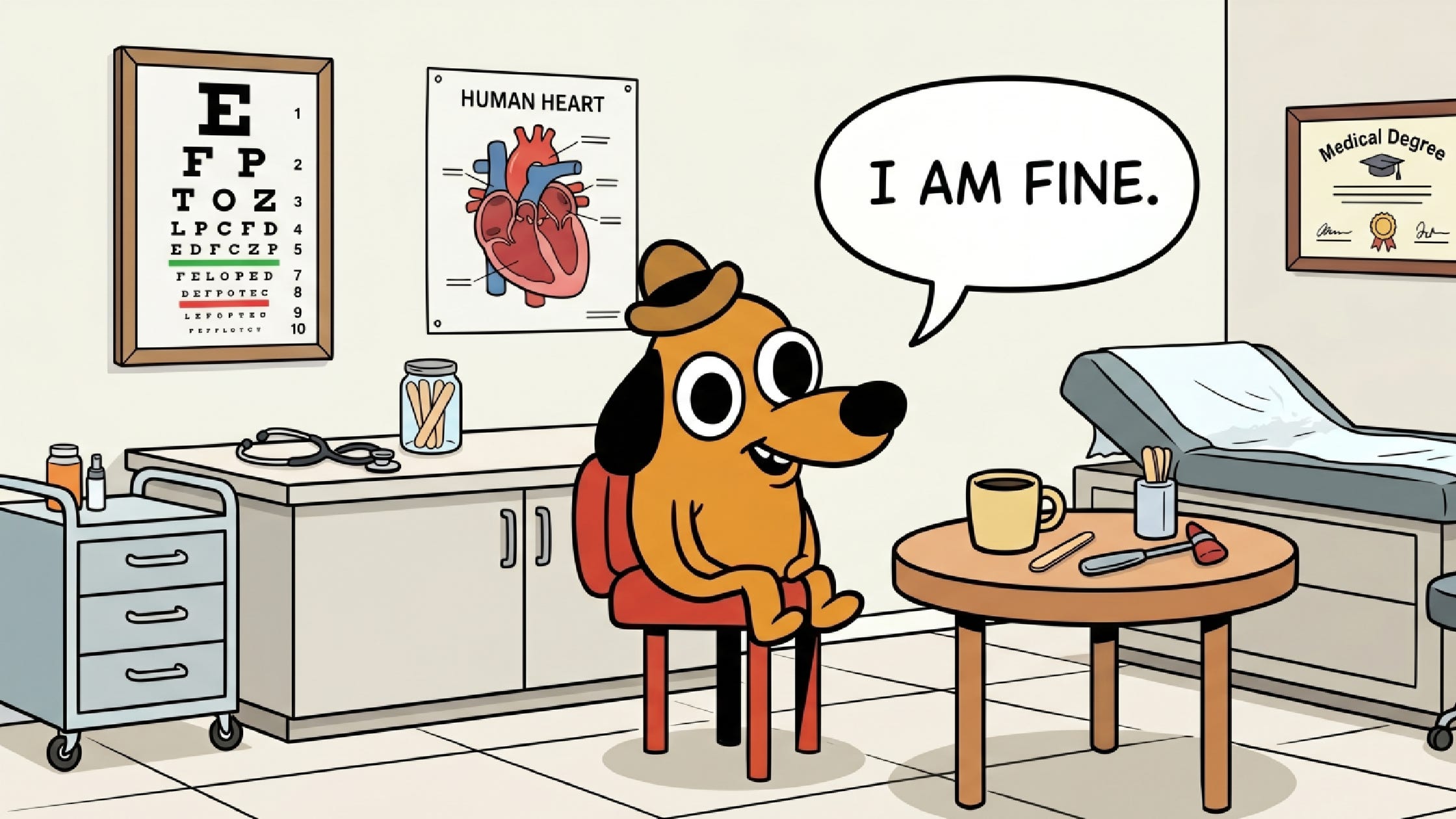
The Comfort Crisis in the Doctor's Office
3 ways to change the conversation with your doctor for better results.
I’m a big fan of Dr. Lucy McBride. She’s got all the credentials: Went to Harvard Medical School, did her residency at Johns Hopkins, and has been a primary care physician for 25 years. She sees patients from all walks of life, every day—which allows her to pair scientific knowledge with on-the-ground reality in a way most doctors writing about health don’t.
Her Substack Newsletter, Are You Okay?, covers medicine the way I try to cover health and mindset: accurate, yet completely actionable—giving out information that works for real (busy) people in the real world.
So I was thrilled to hear that she’s distilling all of her wisdom into a new book, Beyond the Prescription: A Doctor’s Guide to Taking Charge of Your Health. It comes out August 11 from Simon & Schuster. (Pre-order it here).
We’ve been having conversations in the run-up to the book, and she mentioned something fascinating: she sees the same themes play out in her exam rooms that we write about here—avoiding discomfort is easier in the short term, but it hurts us in the long run.
What she said was an “aha” moment for me. I thought it would be for you too.
I asked her if she’d want to write about it for Two Percent. She said yes, and now here we are. Today, Lucy is taking over.
From here you’ll learn:
Why people who are doing everything right—diet, exercise, etc—often come to Lucy with scary lab results.
The underlying problem driving poor lab work in people who live a healthy lifestyle (this is important for all of you—and me).
Three techniques you must use next time you see your doctor if you want to have great long-term health.
Quick housekeeping
In case you missed it:
On Wednesday, we ran the ultimate exercise for fixing and improving back pain. The research found it came out on top.
Friday’s Burn the Ships is filled with my favorite exercises of all time.
From the podcast: Tuesday we covered how to find joy in any job and overhaul your finances. Thursday I spoke to Sam Quinones about one of the keys to making hard work pay off, plus his experiences reporting on the drug trade. Watch it here. Listen here.
Check out the best damn exercise apparel brand in the world: Janji.
Janji makes gear built for ultra-distance pursuits. They’re the only company making apparel specifically for the hardest workouts and adventures—my favorite kind. The 7” Multi Short 2-in-1 is my go-to. Find Janji at Janji.com and at REI stores nationwide.
Here’s Lucy…
The Comfort Crisis in the Doctor’s Office
My patient came in with lab results ordered by her gynecologist—and to tell me about her plan to improve her biomarkers.
I looked at the labs. The patient’s liver enzymes were elevated. Her A1C was creeping toward prediabetic range. She’d done her research, the way many of my patients who take their health seriously do.
And she had a plan: she’d do a cayenne pepper and lemon juice cleanse, and use a continuous glucose monitor to track her blood sugar in real time. She hadn’t started either one yet, she told me, but she would soon.
I smiled and told her I was happy she was taking her health so seriously. “But before we start making a plan about your lab results by themselves,” I interjected, “let’s talk about how you’re doing.”
A pause. Then: “Fine.”
Another pause. Longer this time. And then she started talking. Hesitant at first, then more came out.
It turned out things were not fine. She told me her marriage had been quietly unraveling for about eighteen months, which was, not coincidentally, roughly when her labs had started shifting.
She wasn’t drinking heavily. But most evenings, after the kids were in bed and the house got quiet, she poured a glass of wine. Then another. It was comfort. It was the only part of the day that felt like hers.
She hadn’t mentioned the marriage situation and its aftereffects because she didn’t think it was relevant—and because she was a little ashamed and didn’t want me to derail her plan.
But here’s the thing: no cayenne cleanse could fix her situation. No CGM data was going to show me what I needed to see.
The data on her labs wasn’t wrong; it was just incomplete. The real information was living somewhere the blood test couldn’t reach. And reaching it required her to get honest with someone.
The Medical Comfort Crisis
If you’re part of Michael’s community, you already understand the core principle: avoiding discomfort now creates bigger problems later on.
When you skip the hard sweat or gravitate to comfort foods or avoid a difficult conversation, you’re not lazy. You’re human. You’re doing what feels survivable in the moment, but often at a cost down the road.
I see the medical version of this everywhere in my practice—working with patients from all backgrounds every day.
People who exercise consistently, eat carefully, track their macros, and then sit across from me and say everything’s fine when it isn’t. (In fairness, I do this, too!)
Sometimes the discomfort we’re avoiding isn’t physical. We think we’re fine because we’re doing a lot of good stuff. But we still avoid the deeper stuff. And unlike skipping leg day, avoiding the tough stuff is harder to measure but no less important to our health.
Here’s what makes it harder: our medical system rewards avoidance.
A fifteen-minute appointment with your GP is not designed to surface a crumbling marriage, drinking habit, or unresolved social issues that don’t quite rise to the level of “crisis” or show up in tests.
Doctors are trained to work through a problem list efficiently, and patients are trained—through the experience of rushed appointments and transactional encounters—to present themselves tidily. You get your labs reviewed, your medications refilled, and you get a referral if you need one.
You leave with the impression that everything measurable is being measured, and that’s enough.
It isn’t enough. And the patients who are most health-motivated—the ones who are already doing the work—are often the ones who are best at performing fine.
They’ve got the CGM. They’ve read the research and know what they eat and how they exercise. They arrive with a plan. But the plan just doesn’t account for what’s actually driving the numbers.
Three Ways to Change the Conversation
1. Tell your doctor the awkward or embarrassing thing
Not because your doctor is a psychotherapist, but because the information that feels most awkward to share is often the most clinically relevant.
The drinking you’ve been minimizing. The anxiety you’ve convinced yourself you can handle on your own. The relationship that’s been grinding you down for a year and a half.
These aren’t personal confessions. They’re data. They will (and should) change what your doctor recommends. And that gets you treatment that actually works.
A useful place to start: before your next appointment, write down the one thing you’d be most relieved not to have to mention. That’s probably the thing to lead with.
2. Ask your doctor different questions
Instead of asking “Am I healthy?” which is easy to answer but tells you almost nothing, instead ask, “What would you want to know about my life that would change what you recommend to me?”
Or, if you want something more direct: “Is there anything I haven’t told you that you’d want to know?”
These questions signal that you’re open to a real conversation, which gives your doctor permission to have one.
Most doctors want to ask the harder questions, but many don’t feel licensed to. They may not solve your real problem immediately, but they might refer you to someone who can.
3. Elicit the right question from your doctor
Lower your defenses—like, really lower them.
Say “I’ve been embarrassed to say this, but—” Seven words, and the temperature in the room changes.
Doctors are trained to stay professional and neutral, but we’re also human. When a patient signals vulnerability, it almost always brings out a different kind of attention.
I’ve had appointments where a patient said something like that, and we spent the next twenty minutes on the real problem, the one that had been lurking under the lab values for three years. It allowed me to practice better medicine—I’d been trying to resolve an issue for three years, but lacked the critical piece of information to solve it. I could only get that when the patient opened up.
The takeaway
These three approaches don’t guarantee your doctor will solve all of your problems. Some are genuinely too rushed or stressed out to meet you where you are. If that’s consistently your experience, it may be worth finding someone else.
But most primary care physicians got into this work because they wanted to care for the whole person, not just change their lab results.
They’re just operating inside a system that doesn’t make it easy, and often waiting for a patient to open the door to do the real work.
Back to My Patient: What Happened Next
My patient with the poor lab work didn’t use the CGM. She didn’t do the cleanse.
Instead, she started couples therapy, cut her evening drinking down to one glass a few nights a week, and—slowly, over several months—started sleeping better.
Her labs normalized. Not because of anything I prescribed, but because she finally told me what was actually going on. She seemed to realize, under the surface, that the marriage was draining her. But sometimes it takes a doctor agreeing to get us to do something and help guide us.
Her original plan wasn’t “wrong.” But it was downstream of the real issue—and unlikely to solve it.
Which is all to say: The most important health data rarely shows up on a lab report.
It lives in your biography—the things you’re managing, the things you’re avoiding, the things you’re embarrassed to say out loud.
Learning to bring that information into the room is one of the highest-leverage things you can do for your health.
But knowing what to bring is only the beginning.
In my book Beyond the Prescription (Simon & Schuster, August 11), I lay out a complete framework for mapping your health ecosystem—not just the lab values and the lifestyle inputs, but the biographical and psychological data that most doctors never get to ask about and most patients never think to offer.
It’s not a “here’s what to do” book. It’s a “here’s how to think about what you actually need—and how to get it” book. If the conversation in this post resonated with you, it’s where to go next.
Pre-order here.
Now back to Michael
Thanks for reading Lucy’s post. Now do two things: pre-order her book, and use the information in this post next time you visit your doctor.
Have fun, don’t die,
-Michael


That's the beauty of a Direct Primary Care practice. My adult appointments are 45 to 60min and if we can't get to the root causes in that amount of time I'll see them again in a week or two for another 45-60min appt and they are not financially penalized for returning b/c of the practice model.
Sometimes I feel like Michael should pay me a small commission b/c of the number of patients I've recommended Comfort Crisis to! :)
I am wont to tell many of my patients (in the appropriate time & setting) when they face uncomfortable and hard work to effect positive change "The road to Heaven feels like hell and the road to Hell feels like Heaven."
Keep up the good work, Michael!
Wow, this hit on such a human level. What a beautiful breakdown of how you can actually PARTNER with your provider to have real, life-changing convos.
Most doctors ARE capable of becoming coaches, motivators, and confidants. People are just avoiding the (verbal) discomfort.
New title: The Verbal Comfort Crisis ; )