


In case you missed it: Two Percent has a new podcast. Here’s the full announcement—early feedback has been great. Thanks to all those who listened or watched.
Listen to the first episode on Apple Podcasts or Spotify.
Watch it on YouTube.
Also: Please subscribe. It helps us get guests.
Now onto today’s post: I’ve done multi-week hikes, ultra runs, and 24-hour rucking events. And the biggest problem I usually run into is something I think I’ve solved: eating enough of the right foods at the right times.
When we don’t eat enough during a long effort, our performance and mindset drop, the event gets harder, and we start digging a physiological hole we can’t climb out of.
The solution is simple. Eat enough. Of course, that’s easier said than done.
For example, during a long thru-hike, I thought I was eating enough and had my vitamins and minerals dialed.
But the numbers didn’t lie. Dr. Andy Galpin and his excellent team at Arete (check them out here) became interested in how my body would fare. They tested a bunch of my biomarkers right before, right after, and 45 days after my hike.
By the end of it, everything had gone to hell. Forty-five days after finishing, my body wasn’t back to baseline. Much of that could have been prevented with smarter nutrition.
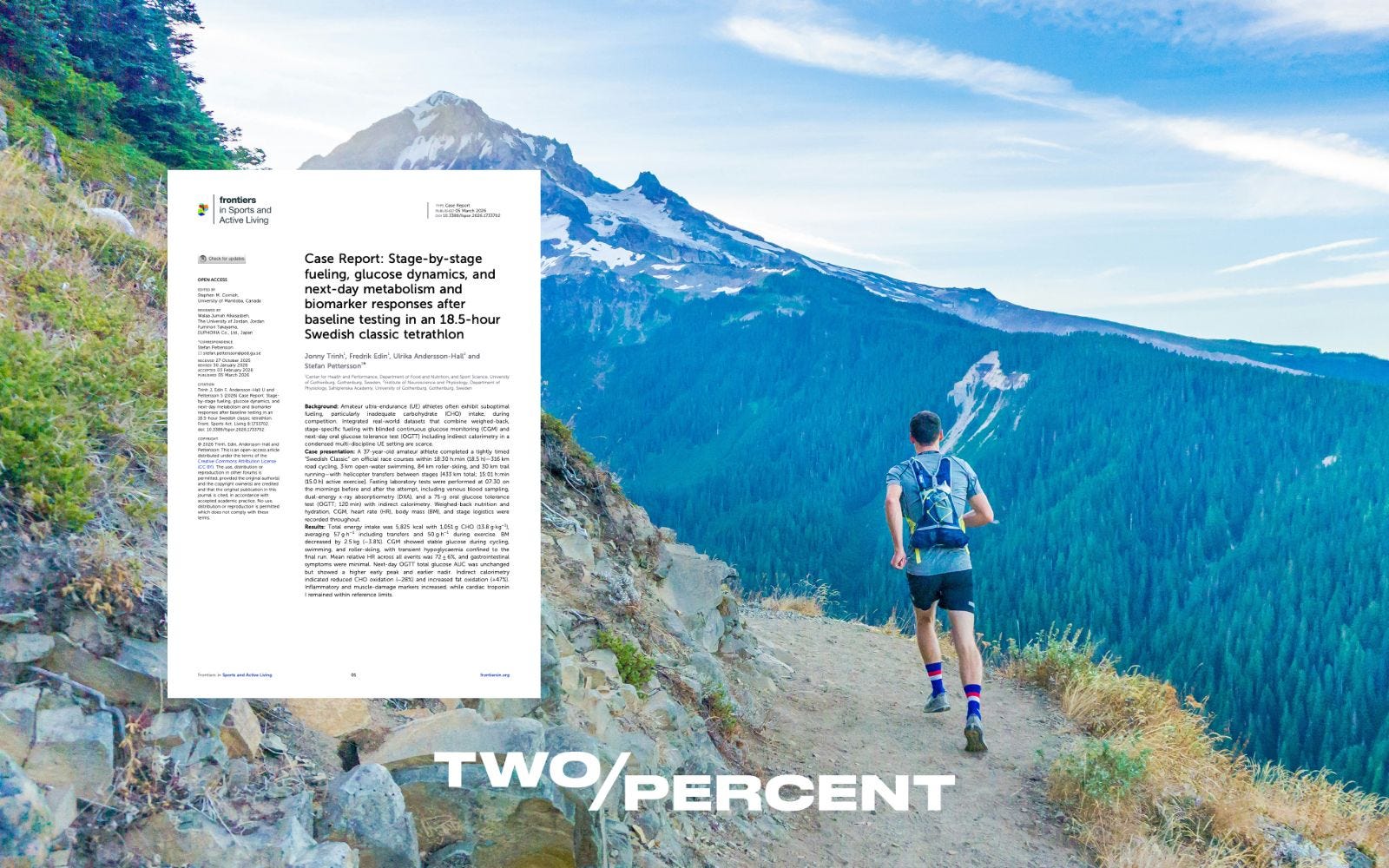
So how do you actually prevent it? A new, wild study from Sweden gives us tactical answers.
A 37-year-old Swedish athlete recently attempted what’s called “The Tetrathlon.” It pairs all 4 of Sweden’s most iconic endurance events back-to-back.
196 miles of cycling
2 miles of open water swimming
52 miles of roller skiing (basically cross-country skiing on pavement)
19 miles of trail running.
Researchers from the University of Gothenburg followed the athlete the entire time—they tracked every calorie he ate, every change in blood sugar, every heartbeat, every drop in performance. They also analyzed his blood before and after, and tested his metabolism the next morning. Then they published the whole thing.
You probably won’t do a Tetrathlon, but you should still care about the findings.
Our recent survey showed that most Two Percent readers do long and hard physical events. Stuff like backpacking trips, marathons, ultras, century rides, Misogis, long walks, or big day hikes with a loaded pack.
Any event over two or three hours starts to look, physiologically and practically, a lot like what this guy did—just slightly dialed back. The fueling mistakes he made and the physiological curveballs his body threw at him are the same curveballs everyone faces.
This study is rare. Most endurance nutrition and performance research is either tightly controlled lab work that doesn’t reflect real life or self-reported race data with massive gaps.
This one tracked a real event in real conditions. It’s a useful and complete physiological snapshot of an extreme endurance effort.
Today you'll learn:
How burning 15,000 calories triggered an extreme, forced reset in one athlete’s metabolism.
The exact reason your appetite shuts off when you need fuel the most, and why listening to your body will make you crash.
Why most endurance eating plans are setting you up for failure during long physical efforts.
Five specific, science-backed strategies to bulletproof your endurance fueling for your longest, hardest days.
Thanks to our partners
Function Health offers 5x deeper insights into your health than typical bloodwork. You’ll learn critical information that can guide you into feeling better every day. It helped me identify a mineral insufficiency—and was cheaper than my insurance. Go to my page here to sign up, receive a discount, and pay just $340.
David Protein Bars have the highest amount of protein per calorie of all protein bars. That makes them a great option for anyone who wants protein on the go without the excess sugar and fat of most bars. Visit DavidProtein.com.
Do epic endurance feats with Janji, an independent running brand making gear built for ultra-distance pursuits. They’re the only brand making gear specifically for 200-plus-mile adventures—my favorite kind. The 7” Multi Short 2-in-1 is my go-to running short. Find Janji at Janji.com and at REI stores nationwide.