

Why I Banned "Dopamine" on Two Percent
I want this place to be useful and accurate.

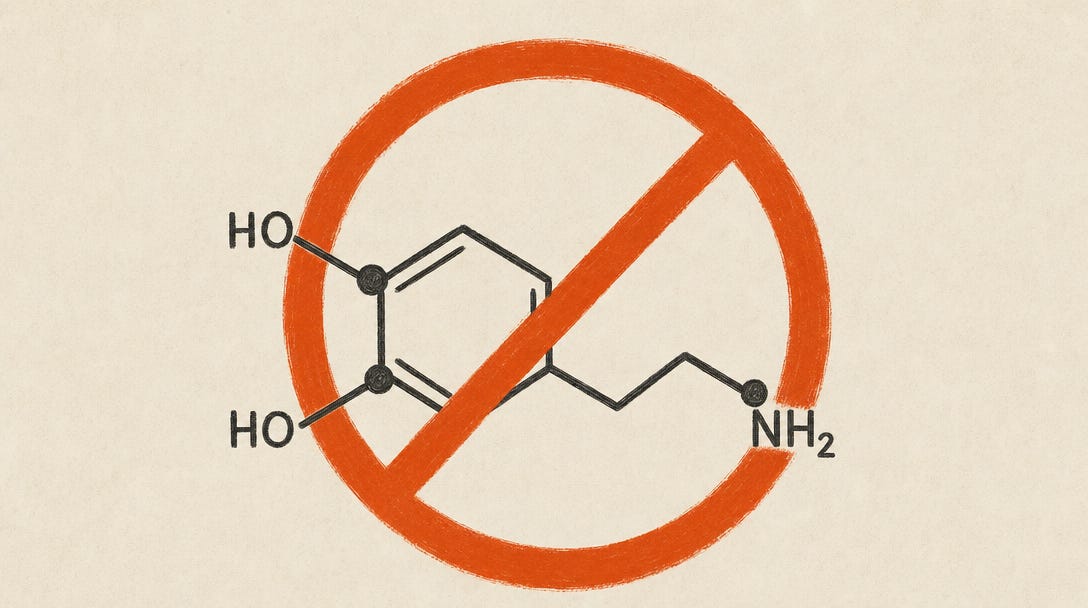
I was recently talking to Sally Satel. She’s a Lecturer in Psychiatry at the Yale School of Medicine and a practicing psychiatrist who’s worked with everyone from the upper-class in D.C. to opioid addicts in Appalachia.
We were talking about dopamine. If you’re here, dopamine is probably on your radar. It’s become part of any article, social post, book, or podcast that touches on bad habits.
We hear dopamine drives all our bad habits—addiction, scrolling, eating junk, and much more. If we can just fix our dopamine, we’re told, we’ll fix ourselves.
Satel disagrees1.
“When people bandy about ‘dopamine,’ they do so as a shorthand for pleasure—so that’s incorrect right there,” she told me. “The brain and behavior is just way too complicated to be boiled down to one neurotransmitter. Yet so many great articles and books with good, common-sense advice start dragging in dopamine, as if that adds to the gravity of a topic.”
She recently wrote a spot-on article in The Free Press about what we get wrong about dopamine and addiction. It’s worth reading.
Even lab scientists who’ve studied dopamine their entire careers disagree2 on its role. Yet people online with no scientific training are pushing dopamine protocols like they’ve cracked the habit code.
This conversation came on the heels of others I’d had with a few smart doctors and PhDs, who think the cultural obsession with dopamine has been largely incorrect and a total distraction.
Dr. Trevor Kashey, who you might remember from The Comfort Crisis, called this “neurologizing.” He said, “We use ‘neurologizing’ to explain a lot of human behavior. It sounds authoritative, but a lot of it is uncertain, and it provides zero practical solutions for helping people.”
The upshot: Once you stop worrying about and blaming your brain chemistry, you can focus on what actually moves the needle on behavior change. That’s what today’s post is about.
Today’s post covers:
The messy truth about dopamine.
Why top psychiatrists from Yale and neuroscientists from the University of Michigan say the cultural obsession with dopamine is inaccurate.
What we think dopamine actually does in your body.
How looking inward at your brain chemistry traps you in bad habits and distracts from real change.
A counterintuitive, 5-step environmental design framework used by behavioral experts to alter bad habits without relying on willpower.
Shoutout to our partners
🏃♀️ Janji makes my favorite endurance apparel—comfortable, durable, unique. I wear Janji for every outdoor workout. They’re the only brand making gear specifically for 200-plus-mile adventures—the best damn kind. The 7” Multi Short 2-in-1 is my go-to. Find Janji at Janji.com and at REI stores nationwide.
✈️ David Protein Bars have the highest amount of protein per calorie of all protein bars. That makes them the #1 option for anyone who wants protein on the go without excess sugar and fat. Visit DavidProtein.com.
🚨 Momentous rarely runs site wide sales—but they’re running one now. Save up to 40% during the Momentous Anniversary Sale. Every product is heavily tested for purity because Momentous has contracts with professional sports teams and the U.S. military. I use their Plant Protein Powder, Multivitamin, and Creatine daily.
Keep reading with a 7-day free trial
Subscribe to Two Percent with Michael Easter to keep reading this post and get 7 days of free access to the full post archives.