

Why Women Should Ruck
Four reasons why rucking is the best exercise for women.

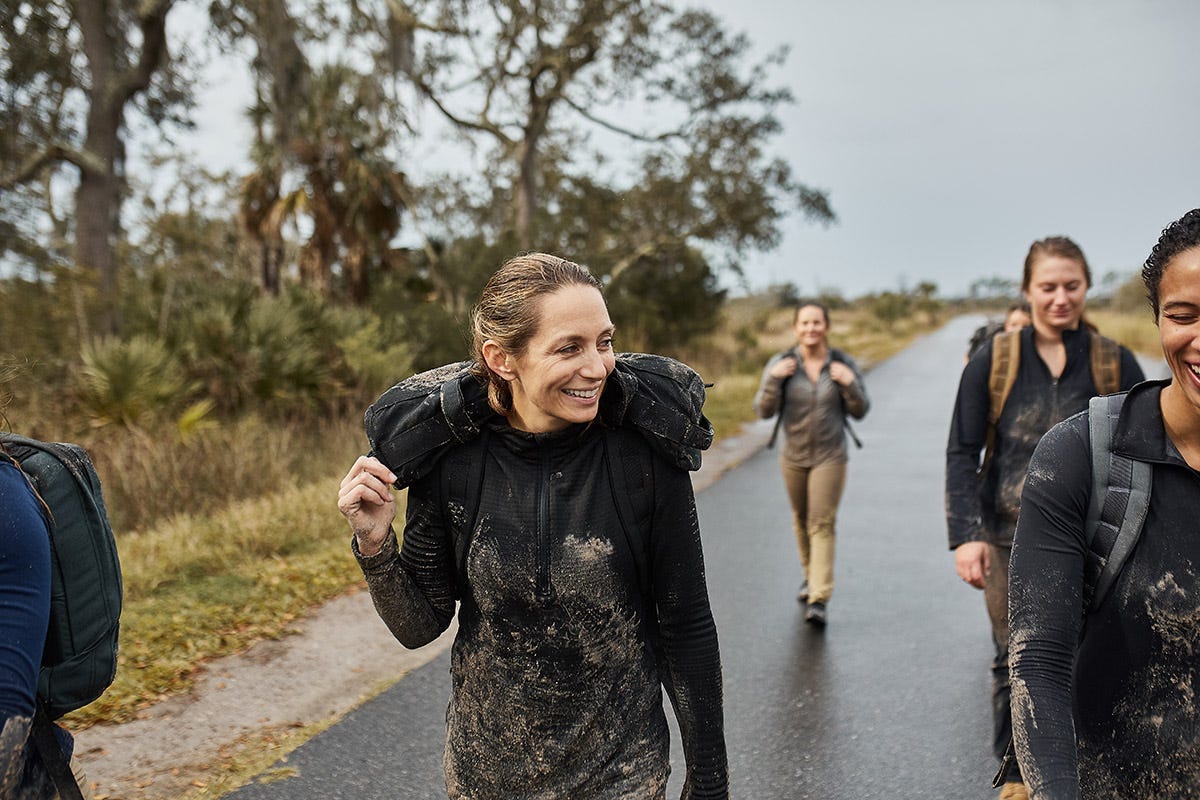
While writing about rucking for my book, The Comfort Crisis, something struck me as I read all the research: Rucking is an incredible exercise for women.
I thought of my wife and mom and how rucking could be a great way for them to make their normal exercise routines a little more effective. I’m not alone in my thoughts. More and more health scientists are realizing that rucking might be the best exercise for women. That’s because rucking gives women unique benefits that other exercises don’t.
But no matter your pronouns, rucking gives everyone an opportunity to improve their wellbeing. I've also included new science about how a lot of this info also applies to men. This email is part two in a four-part series about rucking. (P.S. Please consider forwarding this to a friend or read on and share this important research. If you received this email from a friend and enjoyed it, you can sign up for the newsletter here.)
Four reasons rucking rocks for women
Rucking sneaks in weight training—no weight room required
The US government says everyone should do at least 150 weekly minutes of endurance activity and strength train twice a week. That’s because hitting those significantly lowers your risk of dying at any given moment.
Only 19 percent of women meet those recommendations while 26 percent of men do.
Why the difference? Women and men do endurance exercise at about the same rate, but women are far less likely to strength train.
Rucking combines endurance and strength. It allows women to meet those guidelines and work their muscles without setting foot in a weight room.
This is critical because scientists are now realizing that not having enough muscle can be far more dangerous for women than an unhealthy scale weight. A recent study of 50,000 Canadian women, for example, found those most at risk of death registered a “healthy” BMI but had the lowest levels of lean muscle. Similar findings have been shown in men.
Rucking Strengthens Bones
Everyone starts losing bone density around age 30. But women after menopause begin losing it at a rapid and dangerous rate.
This is why bone fractures are one of the biggest health threats to women.
Aging women in the US are two, five, and eight times more likely to break a bone than they are to have a heart attack, get breast cancer, or have a stroke, respectively.
But here's the thing: osteoporosis is now becoming a growing and significant threat to men too, according to the NIH. And because doctors don't test men for it, they often don't realize they have an issue with bone loss until they fall and break something.
If you happen to fall and break a hip, you’re essentially screwed. About 50 percent of people over age 65 who break their hip are dead within six months.
The best way to stop and even reverse bone loss—according to Dr. Robert Wermers, a bone disease specialist with the Mayo Clinic—is to do “aerobic walking where you’re bearing weight.” I.e., rucking.
One study found that aging people who trained with a weight vest didn’t lose bone while those who trained without a weight vest saw a loss in bone density. The scientists say the earlier in life you start rucking the better you’ll be.
Women Ruck Harder
Scientists in the UK wanted to know how women and men compared when they rucked. They gathered a group of British military recruits.
The recruits had to ruck six miles with either 33 or 44 pounds. The weights weren’t split by sex, meaning some women rucked with 44 pounds.
The men, however, weighed an average of 170 pounds while the women weighed 140.
This means the women rucked with a heavier load relative to their body weight.
The scientists took all kinds of measurements on the men and women. Then they sent them out on a hard outdoor rucking course and retook the measurements once they were done.
Two interesting findings arose:
First, the women completed the course an average of two minutes faster than the men. Because of this effort, the women reported a higher rate of perceived exertion (basically how hard the ruck felt) compared to men, yet they were better able to push through the discomfort. This is a finding that’s been repeated in other research. Women have a high exercise discomfort tolerance.
Second, the women also recovered their fitness faster. When they retested the men on a marker of leg strength, their performance had plummeted. Meanwhile, the women’s strength hadn’t dropped all that much.
Women Are Damn Good At Carrying
In 1895 WJ McGee, who ran the Bureau of American Ethnology, traveled to Mexico’s Tiburon Island to study the Seri hunter-gatherer tribe. He observed that the women would frequently make a 15-mile round trip excursion from the beach up into the mountains—through a gnarly landscape of mesquite, cactus, and agave.
They’d fetch water and “rapid walk” it back to camp in heavy, awkward clay jugs. He stated that the women of the tribe were “notable burden bearers.”
Another fascinating anthropological finding came in 1986. Anthropologists at Harvard noticed that, “when traveling in East Africa one is often surprised at the prodigious loads carried by the women of the area.” They wrote:
“It is not uncommon to see women of the Luo tribe carrying loads equivalent to 70% of their body mass balanced on the top of their heads. Women of the Kikuyu tribe carry equally large loads supported by a strap across their foreheads.”
So, for example, if a Luo woman weighed 120 pounds, she’d sometimes carry about 85 pounds atop her head.
The Harvard scientists wanted to learn how the Luo women did this. So they teamed up with some colleagues at the University of Nairobi. They found something fascinating: The women could carry up to 20 percent of their body weight on their head without burning any extra calories. Nada. Zero extra calories.
It was only once a woman was carrying 30 percent of her body weight on her head that she burned more calories. At that point, she then burned 10 percent more calories. When she carried 40 percent of her body weight, she burned 20 percent more calories, and so on.
Have fun, don’t die, keep on rucking.
Michael
Does rucking make sense if I’m already 100lbs overweight? I feel like an extra 20-40lbs will just be a drop in the bucket or hard on my knees.
Hey Michael,
I've known about your info for a few years but have not been a subscriber. I heard you on Rich Roll this morning on my podcast feed. Talking about your new book coming out soon and other things.
I decided to take the plunge and subscribe to your substack.
I want to start Rucking and not sure what weight I should start with.
I'm 70 years old, I lift twice a week, with a personal trainer. I can dead lift 125lbs.
I cycle 2 - 3 days a week and avg of 30 - 50 miles/ride.
I'm very short, only 4'8" tall and I have about 40lbs of excess body fat...
No matter what I do, I can't seem to keep the excess body fat off my body.
I went on a 40 day cycling tour across India in 2025 (avg riding day = 60 miles) and lost about 22lbs on that trip but it has slowly crept back on over the year (now 2026). I did struggle on this tour, it was my first long cycling tour. I wrote a blog about my trip if anyone is interested in what it's like to cycle India - https://erinely.blogspot.com
I have a post on there about what I did to get ready for that trip.
I know about eating real food, I've been eating local and organic for about 30 years.
My downfall is moderation, I am not good at moderation.
There are other things I need to moderate, alcohol is one of them.
Regardless, yes I commit to changing these things and I want to kind of give myself a reset.
I'm going on a 45 day cycling tour across Japan in Sept 2026 and want to be stronger for this trip. There is a lot of climbing in Japan, lol
I do hike sometimes about 4 or 5 miles, but it's not regularly and not with any kind of weight.
I'm lucky I live in a place where I can hike right outside my door, I'm about a 20 minute walk away from the forest.
If I wanted to start rucking twice a week, to add to my cycling and weight lifting sessions.
What weight do you think I should start with?