


It’s Memorial Day.
Before you start grilling, consider doing something hard.
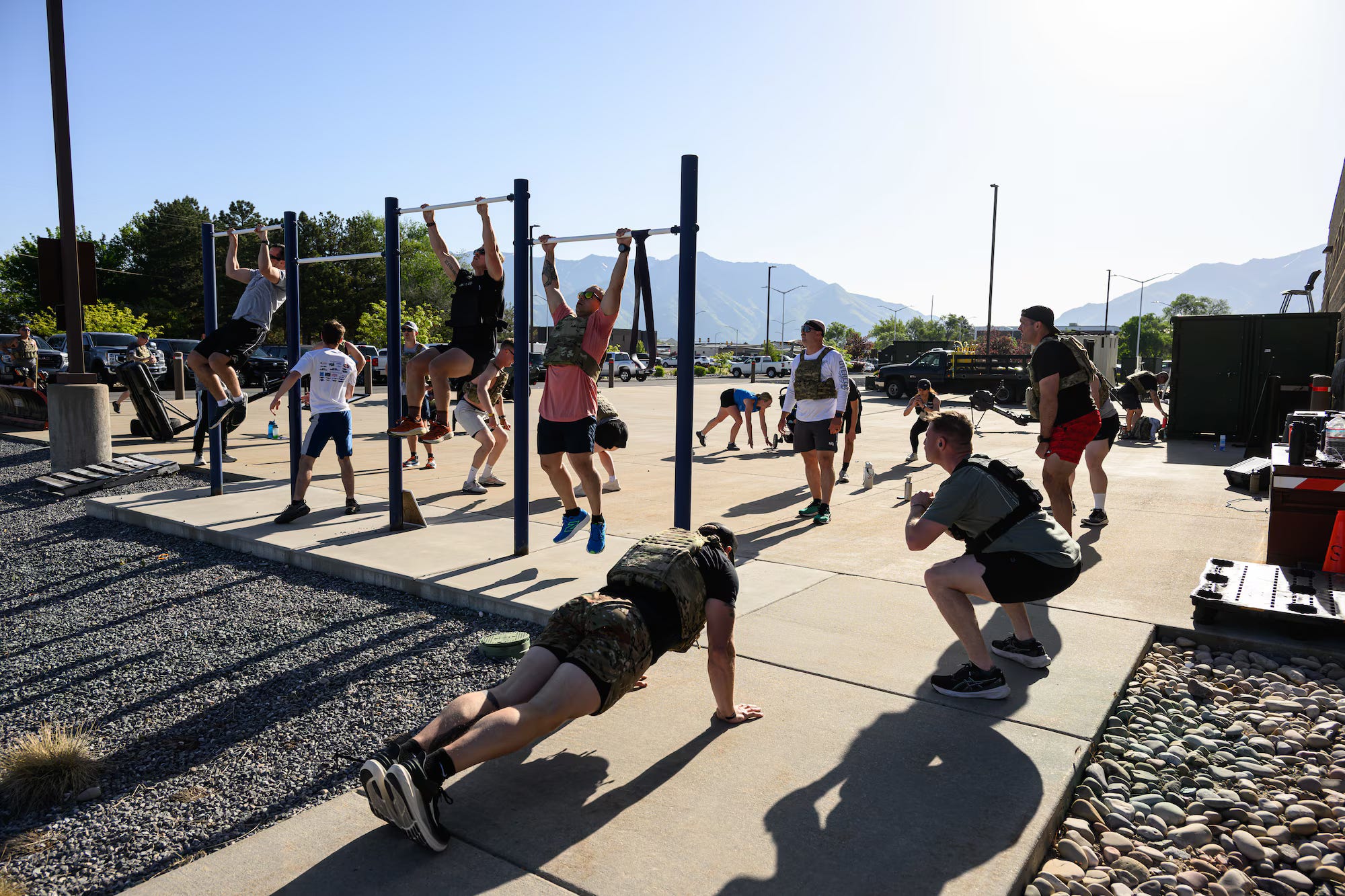
Hundreds of thousands do—they follow the Memorial Day Murph workout tradition. It honors Michael Murphy, a Navy SEAL killed in Afghanistan in 2005 and posthumously awarded the Medal of Honor.
Today’s post is about Michael Murphy, how the workout tradition came to be, and why you should find your own Murph today.
The standard workout is a thresher. But you don’t have to do the challenge as written.
You can and should find your own Murph this Memorial Day.
You can alter the workout to your ability level. People from ages 9 to 90 have done their own Murph workout.
Or you can find a way to sacrifice for others. Volunteer. Do a favor. Be kind.
“The idea is to make (your Murph challenge) tough. It’s about the effort,” explained Dr. Josh Appel, who started the tradition of the Memorial Day Murph workout (more on that below). Just carve out a long, effortful moment where you consider sacrifice.
A pessimist would call this tradition silly. Can doing something hard really teach us about the ultimate sacrifice soldiers make for our freedom?
A few years ago, I investigated that question and found something powerful. I spoke to soldiers, gold star families, generals, and everyday Americans.
It showed me the strength of traditions. They can build us, change us, and move us forward.
I run this post every Memorial Day. Always will. Each year, I update it.
I’m publishing two things today.
First: The never-told origin story of the Memorial Day Murph challenge.
Second: Tips that will help anyone find their own Murph and do it better.
Housekeeping
God bless those who served.
ICYMI:
Wednesday’s post explained why you should stop chasing happiness. Surprisingly, that’s exactly how you’ll find it (which I learned while living with Benedictine Monks).
In Friday’s AMA, I answered 15 of your most pressing questions (a great ruck workout, my go-to meals, what I do for my mental health, what I’d change in The Comfort Crisis, and more.)
Last week’s podcasts:
How to eat healthy without going broke: Featuring Nick Norwitz and George Kamel.
The screenwriter Brian Koppelman (Billions, Rounders, Oceans 13) on getting fit at 57, beating anxiety, tribalism, and the logic of poker.
Shoutout to our partners:
Momentous made me feel good about supplements again. Every single product is heavily tested for purity because Momentous has contracts with professional sports teams and the U.S. military. They also sell what works rather than offering a million fringe options that don’t offer benefits. I use Momentous’ Plant Protein Powder, Multivitamin, and Creatine daily.
Function Health offers 5x deeper insights into your health than typical bloodwork. You’ll learn critical information that can guide you into feeling better every day. It helped me identify a mineral insufficiency—and was cheaper than my insurance. Go to my page here to sign up, receive a discount, and pay just $340.
Let’s roll …
Memorial Day Weekend, 2007. Dr. Joshua Appel, M.D., then a medical resident, wanted to mark the day differently.
The holiday had become a thing of beers and barbecues and bargains on mattresses and refrigerators. All of which are great, no doubt.
But Dr. Appel wanted to do something to remind himself and a few willing others of the day’s purpose. A way to contemplate with mind and body those who’d laid down their lives for us.
He’d recently begun training at CrossFit Albany. “And I heard about this hero workout of the day called Murph,” he said.
Hero workouts are dedicated to the memory of a military member or first responder killed in the line of duty.
“And I was like, ‘I wonder if that’s the same Murph …’”
It was one of CrossFit’s hardest workouts. It went like this: run one mile; do 100 pullups, 200 pushups, and 300 squats; then run one more mile. All as fast as possible. All while wearing a weight vest or body armor.
Dr. Appel wasn’t a typical medical resident. He’d been in the military since 1994 as an Air Force pararescueman, which is a combat search-and-rescue specialist trained to retrieve wounded service members.
He enrolled in med school in 2001 and graduated on May 11, 2005. He was on a plane to serve in Afghanistan two days later. “Then on June 28,” he said, “we got the call that a Chinook [helicopter] had been shot down and a Navy SEAL team was missing.”
Operation Red Wings went as tragically as a mission can.
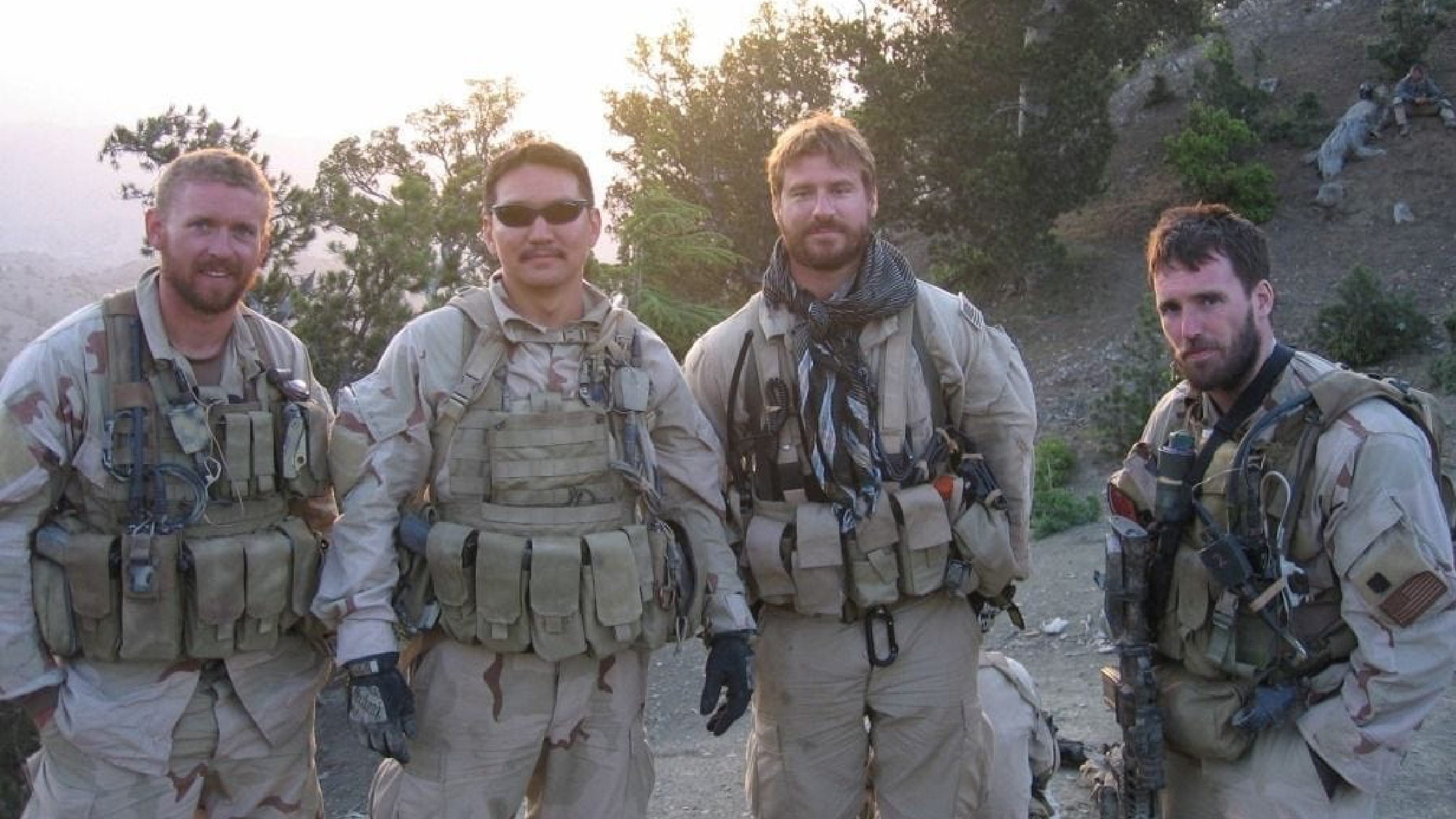
Early on the morning of the 28th, the military dropped four SEALs—Lieutenant Michael Murphy and Petty Officers Danny Dietz, Matthew Axelson, and Marcus Luttrell—about 10,000 feet high in the Hindu Kush Mountains. The team was tasked with providing reconnaissance for an impending action against guerrilla leader Ahmad Shah.
The plan fell apart when some goat herders caught the team’s position.
Within hours, the SEALs were taking fire on three sides by a force of more than 50 anti-coalition militiamen. The SEALs, all wounded, were pinned against cliffs, which blocked the signal they needed to make a distress call.
Understanding his team’s deathly predicament, Murphy, according to the U.S. Navy:
“unhesitatingly and with complete disregard for his own life moved into the open, where he could gain a better position to transmit a call to get help for his men.... This deliberate and heroic act deprived him of cover and made him a target for the enemy … He was shot in the back, causing him to drop the transmitter. Murphy picked it back up, completed the call and continued firing at the enemy who was closing in.”
Murphy, Dietz, and Axelson died on that mountainside. As did the 16 Special Forces service members whose helicopter was shot down while racing in to extract the four SEALs. Luttrell escaped.
“I was the pararescue team leader that rescued Marcus Luttrell and recovered Michael Murphy and Danny Dietz,” Dr. Appel said.
He kept the body armor he wore when he recovered Murphy’s body.
After he’d started CrossFit, Dr. Appel suggested that his gym “get everyone together and do a hero workout on Memorial Day.”
He proposed Murph. “We had 13, maybe 15 people. I thought it would be cool if everybody did Murph, so everyone has the same goal and is working towards the same thing.” Dr. Appel wore his body armor.
“It was very unifying and brought all kinds of people together,” he said. “It wasn’t a race. It was just going out and suffering together for Memorial Day and thinking about the people who have sacrificed everything. Just imagine how the people storming the beaches of Normandy, or hiking the jungles of Vietnam, or liberating Iraq felt like. It sounds kind of corny, but it drives and motivates you.”
Dr. Appel wondered, could it be bigger? “I thought this should be a national thing.”
Michael P. Murphy
“When Michael was two years old,” Dan Murphy, Michael’s father and a Vietnam vet, told me, “he saw our neighbor’s pool. He ran up to it, didn’t even look, and just jumped in. So I run and toss my wallet and keys to jump in and save him. And Michael just swam to the other side and popped up with this big smile on his face.”
At eight years old, Michael hit a game-winning home run and arrived at home plate to declare to his celebrating team, “If you guys hadn’t gotten on base to give me a chance to bat, I would have never been able to bat and hit a home run. We won the game as a team.”
Michael earned the nickname the Protector in junior high after he threw down on a group of bullies who were picking on a disabled student. In high school, he defended a homeless man collecting cans who was being harassed.
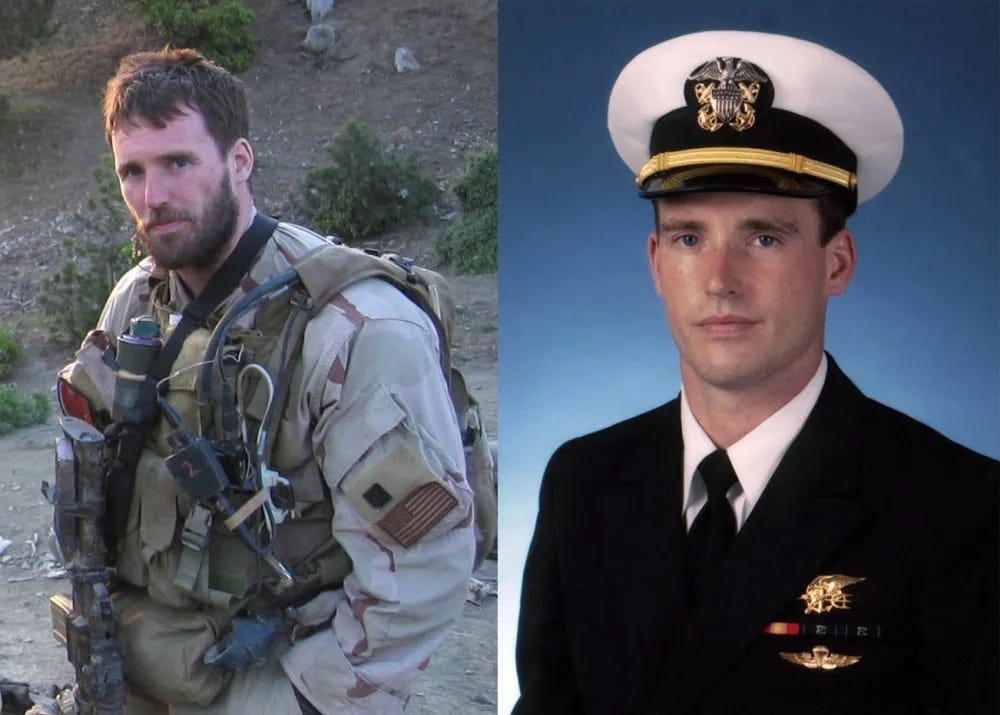
After college, Michael planned to join the FBI, so he applied to law school. He was also interested in enlisting, though his father—who understood the reality of war— disapproved.
But the Navy would allow Michael to channel his protector spirit, to be brave, and make a living.
He earned the SEAL Trident in July 2002 and did three tours. Went to Jordan, Qatar, and Djibouti. His fourth, in early 2005, took him to Afghanistan to support Operation Enduring Freedom.
After deciding to join the Navy, Michael began running, doing calisthenics, and climbing a rope tied to a tree in the backyard of his childhood home on the South Shore of Long Island.
Then he discovered CrossFit, his father says. “And he put together his own [CrossFit-style] workout that fit in with his job as a SEAL.” They run, push, pull, and lift.
Michael did it while wearing body armor, the 16.4-pound military-issued vest, because that’s what he wore downrange. That’s how Body Armor, as Michael called the WOD that would become Murph, was born.
The Workout Spreads
When news about Operation Red Wings began trickling out, Dan Murphy had to reckon with his son’s selfless nature.
The Navy “told us they believed that there was at least one survivor,” he says. “And I remember turning to Michael’s mom, Maureen, and saying, ‘We know the way Michael is. If there’s going to be one survivor, it’s not going to be Michael.’”
After Michael’s death, his Body Armor workout started to spread by word of mouth among the SEAL teams—to outposts in Afghanistan and Iraq and at bases and training centers in Coronado, Virginia Beach, Pearl Harbor, Monterey, and elsewhere.
That’s when Greg Glassman, the founder of CrossFit, got involved. “A SEAL contacted me to ask if I’d honor the death of his commanding officer with a WOD named after him,” Glassman told me.
Back then, CrossFit only had about 13 gyms, but Glassman would log on to CrossFit.com and post fitness principles and daily workouts.
His training method had gained a following among Special Forces operators and other first responders, partly for its online accessibility, but mostly because it stressed function over form, at a time when bodybuilding was the norm in the military.
SEALs stationed at the naval base in Monterey, California, would travel 40 minutes up Highway 1 to train in Santa Cruz, home of the original CrossFit gym. Other first responders joined.
“We did Body Armor wearing whatever weight-carrying apparatus we owned,” says Greg Amundson, one of the first CrossFit adopters and a former DEA agent.
Hero WODs had come before. But Body Armor felt different. “The nexus between the SEALs and the box in Santa Cruz was very pronounced,” says Amundson. “Many of the SEALs who came to train there had known Lieutenant Michael Murphy.”
Body Armor required very little equipment and could be done almost anywhere. And the grind of the workout also led to more camaraderie, team cohesion, and strategy.
“You didn’t know what your partner on your left or right was going to do to get through it,” Amundson says. “All you knew is that you started the run together and you had to end with the run. But in between that ... man, it’s like who knows what’s going to happen. It was an adventure. There was something about Body Armor that had an inherent spirit to it.”
On August 17, 2005, Glassman posted the details of the workout to CrossFit.com as the WOD and included a note:
In memory of Navy Lieutenant Michael Murphy, 29, of Patchogue, N.Y., who was killed in Afghanistan June 28th, 2005. This workout was one of Mike’s favorites and he’d named it “Body Armor.” From here on it will be referred to as “Murph” in honor of the focused warrior and great American who wanted nothing more in life than to serve this great country and the beautiful people who make it what it is .... If you’ve got a 20-pound vest or body armor, wear it.
A Wild Idea
In October 2007, Michael Murphy was awarded the Medal of Honor.
Dr. Appel had made doing Murph every year a personal Memorial Day tradition. In 2010, he contacted Dan Murphy. “I hadn’t ever talked to Dan before, but I figured if I was going to do something nationally, in his son’s name, I should probably get his approval.”
Dr. Appel wanted to start a fundraiser by building a website and asking CrossFit boxes if their members would be up for joining the challenge.
There’d be a small fee, and all proceeds would benefit military charities and the LT Michael P. Murphy Memorial Scholarship Foundation, which Dan created in 2007. “One of [Michael’s] favorite sayings was ‘Education will set you free,’” Dan says.
In 2011, around 7,800 people signed up and donated.
The problem: many people signed up but didn’t finish.
So they started calling it the Murph Challenge. “If we put the word challenge in there, it’s an alert that this isn’t a 10- or 15-minute workout,” said Mike Sauers, a former SEAL who helped Dr. Appel grow the tradition. “And we started bringing in workout programs to prepare people, and making sure there was a path for everyone to perform the Murph Challenge to the best of their ability.”
Dr. Appel puts it this way: “My saying is ‘What’s your Murph?’ You don’t have to be a Navy SEAL to do this workout. Sure, it helps. But you can scale it and anyone can do Murph. Can’t do pullups? Okay, do ring rows. Can’t run? Okay, row. Even if you’re in a wheelchair and 90 years old, we can create something for you.”
That something just has to be long and hard—maybe the longest, hardest thing you do all year—and worth the reflection.
Sauers, meanwhile, worked his connections to get the Murph Challenge to people outside the CrossFit community.
“I had helped train Chris Pratt for his role in Zero Dark Thirty and we’d remained friends,” he says. “He’s done it since 2012.”
John Krasinski did it along with The Rock in 2018. “I love that it was designed to humble us,” The Rock posted. The megawatt endorsement helped Murph go mainstream.
Today, more than 100,000 people participate.
Dave Castro of CrossFit told me that three things helped transform Murph into a bigger-than-life, iconic workout: Murphy’s story, the brutal scale of the workout, and Memorial Day as a communal anchor.
How to find your own Murph
1. Scale your Murph
Anyone can do Murph. All you have to do is modify it.
Appel’s 90-year-old father recently did a Murph workout. His dad rode one mile on a fan bike, then did wall pushups, then did a ring row squat variation and finished with another mile on the fan bike.
You can make it easier by:
Cutting all the reps in half or by 75 percent.
Substituting easier exercises.
Do pushups with your hands on a bench or wall. Do quarter squats. Do inverted rows instead of pullups—the more vertical you stand, the easier rows get. Walk or ride an exercise bike a mile instead of running it.
2. Don’t start too fast
Running the first distance too fast will exhaust you for the long slog of exercises ahead. Find a pace that’s just slightly faster than you can have a conversation at.
3. Don’t max out
Most people run into problems on the pullups or pushups.
Stay far from failure on every rep, so you don’t burn out early.
If you can do 5 pullups and 15 pushups, don’t max out. Do sets of 1 or 2 pullups and 3 to 5 pushups.
If you start to fail, transition to easier variations like jumping pullups and pushups with your hands elevated.
4. Drop the hammer
On the final mile, lean into the suffering and go for broke. Run or bike far faster than you’re comfortable. You could end up chopping as many as two minutes from your time.
5. Not up for a crazy workout? Help others.
Help a friend or family member.
Volunteer. (Volunteerism rates generally go down around the holidays.)
Donate money to a good cause.
Have fun, don’t die, find your Murph.
-Michael
My Annual Memorial Day Murph Workout ✅
I did all prescribed movements, did not wear the 20# vest.
44:20 was my time which is a 3:07 PR from what was my fastest time last year, 47:27.
The breakdown:
1 mile Run - 9:45
20 x 5 Pull-ups, 10 Push-ups, 15 Air Squats - 25:10
1 mile Run (more hills than first mile) - 9:25
Honor and Remember 🇺🇸
Along the lines of doing something good, I'd add donate blood!