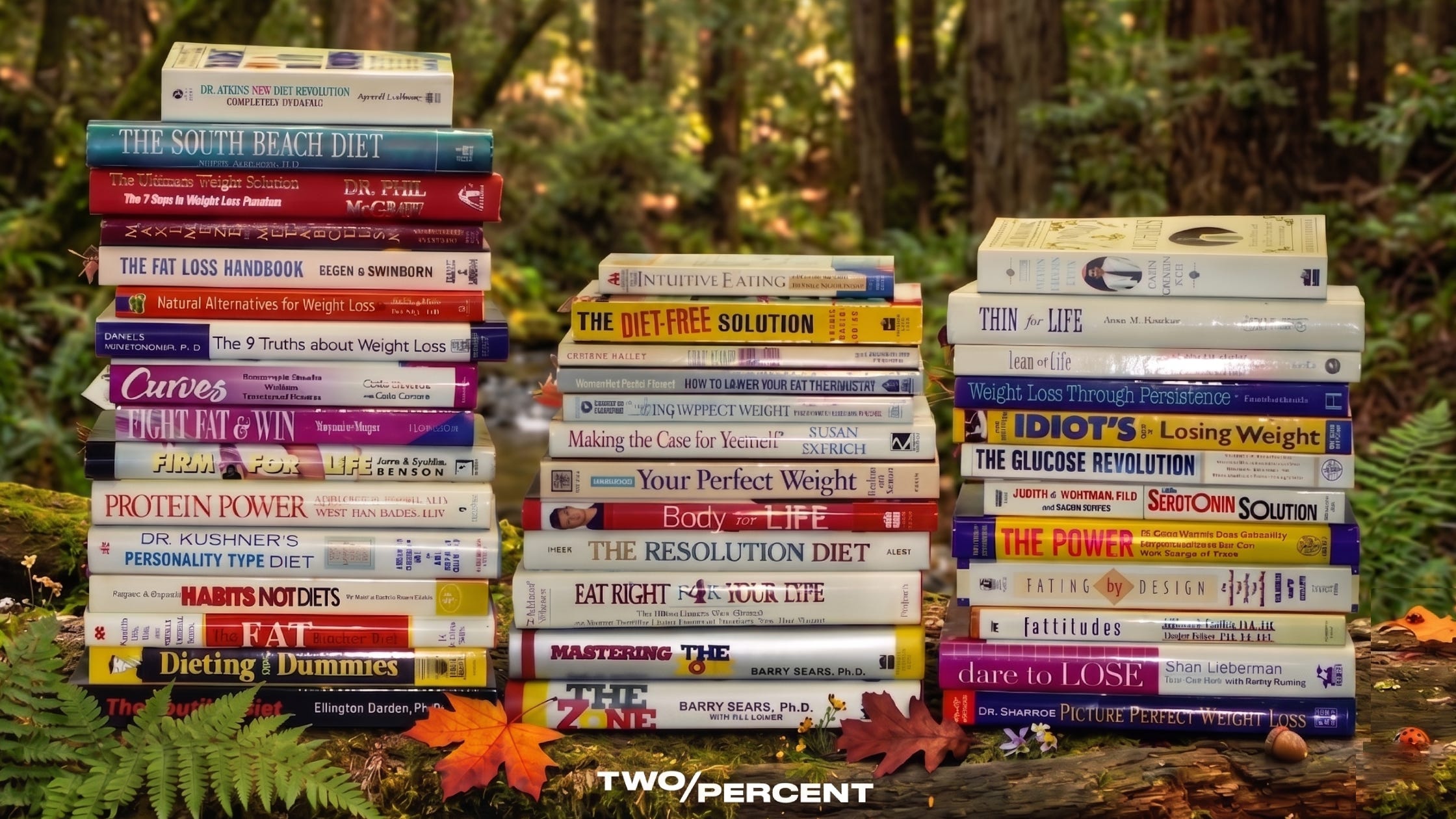
An analysis of 400+ diet books
Only 20% of the advice in diet books tells you what to eat. Here's what it means
On May 1, the price of a Two Percent Membership is going up by $1. Existing Members are NOT affected. Not a Member yet? Lock in our legacy pricing, forever, here.
About 55 million Americans are on a diet at any given moment. Half of the country says it’s trying to lose weight. Diet and weight loss books generate about $600 million in sales each year.
This isn’t anything new. Diet books have been around since the 1860s, yet obesity grew 3,900% since then.
A Cornell researcher named Adrienne Bitar decided to figure out why. She analyzed 400+ diet books spanning that entire history.
What she found wasn’t about food.
In today’s post, you’ll learn:
Why only 20% of diet books are about actual nutrition.
What fills the other 80%, and what that reveals about us.
Why certain diets catch on while others die: sales tactics, stories, etc.
The single most important metric that determines if you will actually lose fat.
How to use findings from 400+ diet books for the rest of your life, without the marketing fluff.
Housekeeping
In case you missed it:
On Wednesday, we ran Don’t Die: Do Pullups part II. It’ll help you do more pullups, one of the most important exercises you can do.
Friday was a deep dive into GLP-1s and muscle loss, based on breaking new research.
We had two great podcasts last week: A conversation with Melissa Urban and an episode covering a surprising take on alcohol and the shaky research around social media. Listen here.
Shoutout to our partners:
Momentous made me feel good about supplements again. Every single product is heavily tested for purity because Momentous has contracts with professional sports teams and the U.S. military. They also sell what works rather than offering a million fringe options that don’t offer benefits. I use Momentous’ Plant Protein Powder, Multivitamin, and Creatine daily.
Function Health offers 5x deeper insights into your health than typical bloodwork. You’ll learn critical information that can guide you into feeling better every day. It helped me identify a mineral insufficiency—and was cheaper than my insurance. Go to my page here to sign up, receive a discount, and pay just $340.
How dieting started
To understand why and how the diet industry started, I spoke to Adrienne Bitar, Ph.D., a professor at Cornell who studies the history of food and health and the author of Diet and the Disease of Civilization.
She told me that dieting is a very new phenomenon for humans.
“To reject food (and go on a diet) is really a privilege,” Bitar said. “For so much of human history, we’ve just been scraping by.” We ate whatever gave us the most calories at the moment.
Go deeper: Read what 11 hunter-gatherer diets can teach us about what humans really ate in the past—and how that can guide us today.
Then the Industrial Revolution happened. Easier access to calorie-dense food paired with less physical labor led people to start gaining weight.
Obesity first rose among the rich—people with the most food and least physical work.
A man named William Banting had a solution. He was one of those rich people who became obese. To lose weight, he came up with a list of “can eat” and “can’t eat” foods and followed it.
Banting ate only meat, greens, and fruit. He avoided root vegetables, potatoes, butter, milk, pork, salmon, sugar, and beer.
It worked. He lost 35 pounds. He wrote about it in the first large-scale diet book, published in 1863 and titled Letter on Corpulence, Addressed to the Public1. His diet was the first iteration of a low-carb diet.
The book became a bestseller in the US and UK and kick-started a new diet industry.
Soon, doctors and quacks alike began cranking out diet books with fantastic names like “Advice to Stout People” and “Foods for the Fat.”
The advice ranged from odd to dangerous: chew every bite of food 100 times, drink only vinegar (Lord Byron’s idea), ingest a tapeworm, take arsenic pills, pray the fat away.
Over time, obesity moved down the economic ladder and spread worldwide. As researchers at Our World in Data explained, “Obesity is one of the world’s largest health problems—one that has shifted from being a problem in rich countries to a health challenge around the world.”
Diet books are now some of the bestselling books of the 20th and 21st centuries.
The truth about diet books
On the surface, diet books sell us a tangible goal: eat this, not that to lose weight, build muscle, detox our bodies, improve heart health, etc.
But that’s just surface-level packaging. Bitar, the Cornell researcher, analyzed 400+ diet books spanning that entire history.
She gathered these books from historical archives, online auctions, and garage sales. She even stumbled onto a treasure trove via Craigslist from an old woman who’d been collecting diet books her entire life.
She found that the specific advice on what to eat was “mere details.” Nutritional advice took up only 20 percent of the books on average. The books’ most significant features were the stories about the diet.
“It can’t just be a (list of can and can’t eat foods),” she told me. “A diet has to tell a story about ourselves. It has to pick up on bigger currents in our culture that are prevalent.”
This makes sense. Humans are unique because we can tell stories2. Harvard psychologists found that we’re ~20 times more likely to remember information if it’s part of a story.
Diet books aren’t compelling without stories. Bitar found that the books usually tell a “flab to fab” storyline, but the “fab” has less to do with actual weight loss (or other goal) and more to do with getting the life we want but don’t have.
“Diets use the banal, often boring material of breakfast-lunch-dinner and the quest for self-improvement to channel larger concerns about the success or failure of America,” Bitar wrote. “(Diet books) stand in for the bigger debate about history, salvation, nature, money, power, sin, hope, innocence, experience, time, and all the other ideas that make the world worth thinking about.”
She continued. “There’s this belief of perfectibility. Diet books tell us that if we just eat the optimal or the best combinations of foods, we’ll be beautiful, fit, lovable, healthy, well, and vibrant.”
Diets rise and fall based on cultural undercurrents
Bitar found that people often choose a diet based on their underlying beliefs about the world. For example:
The detox diet, cleanse diet, etc
These diets were originally inspired by drug and alcohol addiction rehabilitation groups and ideas of removing environmental pollution. We then applied that philosophy to eliminating the toxins in our own bodies. The underlying idea is that modern food technology has poisoned our biology, and certain foods can restore us to purity.The paleo diet, clean eating, and eating only organic
These diets pull from the classic biblical narrative of Adam and Eve and The Fall. They inspire nostalgia for the simpler times of our ancestors before the world was corrupted by the modernity of taxes, traffic, and packaged food (a utopia that, Bitar noted, has scant research to support it).Biohacker diets—keto diet, using continuous glucose monitors, precision nutrition, etc
These diets tell us that by leaning on science and integrating data into what we eat, we can surpass our biology and nature and reach an optimized state. This is probably why these diet methods first became popular in the tech industry.The carnivore diet
This diet relies on a narrative that modern men have become emasculated and that by eating only food we once had to hunt (meat), we’ll be able to reclaim our health and physicality. Unsurprisingly, this diet is most popular among men.
The truth about diets
Humans didn’t come with a manual for the perfect day of eating. That’s a good thing. We can eat all kinds of food combinations and be healthy. If we couldn’t, we probably wouldn’t have taken over the world.
Every diet can help us lose weight. Until it doesn’t.
One extensive survey in the UK found that people quit fad diets after about five weeks. My friend Layne Norton, PhD, explained that six of every seven obese people have lost a significant amount of body weight. But they didn’t keep it off.
“People choose a (fad) diet and think, ‘I’m going to lose weight,’” he said. “But they do not give any thought to what happens afterward. People will say, ‘I want to do a ketogenic diet because I want to increase my fat oxidation,’ and they’re talking about all these scientific mechanisms and everything (ed’s note: stories). And that’s great. But can you do (that diet) for the rest of your life? If the answer is no, you need to rethink what your approach is.”
A meta-analysis3 of 14 different diets found that adherence is everything. The scientists stratified the participants by how closely they followed the diet’s instructions and found that the most adherent people lost more fat, regardless of the diet.
“So what (this meta-analysis) showed is that we need to ask, ‘What is going to be the easiest diet for you to adhere to in the long term?’ And you should probably do that,” Layne explained.
The answer to “which diet can I follow forever?” probably won’t fit neatly into a story about purity, optimized biology, or reclaimed masculinity.
How to diet better
If a diet appeals to you, ask yourself why. Every diet sells a story—about purity, optimization, gender, salvation, etc. Figure out which story is pulling you in.
Then forget the story for a moment. Look at the diet only as a list of foods and behaviors. Can you follow the diet’s food and behavioral rules for the rest of your life?
If the answer is no, it may still be worth trying the diet to learn a few valuable takeaways. For example, testing an elimination diet could reveal foods you’re allergic to, as we learned in Tuesday’s podcast with Melissa Urban.
But the key is to then take the parts of the diet you think you can follow forever and ditch those you can’t.
That’s less exciting than any diet book’s ultimate promise, but it’s more likely to stick.
Have fun, don’t die.
-Michael
P.S. If you want to go deeper on this subject, Bitar’s book is a fascinating read.
Smith, D., Schlaepfer, P., Major, K. et al. Cooperation and the evolution of hunter-gatherer storytelling. Nat Commun 8, 1853 (2017). https://doi.org/10.1038/s41467-017-02036-8
Ge L, Sadeghirad B, Ball GDC, da Costa BR, Hitchcock CL, Svendrovski A, Kiflen R, Quadri K, Kwon HY, Karamouzian M, Adams-Webber T, Ahmed W, Damanhoury S, Zeraatkar D, Nikolakopoulou A, Tsuyuki RT, Tian J, Yang K, Guyatt GH, Johnston BC. Comparison of dietary macronutrient patterns of 14 popular named dietary programmes for weight and cardiovascular risk factor reduction in adults: systematic review and network meta-analysis of randomised trials. BMJ. 2020 Apr 1;369:m696. doi: 10.1136/bmj.m696. Erratum in: BMJ. 2020 Aug 5;370:m3095. doi: 10.1136/bmj.m3095. PMID: 32238384; PMCID: PMC7190064.


You had me at "ingest a tapeworm"