

Don't Die: Do Stepups
Why going down the stairs is a critical part of aging, and the science of one of the best lower-body exercises.

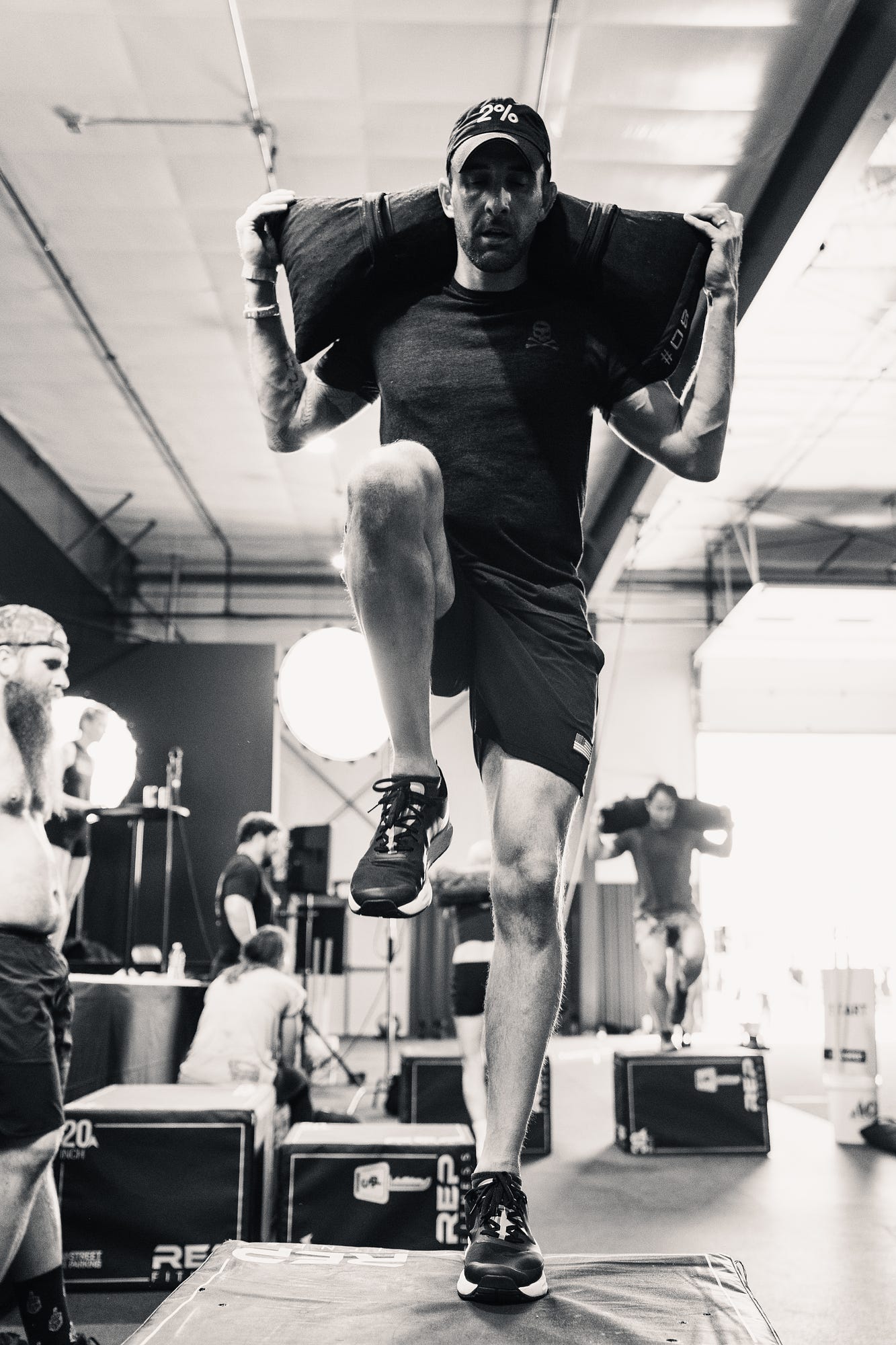
Remember: Only two percent of people take the stairs when an escalator is available.
This Substack explores the “metaphorical stairs”—the slightly harder choices that yield massive long-term benefits for how we live, perform, and age.
Today, however, we’re dropping the metaphors and covering an exercise that helps you climb and descend actual stairs: stepups.
Because if you can do stepups well, you can maintain fitness, function, and independence for the long haul. Stepups can even help us avoid one of the major killers of older adults.
Researchers in the Czech Republic pointed out:
The single stepup is an integral movement performance for functional mobility and activities of daily living.
It’s always been like this. Humans have long needed to be good at stepping up and down to survive and thrive. We evolved to walk on two feet in a rough environment that demanded we ascend and descend rough terrain.
The ability to do that well still matters today.
One study1 found that people who performed better at climbing four flights of stairs were less at risk of dying from any cause. Another noted2 that the ability to climb stairs well reduces the risk of catastrophic accidents in older adults.
This is exactly why the January and February Burn the Ships workouts contained so many stepups. In training to do epic stuff outside, we train to offset the perils of modern living.
Today you’ll learn:
The surprising reason stepups are an essential exercise (performance + longevity).
How to do stepups correctly: movement and equipment tactics.
How to use stepups in a workout.
Quick housekeeping
In case you missed it:
On Wednesday, we explained what to do after a workout: The Two Percent Cool Down. (You asked for it in the survey).
Friday was part III of our three-month Burn the Ships workout plan that will make you ready for the mountains (and life).
Thanks to our partners:
Go outside with Janji, an independent running brand making gear built for ultra-distance pursuits. They’re the only brand making gear specifically for 200-plus-mile adventures—my favorite kind. I love this new weird, amazing jacket they released. Find Janji at Janji.com and at REI stores nationwide.
David Protein Bars have the highest amount of protein per calorie of all protein bars. That makes them a great option for anyone who wants protein on the go without the excess sugar and fat of most bars. Visit DavidProtein.com.
Let’s roll …
How stepups improve performance
Research is just starting to catch up to the power of stepups. The Olympic performance coach Carl Valle said:
In my experience, no other exercise has had so much success with adoption but so little useful research on its effectiveness and execution as the stepup exercise.
The exercise has some of the greatest carry-over to performance in the outdoors and everyday life.
This is probably why the thinkers at MTNTOUGH and Uphill Athlete frequently include stepups in their programs. So do the folks at the Mountain Tactical Institute (MTI). As Rob Shaul from MTI put it:
Loaded stepups are a functional, transferable, and no-excuse way to directly train hiking uphill under load—a foundational fitness demand for all mountain sports.
Two other performance benefits worth knowing:
They work your glutes harder than any other exercise. Glutes are your “go muscles,” and they act as shock absorbers as you run, hike, and ruck. A study in the Journal of Sports Science & Medicine3 concluded: “The step-up exercise and its variations present the highest levels of [glute] activation followed by several loaded exercises and its variations, such as deadlifts, hip thrusts, lunges, and squats.”
They’re safer than many other popular lower-body exercises. They don’t load your spine as severely, and they happen on one leg at a time, which generally reduces injury risk and fixes strength imbalances.
How stepups help us age better
As we age, we’re often fine at climbing up stairs. But we start to lose the ability to slow ourselves down as we descend stairs or step off a curb. I.e., the “brakes” die before the “engine.”
Researchers call the ability to slow yourself down while descending “eccentric deceleration.”
If we don’t have the strength and coordination to decelerate and land softly, our chances of falling skyrocket. Notice how no one says “I fell up the stairs.” They say, “I fell down the stairs.”
And if we fall and break a hip, we’re screwed. You’ve probably seen me cite the data here, but a new review4 updated the numbers. It found 21.8% of older adults who break their hip will be dead within a year.
Stepups build eccentric deceleration because the lowering phase trains your brakes.
Stepups also:
Reveal and fix your asymmetries. Because you work one leg at a time, you can see if you’re weaker or moving differently on one side. Fixing relative weaknesses and movement asymmetries can help you avoid injuries and stay mobile.
Many people discover after a DEXA scan that one leg has significantly more muscle than the other. Single-leg exercises like stepups fix that.
Protect your knees. Stepups work muscles that stabilize your knees, which can help you avoid pain from running and living. The “Patrick stepup,” in particular, has research behind it and is also often used in physical therapy settings.
How to do stepups correctly
The famed strength coach Mike Boyle calls stepups “hard to do well and easy to do poorly.” Here’s how to do them right.
1. Use the right height box or step
Tall boxes are where good form goes to die.
The height of the box or step you use should depend on your height and ability level. Use common sense. Start with a step or box that’s anywhere from 3 to 12 inches off the ground.
Once you’re comfortable with one height, gradually go higher.
Eventually, you want to use a box that puts your front thigh parallel to the ground in the “down” position. Going higher than that has diminishing returns. For example, MTI has its athletes use boxes that are 17 inches or shorter.
2. Drive upward with your front leg
The “working” leg—the one on the box or step—should do most of the work.
A common mistake is pushing off the back leg to generate momentum, then bending forward and using your back to finish the rep. When that happens, the front leg barely works.
To fix this, do three things:
Push through your front foot.
Think of your back foot and leg as a rudder that keeps you on course rather than an engine—it shouldn’t be pushing you up. The pushing should come from the front leg.Pull your toes toward your shin on your back (non-working) leg.
That makes it harder to cheat by pushing off your back leg.Stand tall.
As you execute the exercise, you’ll naturally lean forward. But try to avoid leaning too far forward. Your chest should be up. This takes strain off your back and helps you avoid jerky momentum.
3. “Lock out” your hips at the top
When you reach the top of the movement, come to a full standing position. Your ankle, knee, hips, and torso should all be in a straight, stacked line.
You can use different tricks to ensure your hips lock out. For example:
Drive your non-working leg upward and lift it until your thigh is parallel with the ground and knee is bent 90 degrees in front of you.
Touch your back leg’s heel to the front of the box.
Flex your butt at the top. (This is what I do. It’s the simplest cue—and it works).
4. Lower yourself slowly
This is the most neglected part of the exercise and arguably the most important. Don’t flop back down to earth. Control the descent. That’s where eccentric deceleration gets built—and where the real payoff for aging, trail running, and rucking lives.
Putting it all together …
Here’s a quick-and-dirty video showing you the difference between a good and bad stepup.
Note how in the good example I:
Use a Yeti cooler as a step. My standard Rogue box is a bit taller than is ideal for stepups for most people most of the time.
Don’t push off my back leg.
Stand tall and lock out my hips.
Lower myself slowly.
In the bad example I:
Use too tall of a box.
Push off from my back leg.
Don’t lock out at the top.
Plummet back to earth.
How to Use Stepups
As a warmup: Bodyweight stepups are a great way to get your lower body and core firing before a workout. Do a set or two of 10 onto a low box.
To protect your knees: If you’ve ever had knee issues (or if you run often), try the “Patrick stepup.” Some studies show it can help with knee pain and protect knees, and it’s also often used in physical therapy settings.
In a workout: Weighted stepups are great, but a little weight goes a long way. If the weight messes up your form, use less weight. I’ll do them while wearing a weighted pack, or holding dumbbells or a sandbag.
As a workout: I’ll often set a timer and do stepups for 40 minutes straight. I usually wear a pack that weighs about 10 to 15 percent of my bodyweight. The point isn’t to accumulate as many reps as fast as I can. The point is to pack in a lot of great reps to prepare for the mountains. I do this when I have something good to watch on TV, like a documentary or Golden Knights game. The time goes by surprisingly fast.
Try different variations: Each has unique benefits. For example, researchers at Marquette University5 found that regular stepups are best for your glutes and hamstrings. Crossover stepups hit the side of your glutes, which helps with stability. Lateral stepups hit your outer quads.
Have fun, don’t die, do stepups.
-Michael
European Society of Cardiology. "Performance on exercise test predicts risk of death from cardiovascular disease and cancer." ScienceDaily. ScienceDaily, 7 December 2018.
Di Giulio I, Reeves ND, Roys M, Buckley JG, Jones DA, Gavin JP, Baltzopoulos V, Maganaris CN. Stair Gait in Older Adults Worsens With Smaller Step Treads and When Transitioning Between Level and Stair Walking. Front Sports Act Living. 2020 Jun 25;2:63.
Neto WK, Soares EG, Vieira TL, Aguiar R, Chola TA, Sampaio VL, Gama EF. Gluteus Maximus Activation during Common Strength and Hypertrophy Exercises: A Systematic Review. J Sports Sci Med. 2020 Feb 24;19(1):195-203. PMID: 32132843; PMCID: PMC7039033.
Determinants of One-Year Mortality After Hip Fracture in U.S. Older Adults: A Socio-Ecological Systematic Review and Meta-Analysis; Oluwaseun Adeyemi, Dowin Boatright, Joshua Chodosh; medRxiv 2026.02.10.26346053;
Simenz CJ, Garceau LR, Lutsch BN, Suchomel TJ, Ebben WP. Electromyographical analysis of lower extremity muscle activation during variations of the loaded step-up exercise. J Strength Cond Res. 2012 Dec;26(12):3398-405. doi: 10.1519/JSC.0b013e3182472fad. PMID: 22237139.
Great advice. As a 70-year-old in the fitness industry, I think stepups are one of the most underutilized longevity exercises.
The eccentric “braking” you describe is great for preventing falls, but stepups also have another benefit: the repeated stepping impact can help stimulate bone density, which matters for people dealing with osteopenia and osteoporosis. The single-leg nature also builds balance and symmetry—both key for staying mobile later in life.
I do jump ups and downs. More impact and osteopenia, osteoporosis benefit - IF approved by your doctor. Use a low height and have a spotter.
For older folks, the trick is exactly what you suggest: lower step heights and slow, controlled descents. Simple movement, big payoff.
Edit: I should have mentioned how this elevates heart rate and has cardio benefits too.
I live in a townhome, so throw 15-20lbs in a pack, and do 50 floors throughout the day. It has done wonders.