

The "Inactivity Mismatch Hypothesis"
Evolutionary data shows that the world's healthiest people sit 10 hours a day. Here's why your comfortable chair is the real problem, and how to fix it.

I just finished a stretch of travel, where I found myself bound to an airline seat for hours. Then I’d land, sit in a rental car and drive to the hotel, sleep, and do it all again the next day.
I sat more than I have in months.
All of my sitting came on the heels of a recent report finding that the average American now spends about nine to ten hours a day in a chair. The phrase “sitting is the new smoking” made the rounds.
After all, a handful of years ago, the Canadian government funded a giant systematic review of the research1. It found:
High levels of sedentary behavior are unfavorably associated with cognitive function, depression, function and disability, physical activity levels, and physical health-related quality of life in adults.
But a theory from an evolutionary biologist at USC shows the issue is a lot more complicated than that.
The problem may not be that we sit. Rather, it’s how we sit.
The upshot: A few tweaks to how we sit can do us a lot of good. It can likely reduce our risk of diseases that kill us, make us stronger and more functional as we age, and even prevent and relieve back pain.
Today, you’ll learn:
Why the world’s most physically active people rest 10 hours a day.
The differences between how we sit and how they sit (and why our comfort is killing us).
The exact, science-backed changes you can make to your daily routine to reverse the damage of modern chairs.
Housekeeping:
In case you missed it:
On Wednesday, we covered The Most Comprehensive Analysis of Strength Training Ever Assembled and what it can tell us about strength, muscle, and aging well.
Friday’s monthly Expedition post (your favorite in the survey) explored 23 topics that’ll make you healthier, wealthier, and wiser this month.
Thanks to our partners:
Momentous made me feel good about supplements again. They’re heavily tested and trusted by pro sports teams, the U.S. military—and Two Percent. I use Momentous’ Plant Protein Powder, Multivitamin, and Creatine daily.
Function Health offers 5x deeper insights into your health than typical bloodwork. You’ll learn critical information that can guide you into feeling better every day. It helped me identify a mineral insufficiency—and was cheaper than my insurance. Go to my page here to sign up, receive a discount, and pay just $340.
The hunter-gatherer rest paradox
Scientists study hunter-gatherer tribes because they provide a model of how we lived for nearly all of human history. They can help us understand how we’re adapted to live and why we get sick today.
Hunter-gatherers don’t seem to get many of the diseases that kill us: obesity, high blood pressure, type 2 diabetes, and cardiovascular disease. They get about 14 times more physical activity than the average American (they need to move a lot to survive by hunting and foraging).
So it seems reasonable to assume that these people rarely sit around. And that would imply that sitting is a modern mismatch that hurts us.
In his fieldwork with Hadza hunter-gatherers in Tanzania, however, USC evolutionary anthropologist David Raichlen noticed something surprising.
Yes, the Hadza move around a lot. But they also do a lot of nothing—lounging around for long stretches of the day.
He decided to study this observation:
He strapped scientific-grade activity trackers to tribe members to measure the time they spent moving versus resting.
He also placed small EMG devices on their bodies to measure the tribes’ muscle activity as they rested.
He documented how they rest by taking field notes and photographs.
The results: The tribe members spent an average of 9.8 hours a day at rest2.
That’s roughly the same as people in the US, Netherlands, and Australia. I.e., the same as the people scientists keep screaming at to stop sitting so much.
Yet the Hadza hardly get the diseases we do.
The difference: we rest comfortably—the Hadza don’t
When we sit, we do so on plush couches or ergonomic office chairs with various levers to dial in the comfort.
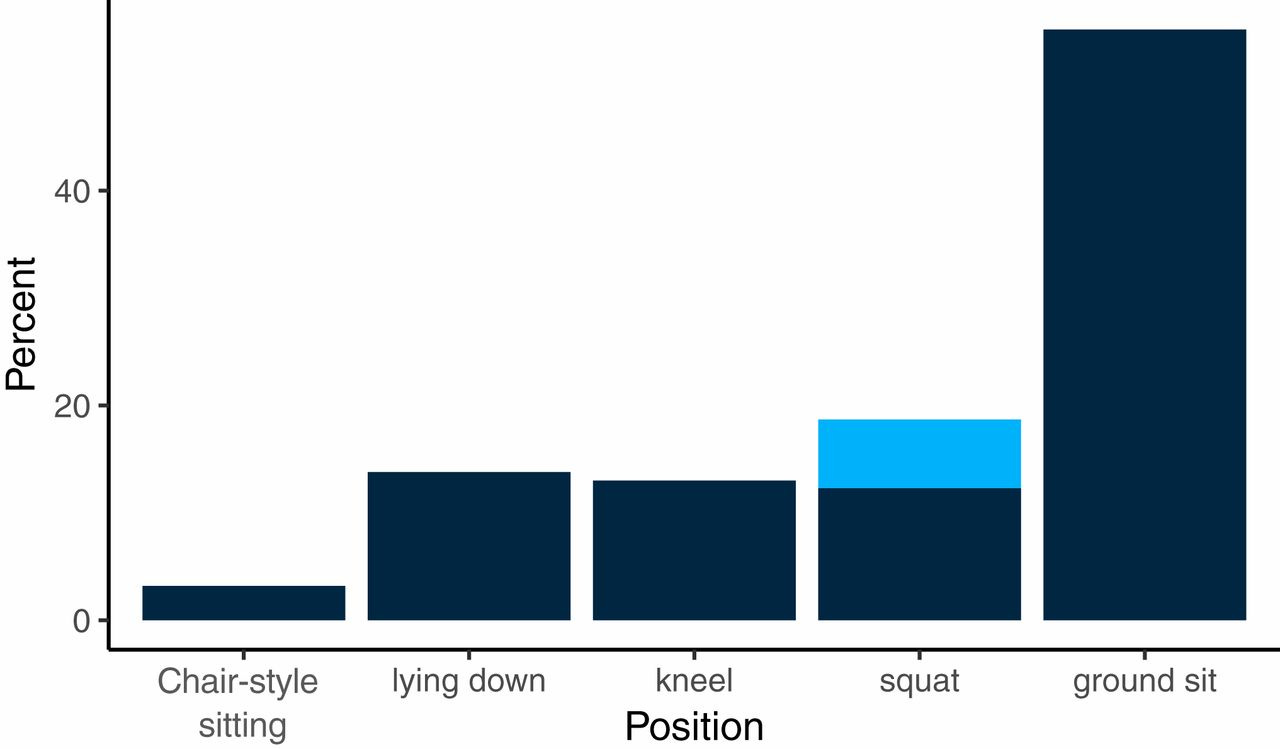
Meanwhile, Raichlen found, that when the Hadza rest, they sit on the ground, lie down, kneel, or even squat.
Here’s how much time the tribe members spent in various rest positions:
The power of not melting into a cushion
Chairs are comfortable precisely because they eliminate the effort that our muscles would normally put forth in rest positions.
But the rest positions of the Hadza—kneeling, squatting, and ground sitting—aren’t free. They lightly engage all the muscles in our lower body and trunk. Here’s the data:
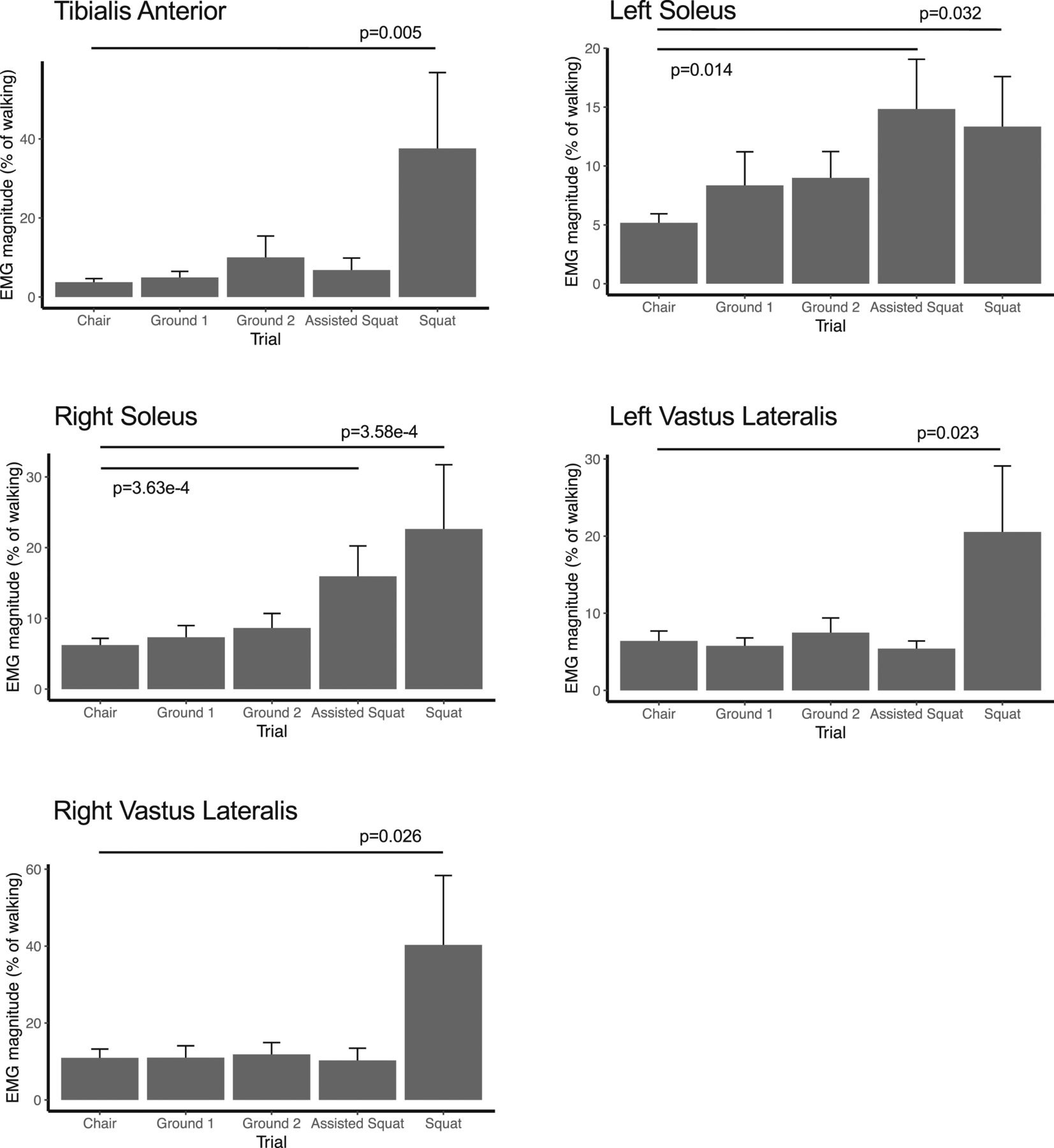
Consider resting in a squat position—you still have to activate your lower body and trunk to keep yourself up. This leads to muscle activity in our calves and quads that’s equal to about 20–40% of the levels recorded during walking. Kneeling produced similar effects.
Even sitting on the ground requires us to lightly activate our legs and core to keep our torso propped.
The way we sit also seems to factor into our relatively high rates of back pain.
Back pain is rare among the Hadza. Raichlen told me, “Squatting or sitting without their backs resting (on a chair back), unsurprisingly, increased their lower back muscle activation significantly.”
Modern chairs remove the light work our back muscles used to do while resting, weakening our backs over time. Then, when we chair-weakened people bend over to lift something or move into a new position, our bodies are more fragile.
This is one reason, according to back health expert Dr. Stuart McGill, that people who go to the gym actually experience more back pain than those who don’t. The problem stems from sitting all day, then hammering at the gym with a relatively weak back.
Scientists at Harvard estimate that the way we now live causes 83 percent of back pain (which is the most common and debilitating pain).
The inactivity mismatch hypothesis
Raichlen calls the resulting theory the “inactivity mismatch hypothesis.” He wrote:
This hypothesis posits that our physiology evolved within the context of a high duration of sustained muscle activity throughout all parts of the waking day, both through physical activity and through resting postures that maintain low levels of muscle activity. Prolonged periods of muscular inactivity during chair sitting, a common element of daily life in industrialized populations, are best viewed as a key mismatch with our evolutionary past.
In other words, we evolved to be mildly active and engage our muscles even at rest.
But our modern comforts have removed that light effort we used to get hours each day.
Raichlen noted in the paper that when our muscles fully relax, they stop producing the enzyme lipoprotein lipase, which helps clear fat from the bloodstream. This can lead triglycerides to accumulate, insulin sensitivity to drop, and blood flow to slow. Inflammation can creep up.
He wrote that sitting in postures that don’t require muscle activity leads to, “detrimental effects on lipid and glucose metabolism, blood flow and endothelial health, and regulation of inflammation.”
3 ways to rest better
The answer isn’t to get rid of your chairs and sofa forever.
But we might see some benefits if we didn’t make every moment of rest optimized for comfort. Here are a few ways to get there:
1. Sit without the backrest
Even your regular office chair becomes more effortful if you don’t use the backrest. Your trunk muscles have to work to keep your torso propped straight.
Of course, you can’t slump over when you do this. Biomechanist Jenn Sherer explains that slumping over with your back forming a C can lead to spinal disk bulges and pain.
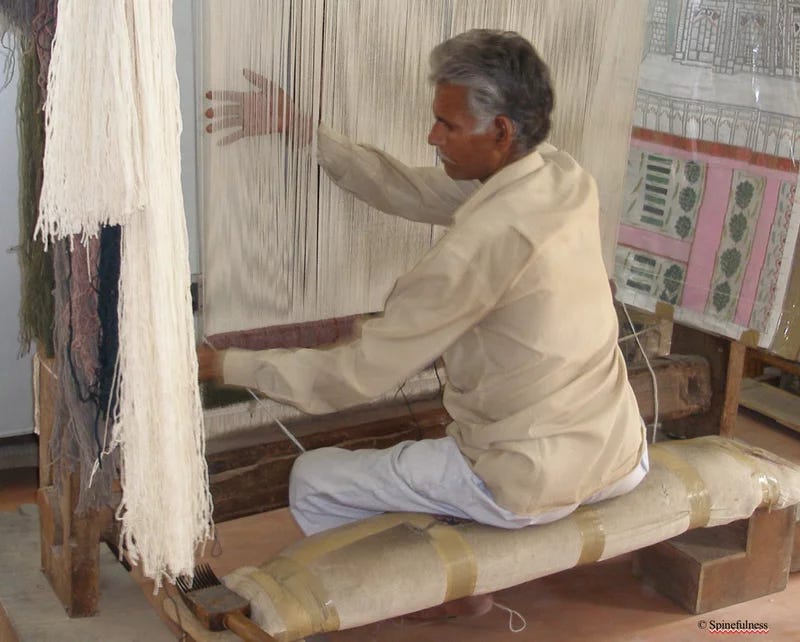
A strange yet easy tip to sit better: picture yourself with a tail. You want to sit with your pelvis positioned in a way that your tail could wag as you sit, with your back straight.
To illustrate this position, Sherer uses the image below of a weaver in Rajasthan, India. I.e., try to sit like this guy.
Sitting without a backrest seems like a minor tweak, but a Two Percent reader once messaged me to say, “I’ve had back pain for a long time. I always read for about half an hour at night, and I started reading sitting upright with my back straight. My back pain has gone away, and I haven’t changed anything else.”
Simple tweaks can be powerful.
2. Sit on the floor for ten minutes as you watch Netflix or read
Ten minutes sitting on the floor at night is totally doable. Put in the time, then retreat to the couch.
Sit cross-legged, with your legs extended, whatever. Try to keep your back relatively straight. Ground-level sitting activates more muscles than a chair, and getting up and down from the floor is itself a useful movement.
The Hadza transition from ground to standing about fifty times a day. Rising from the floor runs your joints through a full range of motion and builds the kind of functional strength that predicts how long you’ll live.
One study of adults aged 51 to 80 found that those who needed more support to get up from the floor were roughly five times more likely to die in the next six years3.
3. Break it up sitting
The Hadza’s average sedentary bout was about fifteen minutes before they shifted posture, stood, or moved.
I, on the other hand, spent two hours in the same half-dead position on the couch watching The Sopranos over the weekend. I don’t think I’m unique—we’re less likely to shift around in comfortable chairs and couches.
A standing break every twenty to thirty minutes is a good way to interrupt sitting and get your body moving again.
At work, standing desks can also help. The research shows that standing desks (despite manufacturer claims) don’t lead us to burn significantly more calories than sitting.
But to me, the benefit is that our muscles work slightly more, and we’re more likely to move around. We pace more. We change positions far more frequently. That keeps our muscles from going totally offline.
Have fun, don’t die, rest well.
-Michael
Saunders TJ, McIsaac T, Douillette K, Gaulton N, Hunter S, Rhodes RE, Prince SA, Carson V, Chaput JP, Chastin S, Giangregorio L, Janssen I, Katzmarzyk PT, Kho ME, Poitras VJ, Powell KE, Ross R, Ross-White A, Tremblay MS, Healy GN. Sedentary behaviour and health in adults: an overview of systematic reviews. Appl Physiol Nutr Metab. 2020 Oct;45(10 (Suppl. 2)):S197-S217. doi: 10.1139/apnm-2020-0272. PMID: 33054341.
D.A. Raichlen, H. Pontzer, T.W. Zderic, J.A. Harris, A.Z.P. Mabulla, M.T. Hamilton, & B.M. Wood, Sitting, squatting, and the evolutionary biology of human inactivity,Proc. Natl. Acad. Sci. U.S.A.117 (13) 7115-7121,
Brito LB, Ricardo DR, Araújo DS, Ramos PS, Myers J, Araújo CG. Ability to sit and rise from the floor as a predictor of all-cause mortality. Eur J Prev Cardiol. 2014 Jul;21(7):892-8.
I've used a QOR360 stool for about 7 years now, and love it (I'm sitting on it now). https://qor360.com/ No backrest, and the seat pivots so you need to use your core to keep a stable position.
Does anybody have recommendations on office chairs without a back rest? maybe one where I could even sit cross legged?