


The Two Percent New Year Challenge is now live. If you want 2026 to feel different—better, clearer, more capable—this is your on-ramp. Become a Member to join.
In November of 1944, 36 men entered a lab at the University of Minnesota. They were to be the guinea pigs in one of the most extreme and dangerous studies ever conducted.
World War II was raging. But just as many civilians were dying of starvation in Europe as were soldiers in battle.
These 36 men were healthy, happy, and highly educated—and they volunteered to starve to help scientists understand the effects of starvation and how to bring starving people back from the brink.
In the study, the men were forced to walk at least 3 miles and do 2 hours of physical labor every day.
During the first 12 weeks, the men ate normally: about 3,200 calories a day. Meanwhile, the researchers took baseline measurements of their weight, body fat, resting heart rate, blood panels, strength, mental health, and more.
Then the diet was abruptly cut in half, so the guys ate aout 1,500 calories a day for 24 weeks straight.
The starvation diet was designed to resemble wartime famine foods: potatoes and cabbage, with little meat; only two meals a day; only black coffee and water to drink; and even a daily cigarette quota.
The men had to keep walking and working, and the scientists continued measuring. This photo show just how profound the changes were:
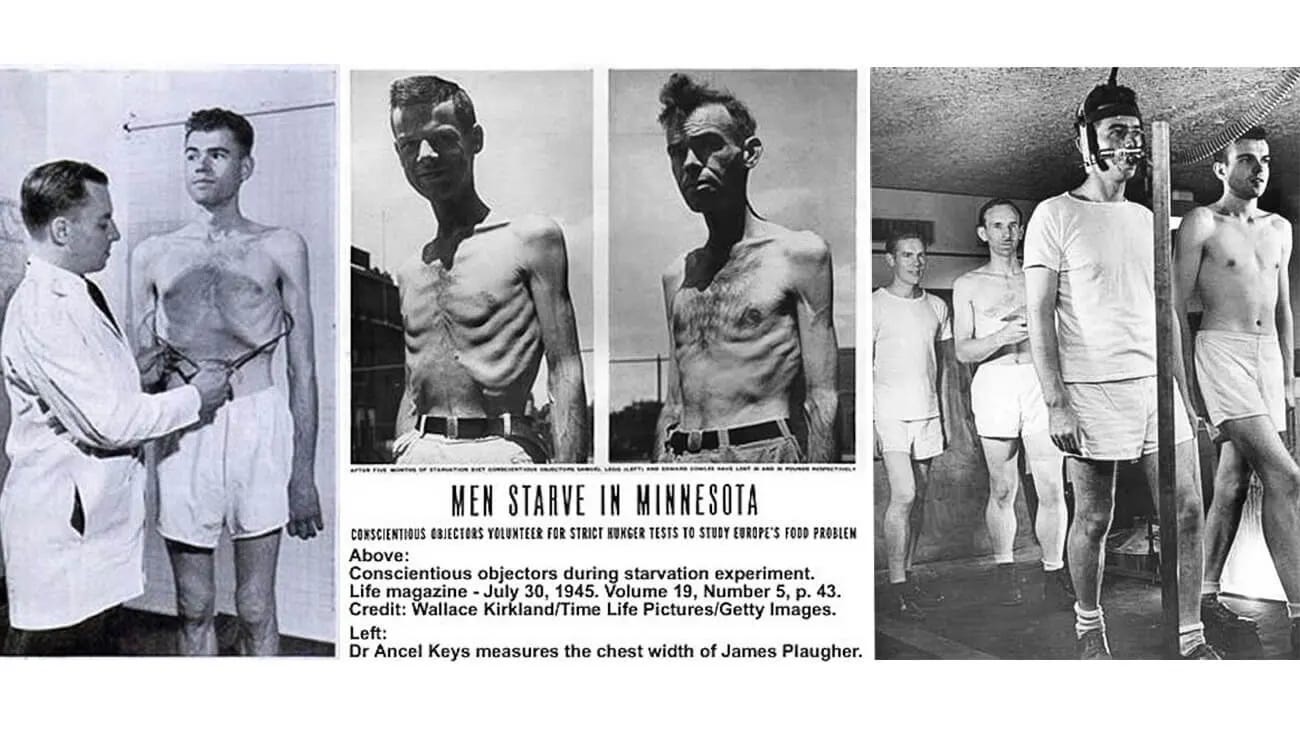
But what happened to the men internally—both to their bodies and minds—is even more important.
The lessons don’t just apply to starving people. They apply to the roughly 50 million Americans who go on a diet each year—especially right now, at the New Year.
And they can tell us everything we need to know about metabolism and why 97 percent of those dieters fail.
Here’s what you’ll learn today:
The Minnesota Starvation Experiment: The harrowing story of the 36 men who volunteered to waste away for science in 1944.
The 4 Mechanisms of Sabotage: The specific biological tools that your body wields when you start dieting.
The Survival Paradox: How those four mechanisms sabotage our progress, and often lead diets to backfire.
Quick housekeeping:
This post, like all Monday posts, is free for all subscribers of Two Percent. Enjoy.
But only Members get full access to all three Two Percent posts each week. Become a Member:
In case you missed it:
On Wednesday, we covered 9 Lessons from 2025: What I learned about mindset, health, adventure, and survival.
On Friday, we ran a Burn the Ships workout. It’s Part I of a three-part series that builds real-world performance and sets you up to age well.
Thanks to our partners:
🚨 New partner alert: Janji, an independent running brand making gear built for ultra-distance pursuits. They’re the only brand making gear specifically for 200-plus-mile adventures—my favorite kind. Check out the Circa Daily Long Sleeve, great alone on cool days or as a layering piece on the coldest days. You can find Janji at Janji.com and at REI stores nationwide.
David Protein Bars have the highest amount of protein per calorie. That makes them a great option for anyone who wants more protein but wants to avoid the excess sugar and fat of most bars. Check them out at DavidProtein.com.
Montana Knife Company. I’ve been carrying MKC knives into the wilderness for a few years. They’re bombproof, razor sharp out of the box, and made in Montana. My everyday carry: The Mini Speedgoat 2.0. Check them out here and mention you heard about MKC from Two Percent.
This is what happens when we start eating less:
1. We burn less
As the men began to starve, their resting metabolisms didn’t remain at their normal rates. The men went from burning an average of 1,590 calories a day at rest to just 964. (That’s the same metabolism of a 55-pound child.)
Their bodies saved calories by doing less of the stuff that kept them healthy. For example:
Their heart rates dropped by a third and their body temperatures by three degrees, making them feel freezing cold even in the heat.
They stopped replacing cells in their blood, skin, and organs.
Their hearts shrank by an estimated 17 percent, and they lost 40 percent of their muscle mass.
What we learned
When we lose weight—by burning more energy than we take in—our bodies pull various tricks to slow down our metabolism and calorie burn rate.
Even if we continue to eat less, we’re now burning less and no longer in a calorie deficit. This sabotages our weight loss and, over time, can make us regain.
It’s one reason research shows that people often hit a weight-loss plateau around five weeks.
2. We move less
When the men weren’t doing their forced walks and work, their habits changed.
Instead of being active and engaged with life, they became lazy and spent most of their time sitting in bed.
Even their minds became lazier. They reported not thinking as clearly, which happened because their brains had dialed back energy use (the brain uses a ton of energy).
What we learned
As we lose weight, our body intervenes to stop the steal by moving less. Our desire to exercise drops, and we’re less inclined to, for example, take a walk, get up and down, and fidget (this spontaneous movement can burn hundreds of extra calories a day).
The most crucial point is that this all occurs unconsciously. We don’t even realize that we’re moving less in our day-to-day lives.
Follow-up research has shown that even if we go to the gym and exercise, our bodies compensates by subtly moving less without us being aware of it. This can partly offset the workout—often more than we’d expect.
3. We fixate on food
The participants were ravenous. No shocker there.
But they also became obsessed with food. Their dreams, thoughts, and conversations revolved around eating.
They reported intense cravings and said that the food they did eat was much tastier than it was before the starvation period.
A few participants became preoccupied with recipes. One said that he “stayed up until 5 a.m. last night studying cookbooks.”
Many non-smokers started smoking or constantly chewing gum to curb their food obsession. The researchers finally had to ban gum after one guy was chewing 30 packs of it a day.
What we learned
A hungry brain redirects its mental energy toward food and getting it.
No, the average dieter doesn’t stay up until 5 a.m. reading recipes. But they likely do, research shows, have more intense cravings and think about food far more often.
This is why losing weight isn’t necessarily a matter of willpower. The brain changes in ways that make the pull of food significantly harder to resist.
4. We feel terrible
The participants were all irritable, depressed, and discontent.
They had awful nightmares. One of the men even cut off three of his fingers while operating a saw (he said he wasn’t sure if he did it on purpose).
The guys would watch comedy movies, and no one would laugh. They lost interest in relationships, sex, and pretty much everything else.
When the scientists asked about this, the participants just shrugged and said they didn’t find anything fun anymore. Their reaction to pretty much everything in life was “resignation,” said one of the scientists.
What we learned
Being “hangry” is a real thing.
As we begin to lose weight, our bodies reacts by making us more irritable and lethargic.
Eating more helps us feel better, which incentivizes us to … eat more and regain the weight.
The takeaway
The great irony is that all of these effects of starvation are beneficial if a person is actually starving.
They helped us save energy and prioritize food back when food was harder to come by (long before we found ourselves in a world of stocked pantries and fast food on every corner).
Today, however, these survival mechanisms are working against us. They’re why so many of the 72 percent of Americans who are overweight or obese struggle to lose weight.
Dieters start with enthusiasm and a normal metabolism. Then they begin to lose weight—and their body and mind sabotage their efforts.
I became interested in this topic after spending a month in the Alaskan wilderness while reporting The Comfort Crisis.
We packed in roughly 2,000 calories a day but were burning thousands more than that, thanks to carrying 80+ pound packs across rough terrain all day. My mind and body went to places just like the guys in the experiment—lethargic and obsessed with food—and I left the wild far lighter.
After I returned from Alaska, I began looking for the best ways to get past these harsh realities of weight loss. We’ll cover those in our Wednesday Members-only post.
Have fun, don’t die, feed the machine.
-Michael
I never would've imagined, outside of the Grinch, a heart could get that small. That is some terrifying stuff.
It bugs me that these studies were often only done on men. Women’s bodies work much differently. I suspect women would fare far worse. The muscle loss they observed is scary and is what worries me
most about diet culture today, especially among women.