


I was emailing with Sam Nichols, a new writer for Two Percent.
“The New York Times recently ran a piece about how working from home is making us mentally ill,” Sam wrote. “Which kind of makes sense, given possible social benefits of being around others … but I used to have to commute 60 to 90 minutes each way to work in a newsroom in Sydney, and that commute made me depressed. Plus it was super hard to organize my life.”
I felt that. I worked in an office from 9 to 6 for about a decade, with a 35-minute commute each way. Our work would be done by 2 or 3 p.m., but my colleagues and I would all stand around waiting until the clock struck 6, because some employers apparently love arbitrary and life-sucking rules.
Sam and I both agreed working remotely can have some downsides—less casual interactions with co-workers, and feeling like you’re “always at work.”
But there is no amount of joking around with colleagues that could get me back commuting to a 9-to-6 office job. The downsides of the office vastly outweighed the upsides.
Sam wrote, “So what’s the answer? How do we make sure remote work doesn’t make us depressed or unmotivated and impact our normal lives?”
“Figure it out,” I responded.
So here’s Sam, who analyzed the remote work study in Science that the NYT article was based on—and found some major flaws. He then spoke to experts and read data comparing office work to remote work. What he found applies to any worker—whether you’re remote, in an office, or out in the field.
Today we’ll cover:
The major statistical flaws hiding inside the recent Science study that blamed remote work for America’s mental health crisis.
The single, specific group that accidentally skewed the entire work-from-home dataset.
The psychosocial trifecta: three distinct environmental factors that predict burnout regardless of your location.
How to deploy a simple 10-minute environmental hack that dramatically alters your daily stress and cognitive fatigue.
One surprising mental health benefit of the commute, and how to leverage it (whether you work from home or still commute).
Quick housekeeping
ICYMI:
Last Monday, we covered the science behind the best nutrition tracking app I’ve found, MacroFactor. Use code TWOPCT to try it free for two weeks.
On Wednesday, we looked at how the sun might add years to your life. Or take them. Read it here.
Thursday’s podcast was one of my favorites yet. It’s useful for anyone who’s noticed their fitness tracker makes them neurotic.
The new Two Percent Gear shop is live. Check it out.
🧪 Check out Function Health. Function offers 5x deeper insights into your health than typical bloodwork. The info can guide you into feeling better every day. It helped me identify a mineral insufficiency—and was cheaper than my insurance. Go to my page here to sign up, receive a discount, and pay just $340.
Here’s Sam:
Three labor economists published a new study in Science1, analyzing five separate surveys of almost 590,000 people conducted between 2011 and 2019, and then again from 2022 through 2024.
Between those two time periods, COVID-19 altered the nature of work. Remote work quadrupled, jumping from 7% of workers in 2019 to 28% in 2023. Mental health issues climbed, too. That was not a coincidence, the three economists concluded.
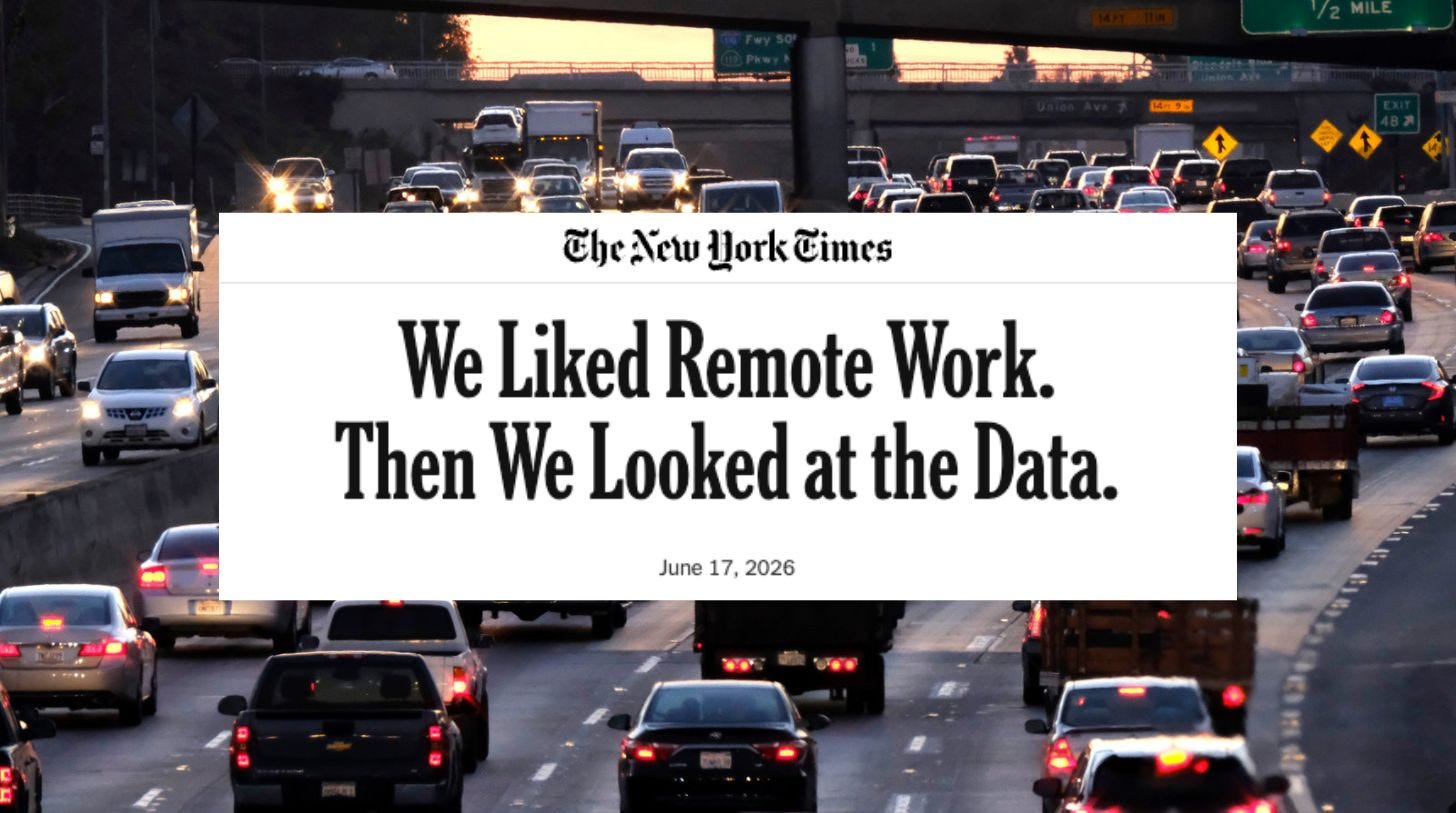
The researchers penned a viral piece in the New York Times, writing “remote work has significantly deepened Americans’ isolation and distress … remote work explains a third of the deterioration in mental health between 2011 and 2024.”
That seems clean and logical. But the study had three big issues worth considering:
First, the researchers didn’t directly study remote workers. They compared jobs that could be done remotely (like software engineers or accountants) to jobs that could not (like nurses and servers) and tracked how each group’s mental health changed2. I.e. their analysis of “remote” work included many people who didn’t actually work remotely.
Second, everyone’s mental health got worse over that period—including people who don’t remotely. Workers in remote-friendly jobs just got worse slightly faster.
And third, a single group of workers in remote-friendly jobs pulled the entire category down, which we’ll get to soon.
With the disconnect between the headlines and the actual findings in mind, I spoke with an occupational psychologist, an engineer, and a mental health consultant. I also combed the literature about what mental health was like before remote work.
Our answer isn’t braving subways and highways, and satisfying the “return to work” fantasies of narcissistic bosses3—office work is probably worse for our mindset than working remotely. But there are things we can do to make working from home better.
We’ll start with the evidence on office work and mental health, then we’ll look at simple things we all can do so work takes less of a toll on our outlook.
Two downsides of the commute and 9 to 5
It’s the worst part of the day
Daniel Kahneman is considered one of the greatest psychologists who ever lived (you may have read his book, Thinking, Fast and Slow). In the mid 2000s, he asked roughly 1,000 working women in Texas to log everything they did the previous day and explain how it made them feel4.
The two worst moments: Commuting and working. Commuting ranked at the absolute bottom among everything people did in a day.
Other research5, from economists at universities in Switzerland, found that a person commuting one hour each way would have to earn about 40% more money to be as satisfied with life as someone who didn’t have to commute.
Offices weren’t utopias
The Science study authors say remote work makes us less social.
But two scientists at the Harvard Business School found6 that putting people in a social office setting doesn’t automatically make them more social.
They examined the impact of open-concept offices, and found, “Contrary to common belief, the volume of face-to-face interaction decreased significantly (approximately 70%).” Workers sitting 10 feet apart just Slacked each other while wearing headphones.
The scientists explained: “Rather than prompting increasingly vibrant face-to-face collaboration, open architecture appeared to trigger a natural human response to socially withdraw from officemates and interact instead over email and instant messaging.”
One group skewed the whole Science study
I mentioned earlier that a very specific group of workers in remote-friendly jobs brought down the whole category of remote jobs.
That group: People who lived alone. They had the biggest drops in mental health. Some went days at a time without human contact. Their mental distress and use of mental healthcare and antidepressants jumped.
People who had remote job and lived with others didn’t have nearly as much mental distress.
So what can we learn from this? And how can we use it?
First, a caveat: bad jobs are bad jobs no matter where they happen
I spoke with Leslie Hammer, an occupational health psychologist and associate professor at Oregon Health & Science University. She told me that the biggest predictor of whether your job impacts your mental health is the job itself, not where you do it.
Hammer said there is decades of research7 highlighting three factors that erode the mental health of workers:
Extreme workloads
Poor relationships with co-workers
Feeling like you have no control over your role.
Think of them as the trifecta of a bad job.
“These stressors transcend location,” Hammer said.
If your job hits all three, no work-from-home hack is going to fix it—and there’s probably something fundamentally wrong with the organization you work for, Hammer said.
You can ask for a lighter load, different collaborators, or more agency. And if the response is “no,” that’s why we have Indeed and Monster. If your job makes you hate your life, you won’t regret leaving it.
Assuming your job is good, the research suggests that, for some people, the office has some upsides. The problem was a set schedule, arbitrary rules, and a commute that made many people miserable.
Three rules of better work—no matter where it happens
Remote work killed a lot of the bad of office jobs, but also some of the good. Here’s how to get some of the upsides of the office without the downsides.
1. Steal one benefit of the commute
Everyone hates commuting. But researchers at Harvard Business School8 found commutes had one benefit: They served as a transition ritual and drew a clear boundary between work and home.
People who used the ride to mentally shift between “work mode” and “normal life mode” had better mental health.
Remote work has no transition. For many, the kitchen table is the office is the kitchen table. Remote employees work about 48 minutes longer per day—and they’re more likely to feel tied to work when they’re supposed to be in “normal life” mode.
The solution: Create a “starting ritual” and “ending ritual.” For example, a 5- to 10-minute walk around the block before work, and another after. Or just make a show of opening and closing your laptop.
2. Schedule in non-working time with people
The three labor economists from the Science study mostly blame social isolation. Workers in remote-friendly jobs spent about an extra hour alone and socialized less.
In offices, human connection happens by accident. You talk to people in the hallway or after a meeting without scheduling it.
With remote work, there are fewer accidental interactions.
I spoke to Megan Delp, an organizational psychology consultant and the director of Workplace Mental Health at National Alliance on Mental Illness. She said remote workers have to make interactions happen on purpose.
She works remotely and schedules hour-long meetings with a colleague every few weeks. For five minutes, they talk about work. The rest of the time, they catch up and B.S. about family, movies, books, sports, whatever.
Research9 conducted by Belgian scientists suggests remote work doesn’t automatically hurt mental health—so long as we regularly talk to colleagues.
If you have zero desire to connect with colleagues, that’s fine. The Science study found that remote workers were less likely to do things with friends, so making an effort could offset that.
3. Change your workspace
Research shows that something as simple as putting a plant on your desk or art on the wall makes people feel better. Naturally, we assume the plant or art made us happier.
But that’s probably not true, according to Leidy Klotz, a professor at the University of Virginia and author of In A Good Place, about how places shape the way we think and feel. (Michael spoke to him on the Two Percent podcast about this topic and the subtraction mindset recently).
Instead, Klotz said, the improvement comes from taking initiative and making our space the way we actually want it.
This aligns with self-determination theory. “It’s been studied ad nauseum,” Klotz says. It basically finds the more agency you have over your life, including your workspace, the better you’ll feel.
It sounds simple, but it’s actually sneakily powerful.
Consider The “Langer-Rodin” Effect10. It found that nursing home residents who were allowed to make choices about their surroundings—like caring for their own plants or arranging their furniture where they wanted it—“became more active, more alert, and happier—and half as likely to be dead eighteen months later,” Klotz wrote in his book.
“That’s just one study, and it’s one specific situation, but it’s so fundamental—this idea of having control—that it literally has life or death outcomes,” Klotz told me. “And then the question becomes, ‘Do we have control over work environments?’”
The problem is, “it doesn’t get enough attention,” Klotz said. We just sit down and work in our spaces without considering how we can make them better for us.
Whether at home or in a corporate building, rearrange your office however you want, not the way the movers or the janitor did when you moved in. Put up artwork—stuff you actually like, not what seems like it would be neutral in an office. Add some plants.
If you can, point your desk so it’s facing the window. One study11 found that something as simple as a view of nature led to lower stress among workers.
Now back to Michael. Thanks to Sam for going beyond the headlines and finding the truth.
Have fun, don’t die, work,
-Michael
Natalia Emanuel et al., Home alone: Remote work, isolation, and mental health.Science392,eaec7671(2026).
In fairness to the authors, this is rather standard for economists. If you only looked at people who chose to work remotely, it could lead to a self-selection problem. I.e., People with mental health problems might choose to work remotely. By comparing job categories, they can, in theory, sidestep that problem—but it also opens up its own set of problems.
Shandell, M. S., Nevicka, B., & Schippers, M. C. (2026). Why narcissistic leaders resist remote work. Organizational Behavior and Human Decision Processes, 193, Article 104494.
Kahneman, D., Krueger, A. B., Schkade, D. A., Schwarz, N., & Stone, A. A. (2004). “A Survey Method for Characterizing Daily Life Experience: The Day Reconstruction Method.” Science, 306(5702)
Stutzer, A., & Frey, B. S. (2008). “Stress that Doesn’t Pay: The Commuting Paradox.” Scandinavian Journal of Economics, 110(2), 339–366.
Ethan S. Bernstein, Stephen Turban; The impact of the ‘open’ workspace on human collaboration. Philos Trans R Soc Lond B Biol Sci 19 August 2018; 373 (1753): 20170239.
Niedhammer, I., Bertrais, S., & Witt, K. (2021). Psychosocial work exposures and health outcomes: A meta-review of 72 literature reviews with meta-analysis. Scandinavian Journal of Work, Environment & Health, 47(7), 489–508 AND Harvey SB, Modini M, Joyce S, et al, Can work make you mentally ill? A systematic meta-review of work-related risk factors for common mental health problems, Occupational and Environmental Medicine 2017;74:301-310.
Jachimowicz, Jon and Lee, Julia and Staats, Bradley R. and Menges, Jochen and Gino, Francesca, Between Home and Work: Commuting as an Opportunity for Role Transitions (December 10, 2019). Harvard Business School NOM Unit Working Paper No. 16-077, Columbia Business School Research Paper No. 16-7.
Vander Elst, T., Verhoogen, R., Sercu, M., Van den Broeck, A., Baillien, E., & Godderis, L. (2017). Not extent of telecommuting, but job characteristics as proximal predictors of work-related well-being. Journal of Occupational and Environmental Medicine, 59(10), e180–e186.
Langer EJ, Rodin J. The effects of choice and enhanced personal responsibility for the aged: a field experiment in an institutional setting. J Pers Soc Psychol. 1976 Aug;34(2):191-8. doi: 10.1037//0022-3514.34.2.191. PMID: 1011073.
Douglas, I. P., Murnane, E. L., Bencharit, L. Z., Altaf, B., dos Reis Costa, J. M., Yang, J., Ackerson, M., Srivastava, C., Cooper, M., Douglas, K., King, J., Paredes, P. E., Camp, N. P., Mauriello, M. L., Ardoin, N. M., Markus, H. R., Landay, J. A., & Billington, S. L. (2022). Physical workplaces and human well-being: A mixed-methods study to quantify the effects of materials, windows, and representation on biobehavioral outcomes. Building and Environment, 224, Article 109516.
My recommondation for a Two Percent method to reduce the downside of commuting is to make it an active commute. Cycling or walking/jogging to or from work turns a commute from a drain to a benefit. And yes, I think it is worthwhile to prioritize this when selecting employment and living locations.
I started working remotely in 2010, and it was beneficial for my mental health with less stress and anxiety. I missed the social interactions at times, but I also got a lot more done since my time wasn't being wasted. It also made it easy to sneak away to bring my daughter to school, throw in a load of laundry, etc.
During covid, everyone was forced to work from home and it was then that the company realized that more work gets done and they save money. By the end of 2023, we no longer had a physical location. We have regular Teams meetings so now our water cooler talk is scheduled. I much prefer working from home, but I can also see how some may have trouble separating the two.