

The Truth About Gamification
Why gamification plays us, and 10 games that actually improve your life.

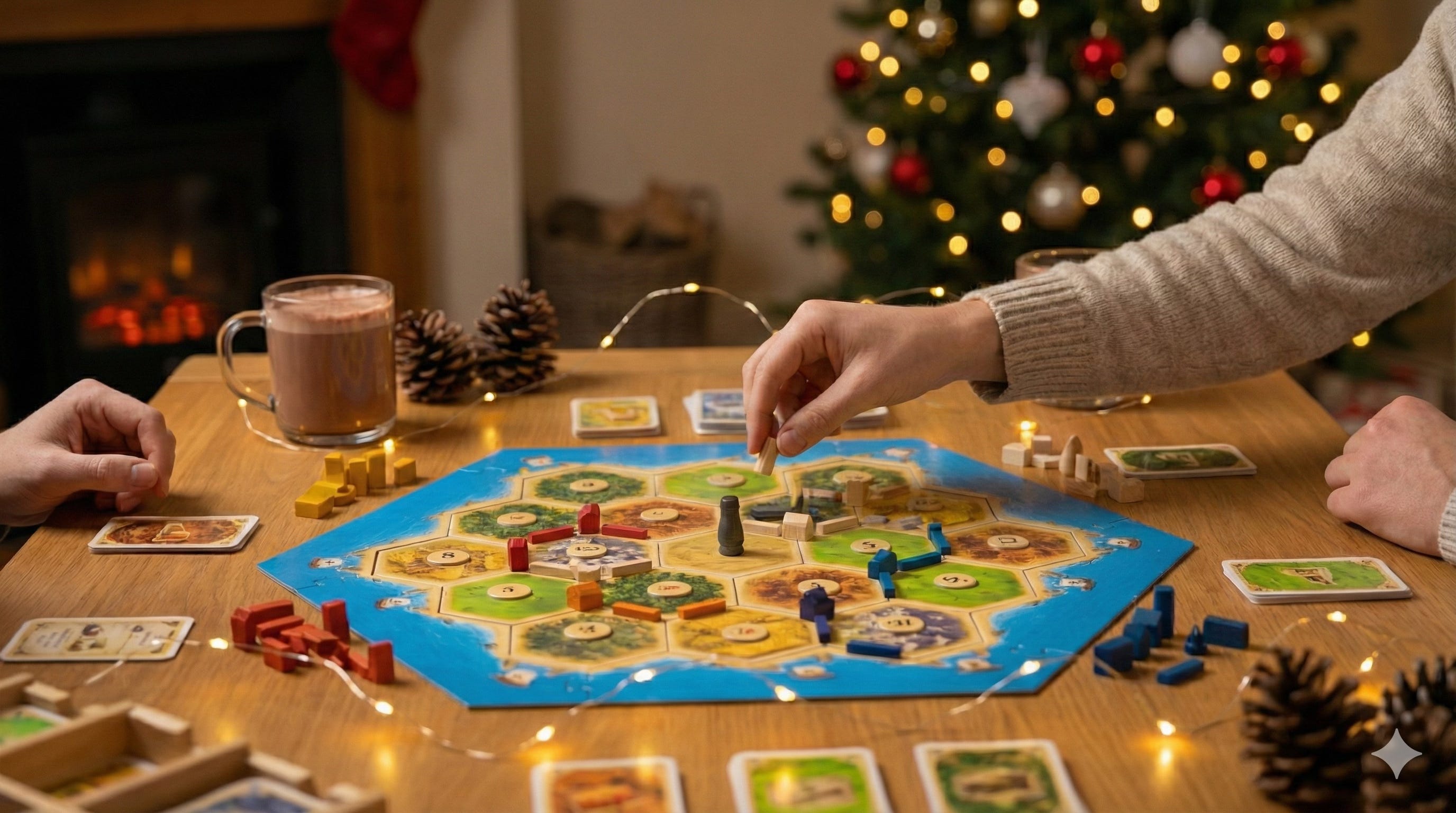
On Monday, we announced the Two Percent Holiday Screentime Challenge in partnership with the Clearspace app.
It’s free, and anyone can and should join. It’s designed to help you be more present with family over the holidays—while also nudging you to move your body. You’ll do pushups or squats to earn time on the apps you choose to limit.
After I posted the challenge, Two Percent reader Eric commented that he’d bought the board game Camel Up—featured in our recent Gear Not Stuff Holiday Gift Guide—and wrote:
I purchased Camel Up and played it as a family Saturday night - it was a great time! Thanks for the recommendation. We’re looking forward to many more family game nights while the kids are home from college. Best part - nobody had their phones out!
At first glance, these two topics—combating screentime and playing board games—may seem unrelated. They’re not.
Board games and habit-forming apps (the ones we’re limiting in the Screentime Challenge) leverage the exact same psychological machinery.
They both use gamification to grab and hold our attention.
But there’s a massive difference in how that gamification affects us over time.
Habit-forming apps use gamification to steal our time and attention, which they sell to advertisers. Like, “please watch these endless reels and clamor for likes and view counts to further the mission of Ram Trucks, Zoloft, and Doritos.”
There’s also no clear “end” to habit-forming apps. We can use them forever. Think: infinite scroll.
Board games use gamification to pull our attention into a shared activity. We sit face-to-face, socialize, laugh, and connect with other humans. And that improves our lives and health.
There’s also a clear endpoint to the game. When the game ends, it ends.
One form of gamification quietly degrades our lives. The other enriches them.
In today’s post, you’ll learn:
Why we’re attracted to gamification (knowing this will help you identify games you may not know you’re playing, and find the right games in life).
How gamification can be used harm us, make us sedentary, and drive us crazy.
10 ways to use gamification in a way that actually improves your life long term.
Some can improve our relationships and parenting.
Others improve our fitness and health.
Others can help us be more productive and make more money.
The result: You’ll use games to get ahead in life, rather than being played.
Shoutout to our partners
🚨 New partner alert: Montana Knife Company. I’ve been carrying MKC knives into the wilderness for a few years. They’re bombproof, razor sharp out of the box, and made in Montana. My everyday carry: The Mini Speedgoat 2.0. Check them out here and mention you heard about MKC from Two Percent.
GOREWEAR. I used GOREWEAR gear on a run this weekend. Specifically, the CONCURVE 2-in-1 Shorts. EASTER gets you 30% off your first GOREWEAR purchase. It’s pure Gear Not Stuff.
Maui Nui: Give the gift of good nutrition. Maui Nui’s gift sets are beautifully packaged and made from ethically sourced, nutrient-dense venison. Try the Stick Starter 6-Pack at $39 each. High-protein, low-calorie, and wildly clean.
Why games capture our attention
Quick warning: The next two sections are a bit heady and I’ve tried to boil the ideas down as much as possible.
But I think it’s important to understand why we like games in the first place, because that can help us:
Identify when we’re trapped in the wrong games (gamification as mental arsenic).
Help us find games that enhance our lives.
If you want a full dive into this topic, read chapter 6 of Scarcity Brain. (Or I can write a dedicated letter about it—just say the word.)
The philosopher Thi Nguyen, who I spoke to for the book, explained that we’re drawn to games because they give us clarity in a confusing world.
For most of human history, life was simpler: hunt or gather, succeed or fail, repeat. Today, we’re flooded with information and forced to make nonstop decisions—about health, work, relationships, parenting, etc—based on information we can’t fully understand or verify.
Like, how do you know you married the right person? Or took the right career path? Or ate the right food to avoid heart disease in 30 years? Or sent your kid to the right school.
That uncertainty is exhausting and stressful. A Nature Communications study found we actually find not knowing more stressful than bad news itself1. Hence the phrase: “Just get it over with.”
Games are the opposite.
They give us clear outcomes, rules, goals, and feedback. The outcome is uncertain during the play—e.g., Eric wonders if he’ll win Camel Up—but once the game ends, the result is unambiguous: You won, lost, scored X points.
“[Games capture us] with point systems that are incredibly narrow, incredibly simple, and incredibly crisp,” Nguyen told me.
Games give us a small world where we can manage and understand everything. We know exactly what we are doing and why. And when we’re done, we know exactly how well we have done.
That certainty and escape from the confusion of the real world is what makes games fun and satisfying.
But there is a dark side.
When we drag those gamified scoring systems into our real lives, they can stop being fun and start being dangerous. Researchers have a name for this specific trap, and once you see it, you might realize that it’s ruining your experience online, at work, and even in your hobbies.
In the rest of this letter, we’ll explore:
How to identify when you are trapped in a gamified loop that’s making you anxious, unproductive, and sedentary (and how to break out).
The specific psychological concept that explains why we obsess over “likes” and “views” even when they destroy the quality of our work and relationships.
10 games you can play to improve your family, fitness, work, and life rather than lose your relationships, attention, and health.
Keep reading with a 7-day free trial
Subscribe to Two Percent with Michael Easter to keep reading this post and get 7 days of free access to the full post archives.