


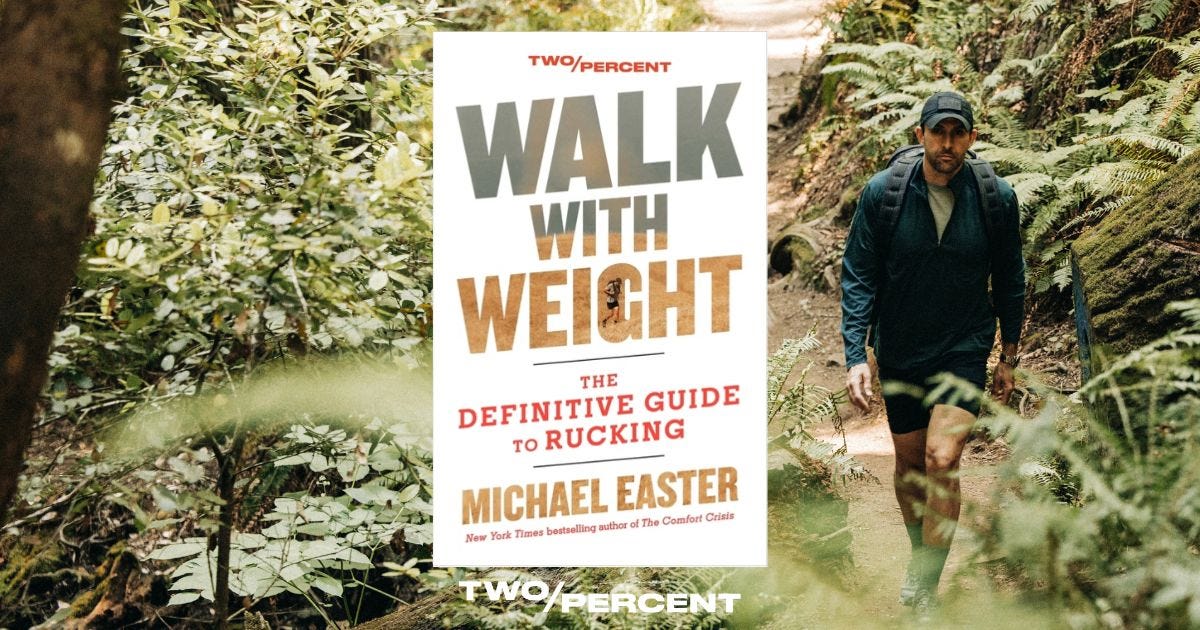
My guidebook to rucking—Walk With Weight: The Definitive Guide to Rucking—is out today in print, audio, and e-book. You can get it here.
This book is different than my last two books, The Comfort Crisis and Scarcity Brain. Those two books explored big ideas across an adventure narrative. This one is a tactical manual.
It covers why walking with weight is arguably the most powerful physical activity you can do, and gives you strategies and tactics to do it better—whether you’re new to rucking or have been doing it for years.
Why I wrote it
The book was born out of necessity.
Chapter 20 of The Comfort Crisis argued that carrying weight shaped human evolution and is our most important physical act—and that modern life engineered it out.
I suggested a simple fix: walk with weight in a pack. That’s an easy way to add carrying back into our lives to improve our fitness, health, and mindset.
After the book came out, I talked about walking with weight on many podcasts. The idea spread, and the act took off. The New York Times, Wall Street Journal, and more covered the rucking boom, crediting The Comfort Crisis for helping spark it.
Then the emails started. People from around the world began contacting me with questions.
I went deeper into the research. I spoke with military physiologists, anthropologists, physical therapists, and more. I tested everything myself.
When I told my publisher about the flood of questions I was getting, they suggested I do a manual for walking with weight.
The book is separated into three parts:
Part I: Why we should walk with weight.
Part II: How to walk with weight (strategies and tactics for all levels, gear considerations, nutrition, etc)
Part III: Live the practice (training plans, hacks, mindset, challenges)
In today’s post, I’ll run through the chapters and give you one practical and actionable takeaway from each.
A funny story: When I planned this book with my publisher, a higher-up asked, “Can you really write an entire book about walking with weight? It’s just one exercise.”
My answer: “There are thousands of books and hundreds of monthly magazines dedicated to running, and running is just one exercise. So, yeah, we have a lot of ground to cover.”
Let’s roll …
Quick housekeeping
In case you missed it:
On Wednesday, we covered a longevity tactic that actually works (and doesn’t suck the fun out of your life in the process).
On Friday, we ran a Q&A where I answered 9 of your questions. The one about the benefits of manual labor was my favorite (even Leah said, “that one was surprising”).
Shoutout to our partners:
Function Health, which offers 5x deeper insights into your health than typical bloodwork. You’ll learn critical information that can guide you into feeling better every day. It helped me identify a mineral insufficiency. Go to my page here to sign up, receive a discount, and pay just $340.
David Protein Bars have the highest amount of protein per calorie of all protein bars. That makes them a great option for anyone who wants protein on the go without the excess sugar and fat of most bars. Visit DavidProtein.com.
I’ve been carrying MKC knives into the wilderness for years. They’re bombproof, razor sharp out of the box, and made in Montana. My everyday carry: The Mini Speedgoat 2.0. Check them out here and mention you heard about MKC from Two Percent. MKC knives sell out quickly, but here’s what’s currently in stock.
Chapter 1: Born to carry
You’ve probably heard that humans are “born to run.” That idea came from a 2004 Nature paper1 and an ensuing book with that title. It set off a running boom, especially barefoot running.
But we missed something critical. In my research, I discovered we were missing another, more powerful evolutionary advantage beyond running: our ability to carry weight.
Running helped us hunt, but carrying helped us dominate and take over the world.
Once we ran an animal down, we’d have to carry it back to camp. We’re the only mammal that can pick up a weight and efficiently carry it a long distance. We also carried water, tools, gear, and our babies.
Walking with weight might be our greatest and arguably most unique physical feat—even more so than running. After all, many other mammals can beat us in a distance race on a cool day. None can out-carry us.
We carried constantly, and it shaped us into who we are. It’s critical for our health.
But today, it’s mostly been offloaded to technology. We have grocery carts, roller bags, cars, carts, and myriad other ways to transport items—and ourselves—more easily.
We outsourced the burden, and with it, a lot of our strength and health.
One lesson: Looking at what all humans did in the past is generally a good guide to what keeps us healthy today. In this case, the takeaway is simple: carry more.
Chapter 2: From carrying to walking with weight in packs
From ancient warriors to D-Day paratroopers, walking with weight has been the foundation of physical preparedness for warfighters.
But somewhere along the way, rucking got wrapped in boot-camp culture: Harder, heavier, faster.
That hasn’t always been a good thing. It’s why I started using the term “walk with weight2”—it makes the act accessible again.
This chapter traces how clever mothers thousands of years ago invented packs, and teaches us how the military has changed rucking—both the good and the bad.
Understanding this history tells us that we don’t need a death march. We need a weight we can carry consistently.
One lesson from the chapter: Find a “go-to” weight. One that feels uncomfortable but isn’t so heavy that the walk feels awful. For most people, that’s between 15 and 25% of their bodyweight.
Chapter 3: Lifespan and healthspan
Walking with weight is strength and cardio fused into one practice. Think of it as cardio for people who hate to run and strength for people who hate the gym.
It burns more calories per mile than walking or running, improves metabolic health, builds or maintains muscle and bone, improves balance, and has a far lower injury risk compared to running.
Its true power lies in its sustainability—you can do it for decades.
The key to living long and well is to find physical activities that engage as many critical systems as possible and don’t leave you injured along the way.
This chapter explores 11 ways walking with weight supports both lifespan (how long you live) and healthspan (how well you live).
One lesson from the chapter: If you’re trying to lose weight, walking with weight is one of the safest and most effective tools available. It burns more calories than lifting, but also works your muscles more than most endurance sports. It seems to preferentially burn fat—more weight loss coming from fat improves long-term health outcomes.
Chapter 4: Be SUPERMEDIUM
Modern culture tends to push extreme body types. Many people want to get waif thin like a runway model. Others want to be as muscular as possible, like a bodybuilder.
Both approaches have tradeoffs.
Having too little muscle is risky: A study of 50,000 Canadian women found that those most at risk of death registered a “healthy” BMI but had the lowest levels of lean muscle.
So is having too much muscle: It increases fat accumulation, slows you down, increases injury risk, and puts more stress on your organs and joints.
Walking with weight allows us to hit the sweet spot. We call this being SUPERMEDIUM: strong enough, lean enough, durable enough, and metabolically healthy enough to handle life and whatever it throws at you.
This chapter argues that loaded walking builds the kind of balanced fitness that makes you useful in the real world.
One lesson from the chapter: BMI often gets criticized, but it’s actually a useful metric for most people, most of the time. The takeaway is to be active—lift, ruck, and do other forms of endurance—and aim for a BMI that’s between 20 and 253. Most of the research suggests that’s the sweet spot for health and overall performance.
Chapter 5: How to start
This chapter hammers the fundamentals. It’s geared to people new to walking with weight, but those accustomed to it will also gain important insights.
It covers:
The pack or vest you should start with.
The types of weights you can use to load the pack.
The amount of weight you should start with.
How to load the pack.
How to adjust the straps.
The type of shoes you should wear.
The pace at which you should start walking.
What your posture should look like as you walk with weight.
How often and how far you should walk at first.
As my friend, the thriller writer Jack Carr, wrote, “Being an ‘expert’ in anything means doing the basics exceptionally well.”
One lesson from the chapter: The most common mistake beginners make is using the wrong weight. Here’s a generality backed by years of observation:
Women tend to go too light at first, which makes for a more enjoyable walk but also leads them to miss a lot of benefits.
Men try to be heroes, going too heavy too soon. This delivers more benefits, but it also makes the initial walks suck and overloads them before they’re ready.
A good starting weight: 10 to 15 percent of your bodyweight.
Chapter 6: Level up
Once you’ve mastered the basics outlined in Chapter 5, you’ll start to really experience the overall benefits, and you may be ready to level up.
Just like with any workout, there are myriad ways to improve your performance. This chapter covers:
Four ways to increase the intensity.
Why you probably shouldn’t run while wearing a weighted pack or vest.
The heaviest weight you should walk with.
The benefits of sternum straps and hip belts on backpacks and how to use them to your advantage.
The new science of goal setting.
Why you should make weighted walking as easy as possible.
Understanding or implementing each tactic will teach you to walk with weight stronger and faster so you can expand your health, fitness, and what you’re capable of.
One lesson from the chapter: The book includes sidebars throughout that answer common questions. A sidebar in this chapter examines the optimal number of daily steps. There’s uncertainty in the science, but looking at it in totality, here’s what I landed on:
7,500 steps a day: Bare minimum for general health.
12,000 steps a day: Ideal number for health. This number maximizes your benefits in the least time (health benefits start to drop off steeply after 12,000 steps).
Of course, if you add a pack, you’ll get more from every step.
Chapter 7: Support
Over the years, I’ve discovered numerous tips and strategies that help us walk with weight better. This chapter covers:
Hydration and dispelling myths around hydration.
Nutrition for your goal (e.g., performance versus weight loss, etc)
How to alleviate any shoulder discomfort when you walk with weight (the fix takes 30 seconds)
How to protect your knees and hips and avoid pain.
Exercises that bulletproof your back and prevent back pain.
How to avoid the most common rucking injury.
The little things often mean a lot. Thus, the chapter covers helpful advice that I believe can make your walks and workouts as effective as possible.
One lesson from the chapter: Some people face shoulder discomfort when they start rucking. I talked about this topic with Doug Kechijian, a Doctor of Physical Therapy, who is my favorite fitness thinker (hit him up if you live in the NY/CT/NJ area).
As long as you stay within smart weight recommendations, it’s unlikely you’ll injure your shoulders while rucking. “Most people are not really in true pain shoulder-wise after walking with a weighted pack,” Doug said. “It’s more like discomfort. This isn’t bad per se, and your body adapts. But it is fatiguing.”
His fix: Hang from a pullup bar for at least 30 seconds after your walk. The ruck compresses your shoulders, but hanging does the opposite. That relieves the discomfort and preps your shoulders for future walks.
Chapter 8: Packs, vests, and other gear
The question I get asked most often is some variation of “Should I use a backpack or a weighted vest?” It’s a great question. Over the years, I’ve seen more people out in my neighborhood carrying weight in packs and vests. It’s a beautiful thing.
When you’re just getting started and considering buying gear, however, it can be hard to decide which to use. As you may have guessed, I’ve done the research here, and my big takeaway for you is this: That you carry weight is far more important than how you carry it. Pick whatever you like most.
One lesson from the chapter: That said, for most people most of the time, a backpack wins. For one, you don’t have to go out and buy new gear—most people already have a pack lying around. For another, backpacks are more versatile. You can easily change the weight. You can carry items like water and a jacket. You can maintain better form on longer walks.
P.S. I have a big gear announcement coming soon …
Chapter 9: Adopt a Two Percent mindset
You all probably know why this Substack is called Two Percent: only 2 percent of people take the stairs when an escalator is available.
To me, that figure isn’t really about the stairs. It’s a metaphor for our current health crisis and how to live better. We often avoid the easiest wins, and it’s killing us. Inactivity is a main contributor to the 10 leading causes of early death. Yet 98 percent of us avoid the simple, obvious, healthy choice of taking the stairs.
This chapter explores many ways to apply the Two Percent mindset to rucking.
One lesson from the chapter: In a rucking survey I sent last year, many of you said wearing your packs around the house while doing chores was a game-changer. “It really got me used to the weight and allowed me to walk farther distances,” wrote one of you. I’ve done the same to prepare for big adventures—and it really helps.
Chapter 10: Challenge yourself
For thousands of years, militaries have used various tests to ensure their soldiers were fit for battle. This chapter lays out different challenges and shows you how to adapt them to your fitness level.
One lesson from the chapter: One of my favorite challenges is an old military standard. British soldiers in the 1600s had to be able to finish a 15-mile ruck (no stopping) at a moment’s notice. Meeting that standard suggested they were in fighting shape. The soldiers used rather heavy weights—but you can use your go-to weight. Being able to walk 15 miles at any time suggests your endurance is strong and your body is functioning well.
Chapter 11: Training plans
This chapter covers different fitness weekly plans for your goals and time. They fuse rucking and strength training so you’ll meet or exceed the federal activity guidelines.
The time-crunched plan: 3 hours a week.
The moderately busy plan: 4.5 hours a week.
The go-getter plan: 7 hours a week.
Each plan covers the basics you need to hit for health, performance, and general readiness (i.e., what you need to do to be a useful human) in the time you have.
One lesson from the chapter: The strength training sessions for the time-crunched plan only require your pack as a weight. A few pack exercises I love: Reverse lunges, stepups, pushups, planks, rows. I’ll sometimes walk to a destination, do a quick workout with my pack on, then walk back.
Epilogue: Lace up
To me, walking with weight isn’t some new wellness trend. It’s what humans were born to do. It’s scalable, forgiving, meditative, and powerful. It’s a return to being human.
Walking with weight is about reconnecting—with your body, your mind, and the ancient rhythms that have shaped humanity—and becoming a better person in the process.
I don’t think we need more comfort or hacks. We need more acts like walking with weight. More effort. More presence. More friction. More long miles under load. On the other side of that effort isn’t just fitness. It’s strength, clarity, and truth.
One lesson from the chapter: Don’t overthink it. Lace up your shoes. Grab a pack. Add weight. Start walking. Ideally soon. As the poet William Wordsworth said, “to begin, begin.”
Have fun, don’t die, walk with weight.
-Michael
Audio Version
Bramble, D., Lieberman, D. Endurance running and the evolution of Homo. Nature 432, 345–352 (2004). https://doi.org/10.1038/nature03052
FWIW, this was prompted by my mom. She read about rucking in The Comfort Crisis and became interested. Then she Googled rucking—and saw photos of burly soldiers with giant packs. Her reaction: this isn’t for me. The hardcore military framing prevents a lot of people from doing something really helpful (plus, rucking was invented by women!).
Of course, these are directionally correct numbers. It’s not like going from a BMI of 24 to 26 suddenly makes you unhealthy, and physical activity, diet, and other lifestyle factors all play a role in health outcomes. But all the data shows that the higher your BMI rises above 25, the greater your odds of developing disease.
Congratulations Michael!!! Can’t wait to read it!
Started on Audible today. Planning to add more rucking to my training. I really need to build strength and endurance for a September Inca Trail hike. The scariest part is the elevation, and endurance training is non negotiable.