

What Doesn't Come Easy Makes You Happy
Modern culture treats convenience as the ultimate prize, but a deep-seated psychological quirk shows effort creates meaning.

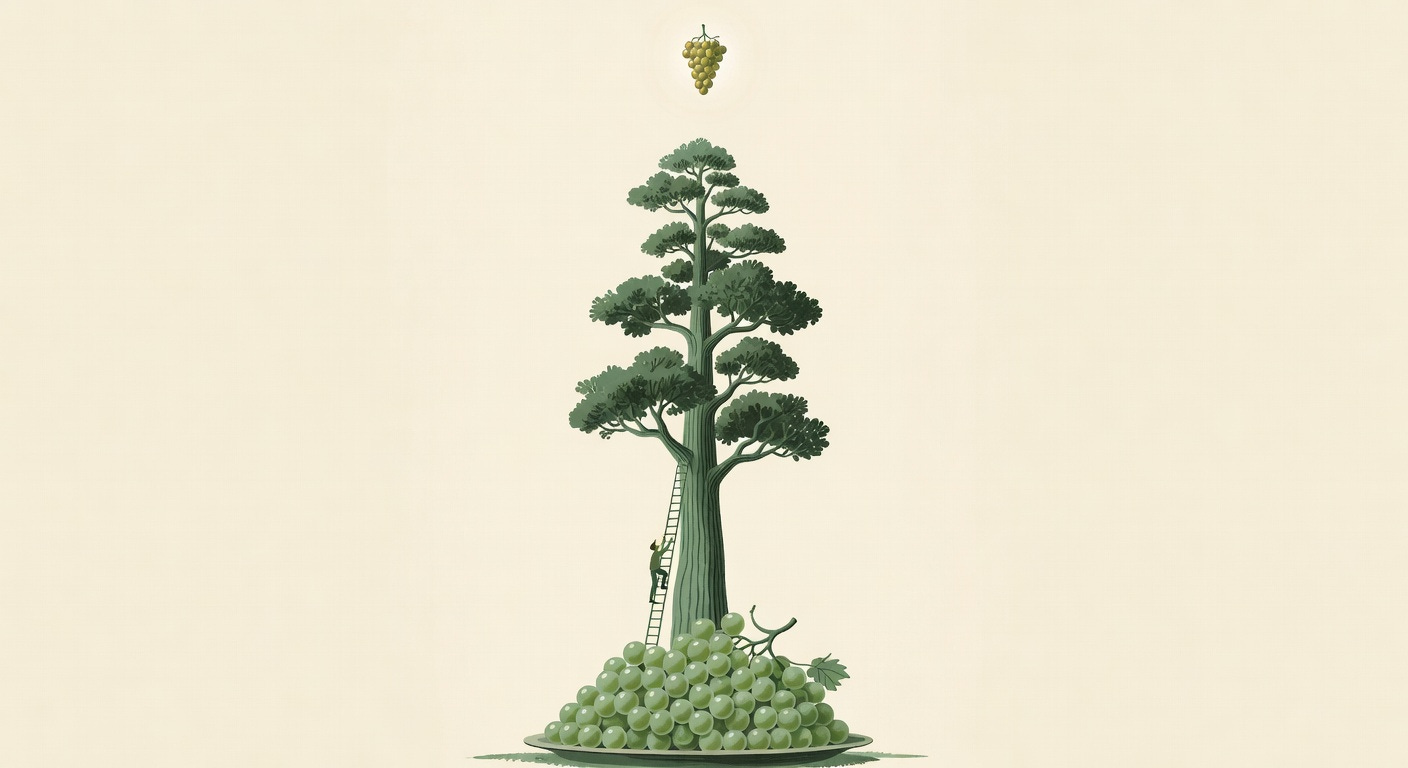
If you’re here, you’re probably one of the weird ones: A rare breed of human who takes the harder path. One of the 2% of people who take the stairs and apply that mindset to the rest of life, as the 98% move through life the easy way.
But, a question: Why are we like this?
The harder path clearly has health benefits. As we learned on Friday, something as basic as taking the stairs for just three minutes a week led to “15% and 13% reductions in risk of cardiovascular disease and all-cause mortality.”
But there’s something deeper to it. Turns out, the harder path is what makes life worth living. More interesting. More engaging. It gives us meaning we can’t find on life’s escalators.
Today’s post explores why. And it gives two concrete ways to leverage the power of one of psychology’s most interesting findings.
Quick housekeeping
In case you missed it:
On Wednesday, we covered how people under 50 should view longevity. It’s important, and not what gets the attention.
On Friday, we covered 3 quick travel workouts you can do anywhere. Research shows they work just as well as the longer stuff.
Podcast: Tuesday, two guests explored why you should GTFOutside and find an adventure. Thursday, Andy Galpin explained what he found while studying my physiology during my 850-mile hike. (Listen here; watch it here).
Shoutout to our partners:
🚨 Momentous rarely runs site wide sales—but they’re running one now. Save up to 40% during the Momentous Anniversary Sale. Every product is heavily tested for purity because Momentous has contracts with professional sports teams and the U.S. military. I use their Plant Protein Powder, Multivitamin, and Creatine daily.
🏃♀️ Janji makes the best endurance apparel—comfortable, durable, different. I wear Janji every outdoor workout. They’re the only brand making gear specifically for 200-plus-mile adventures—my favorite kind. The 7” Multi Short 2-in-1 is my go-to. Find Janji at Janji.com and at REI stores nationwide.
✈️ David Protein Bars have the highest amount of protein per calorie of all protein bars. That makes them the #1 option for anyone who wants protein on the go without excess sugar and fat. Visit DavidProtein.com.
Why friction matters (and why Leah screamed “that’s right motherf*ckers” and C-walked over the weekend)
To understand why we’re wired to need hard things, let’s start with this wacky anecdote pulled from a study:
When instant cake mixes were introduced in the 1950’s as part of a broader trend to simplify the life of the American housewife by minimizing manual labor, housewives were initially resistant: The mixes made cooking too easy, making their labor and skill seem undervalued. As a result, manufacturers changed the recipe to require adding an egg; while there are likely several reasons why this change led to greater subsequent adoption, infusing the task with labor appeared to be a crucial ingredient.
Consider that. People wouldn’t buy a cake mix that was too easy to prepare. It made the cake less valuable to the baker and the people who ate it.
These women instinctively felt that something was wrong with the frictionless option—even though the end product tasted exactly the same.
The feeling was right. Researchers from Harvard, Duke, and UC San Diego call it “The Ikea Effect.”
It tells us this: We value things far more when we have to put effort into getting them.
I thought of this over the weekend. We’d been having issues with some outdoor lighting. The landscapers had shown up twice. Told us they’d fixed it. Still, it wasn’t working.
“F*ck that,” Leah said and headed outside to the fuse box.
Twenty minutes later, in walks Leah, C-Walking like Ice Cube and shouting, “That’s right motherf*ckers. I fixed it.”
It took her time, effort, and a lot of head scratching. But she figured it out. And she was thrilled.
The result of her work—lights turning on and off when we want—is an everyday occurrence. But the fact she had to figure it out herself made it something bigger—far more powerful. Way more powerful than it would have been if the landscapers had fixed it.
The Ikea Effect
The researchers analyzed psychological work going back to the 1950s on a phenomenon called “effort justification.” They described1 it like this: “The more effort people put into some pursuit, the more they come to value it.”
It’s been proven across domains as different as psychotherapy and brainwashing. Even animals get a thrill from things that took more effort. As far back as 1957, scientists observed that “rats and starlings prefer sources of food which require effort to obtain.”2
But this new group of researchers added a critical point: Your labor actually has to be successful. If you work hard and fail, it sucks. Only when your effort pays off does it matter.
To land on this discovery, they ran two experiments3:
In experiment one, people either built a piece of Ikea furniture or were given a pre-built one. Then they were asked to name a price for it. The people who built it themselves valued it 63% more, even though it was the same furniture. This isn’t surprising. We figured that out in the 1950s.
In experiment two, another group built Ikea furniture. But the researchers stopped half of them from finishing, with just two more steps of building left. The people who were allowed to finish their build valued it 150% more. Even though the incomplete group had all the pieces and only needed to add about 30 more seconds of work to finish.
The conclusion: Finishing the hard task is essential.
Why we value what took work
Before we explain how to use this, a question: Why do we value what took effort so much more than an equivalent thing that took no effort?
While reporting Scarcity Brain, I spoke with the psychologist Thomas Zentall4. The guy is a legend—started his research in 1968, has discovered many breakthroughs, and still spends 60 hours in the lab in his 80s.
He pointed out that humans and other animals evolved searching the land for food every day. Sometimes the food was easy to find. Other times not.
Yet we evolved to value the hardest-to-find food far more than the easier-to-find, “even if it’s the exact same food,” Zentall said.
The reason: “That extra psychological value of the harder-to-find food encourages persistence and energizes us to keep looking in the future,” he said. If that food weren’t more rewarding, we’d be less likely to keep pushing and looking in the future—and starve.
“I think that is translated in the modern world in which humans value things they had to work longer and harder to get,” said Zentall.
Zentall gave me examples: It’s why the first real meal we have after, say, a backpacking trip or half-marathon tastes that much better. Why that first big promotion we received after years of hard work earning low income feels much more satisfying.
Or why, Zentall said, “My students who get an A in their most difficult class get much more excited about it than the A they get in the class they felt competent in. These two grades are worth the exact same for their grade point average, but they value the grades that were harder to get.”
How to Use It
1. Lean into friction
As I wrote in The Comfort Crisis, the world has become increasingly frictionless. We don’t physically work for food. We can take the escalator. We can use AI instead of actually reading a book or study. We can (insert thousands of other examples).
But the more we offload the struggle, the less we value the result. We learn less, grow less, and care less about what we’re doing. And the more malaise creeps in.
Apply that thinking to the fact that we don’t have to struggle to get most things anymore, and you can see why there’s a rising tide of meaninglessness sweeping across the country, despite us living in what is the most comfortable period in human history.
2. Don’t quit until the magic happens
The Ikea study advanced 60 years of research by finding that we have to complete what we put effort into for it to matter. If we quit, we don’t return to baseline—we often leave worse off.
When you’re working at something, don’t stop. Keep at it. Use all the tools at your disposal.
A CIA friend of mine told me that what separates agents who survive danger from those who don’t is the “every last bullet” mindset. If a CIA Operative gets ambushed or kidnapped and has to escape, those who force the enemy to use every last bullet because they fought like hell are more likely to escape and survive.
Apply the “every last bullet” mindset to the struggles in your own life. If you start a workout, finish it. If you take on a project and it gets hard, keep pushing. If you’ve got relationship problems, work them out.
The point isn’t to finish the workout or project or fix the problem. It’s to become the person who finishes stuff, because therein lies the treasure—and what makes life worth living.
In closing
Collectively, this study—and the 60 years of research leading up to it—is a reminder of why we do hard things.
Yes, we might be the weird ones. The staircases of life are lonely.
But when we get to the top, we find ourselves happier, healthier, and more fulfilled. Meanwhile, the 98% move up life’s escalators. Easily, comfortably, and viewing us as oddballs—all while wondering why their lives are so mid.
Put in the work. Use every last bullet. It’s the only good fight left.
Have fun, don’t die,
-Michael
Campbell AV, Wang Y, Inzlicht M. Experimental evidence that exerting effort increases meaning. Cognition. 2025 Apr;257:106065. doi: 10.1016/j.cognition.2025.106065. Epub 2025 Jan 23. PMID: 39854968.
Andrea M. Friedrich, Thomas R. Zentall, Pigeons shift their preference toward locations of food that take more effort to obtain, Behavioural Processes, Volume 67, Issue 3, 2004, Pages 405-415, ISSN 0376-6357.
Norton, M. I., Mochon, D., & Ariely, D. (2012). The IKEA effect: When labor leads to love. Journal of Consumer Psychology, 22(3), 453–460.
Yes. Yes. Yes. I did my first 10K Spartan Trail race last month. It was freaking hard and I hated parts of it. Now today I’m starting a trail running plan and have three races scheduled. I love your wife’s mentality. F that. I’m doing it.
This lesson got swallowed up by the optimization and minimum-effective-dose craze. I accidentally learned something interesting about fulfillment/joy and effort from engineering school. Efficiency equals What You Want divided by What You Put In (Desires / Payment)... living life I find the most joy from situations where I aimed for low efficiency... meaning I can level down my desires or conversely become more willing to put in more effort for the same output.
It runs counter to most mainstream narratives these days, but it works, I swear.