

What doesn't kill us ...
Problems can be a good thing.

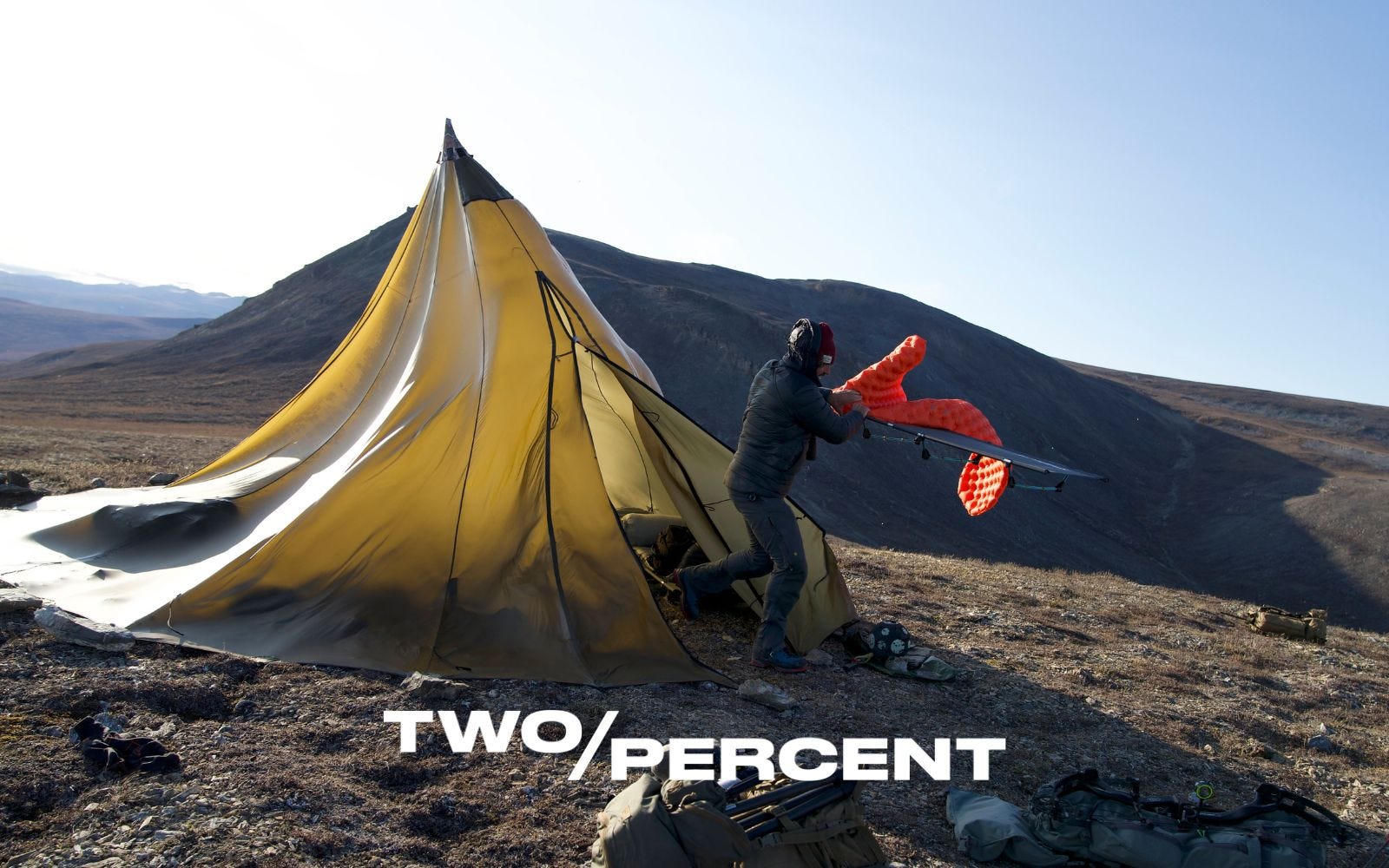
When my strange job puts me in challenging environments and situations—like the Arctic for 30+ days reporting The Comfort Crisis, or Iraq to investigate the drug trade for Scarcity Brain—I notice something interesting: I’m pretty chill afterwards. Stuff that used to stress me out doesn’t. I’m more grateful. I’m happier.
The effect is intense at first, like an afterglow. It eventually fades, but the lessons last in smaller ways forever.
I also see the opposite all the time. In my neighborhood, people who have everything they need but are rarely challenged lose their minds over mild inconveniences, like the trash being picked up late or a weed in another neighbor’s yard.
And so, doing the journalist thing, I’ve studied this phenomenon and talked to experts.
Psychology, for most of its history, was kind of like my neighbors. It assumed that more stress and adversity led to a greater risk of mental health problems. It was a depressing, linear relationship.
But this didn’t jive with the lived experience of millions of people who’d gone through hard things and, in retrospect, thought they’d grown.
And then a psychologist from the University of Buffalo went rogue. He began surveying Americans about their mental and physical health and the challenges they’d faced in life. He even set up lab experiments to test the idea in a controlled setting.
What he found is critical today—because we live in a world where fewer people face legitimate threats and challenges than ever before. And yet mental health issues are worse than they’ve ever been.
Today you’ll learn:
Why the long-held psychological belief that “all stress is bad” is backwards.
How a University of Buffalo researcher proved that a “perfect” sheltered life actually leads to worse physical and mental health.
The sweet spot of adversity we require to build a resilient, steel-trap mind, and why it works.
Quick housekeeping
In case you missed it:
On Wednesday, we looked at the 6 Rules of a Great Workout. Basically: how to build a great strength workout no matter your age, fitness level, or equipment.
Friday’s post was our monthly Q&A, where I answered 13 questions about exercising past age 75, whether we should eat less salt, the downsides of fitness trackers, training for big events when work gets busy, and more.
Shoutout to our partners:
Momentous made me feel good about supplements again. Here’s why I like them: Every single product is heavily tested for purity because Momentous has contracts with professional sports teams and the U.S. military. They also sell what works rather than offering a million fringe options that don’t offer benefits. I use Momentous’ Plant Protein Powder, Multivitamin, and Creatine daily.
The toughening theory
Mark Seery is a psychologist at the University of Buffalo who was always fascinated by the cliche, “What doesn’t kill us makes us stronger.”
Little quips like that seem to have a nugget of truth to them. But the thinking in psychology disagreed.
“The literature suggested that there was this clear, straightforward relationship where when a bad, stressful thing happens to you, it’s always bad, and you’re always dealing with adversity and negative consequences,” Seery told me. “And those events have some lingering damage. So this puts you at a greater risk of psychological and even physical health problems down the road. And it was just a very depressing picture.”
Then one day, Seery discovered research on a budding concept called “toughening.”
“It’s this theoretical idea that being completely overwhelmed by negative, stressful things wasn’t good,” he said. “But it also theorized that being totally sheltered shouldn’t be optimal, either. There should be some amount of stress that gives you optimum psychological and physical wellbeing.”
Psychologists at Stanford had already found this in animals. Monkeys who were occasionally separated from their families as babies grew up to be more resilient and capable in the real world compared to their siblings who spent their youth clinging to mom. They were the leaders, the doers.
Seery wondered if the same thing happened with humans.
He surveyed 2,500 Americans—from all ages, genders, races, and economic backgrounds—about the big stressors and challenges they’d faced in life. Like whether they’d faced illness or financial difficulty, death of a loved one, violence, floods, earthquakes, etc.
He also asked them about their health and wellbeing. Are you depressed or anxious? Are you sick or in pain? How often do you have to go to the doctor, and how many prescription pills do you take? Are you happy?
What Seery found1 imploded the existing literature—and confirmed his notion.
Compared to the people who’d been sheltered their entire lives, “the people who’d faced some adversity reported better psychological wellbeing over the several years of the study,” Seery told me. “They had higher life satisfaction and fewer psychological and physical symptoms. They were less likely to use prescription painkillers. They used healthcare services less. They were less likely to report their employment status as disabled.”
By facing some challenges but not an overwhelming amount, these people developed an internal strength that left them more robust and resilient. They were better able to deal with new stresses they hadn’t faced before, said Seery.
From survey to lab
Seery wanted to know if he’d see similar results in a controlled environment. He brought people into the lab and asked them how many trying events they’d had in their lives.
Then he had them stick their hand in a bucket of ice water and leave it there for as long as they could.
“The same relationship comes out,” said Seery. “People report that the pain feels less intense if they have a history of some lifetime adversity. Not a high level, but, critically, not zero. Their mind is also less likely to go to a bad place during the experience—they have fewer negative thoughts during and after the experience.”
He’s since done this with all kinds of stress-inducing tasks. He’s put people through exams, had them give speeches in front of a big group, etc. The findings are consistent.
“People who’ve gone through some adversity show a more positive response,” Seery told me. “They’re more likely to feel like stressful events are an exciting opportunity rather than feeling a sense of overwhelming dread.”
The sweet spot of stress
One of Seery’s key findings is that there’s a sweet spot. He wrote:
“People with a history of some lifetime adversity reported better mental health and wellbeing outcomes than not only people with a high history of adversity but also than people with no history of adversity.”
Think of stress and challenge as a U-shaped curve that looks like this:
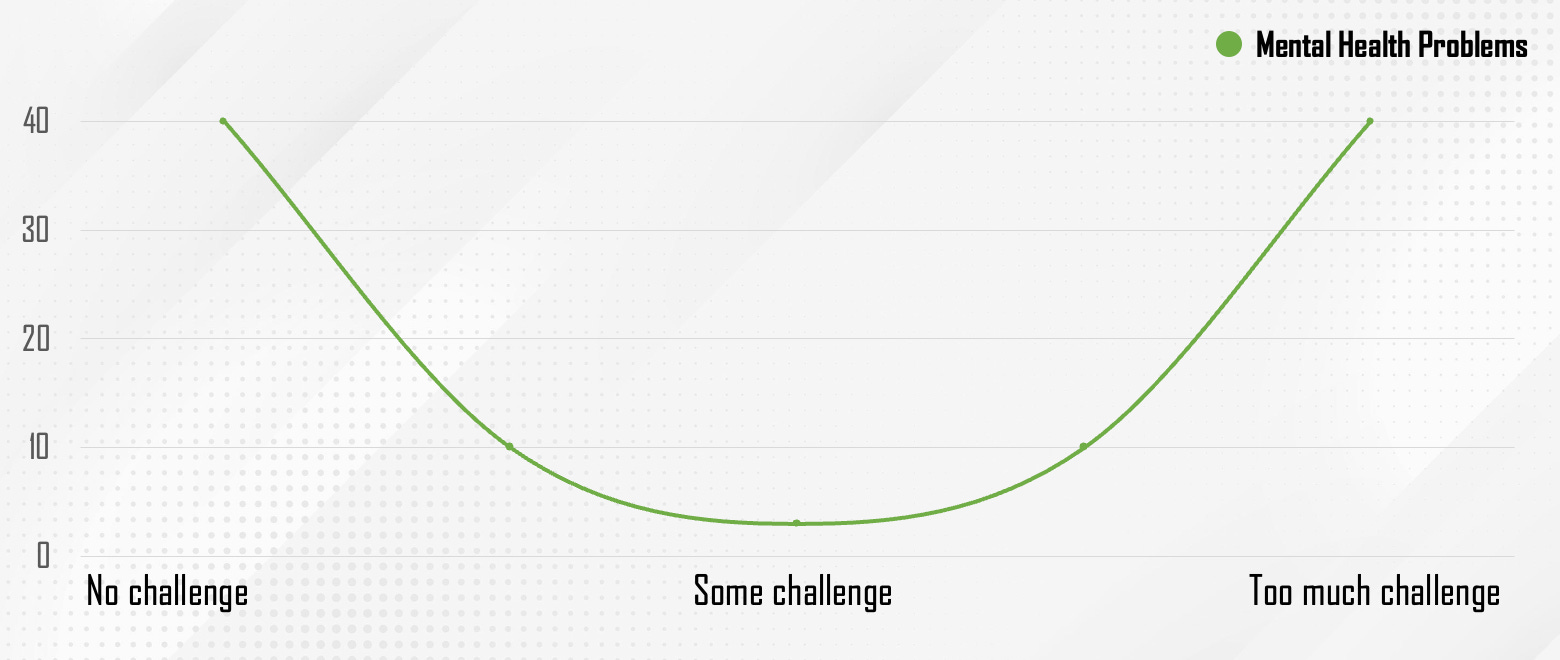
Seery told me to think about this like building fitness.
Your body needs the physical stress of running or lifting weights to build endurance or strength. If you never stress your body, you won’t build fitness, and you’ll be more at risk of physical and mental health issues.
At the same time, if you exercise too hard, too often, with little rest, you’ll get injured, and your physical and mental health will suffer for it.
Why it works
Here’s what Seery’s research—and subsequent research—thinks is happening.
1. We learn to cope
When you spend time in the storm, you learn certain facts about storms that help you weather the next one. And the next one. And so on.
The research2 suggests that navigating challenges teaches us coping skills and how to stay on course and not freak out when life goes sideways. We gain a greater sense of control and mastery over our future.
We’re more likely to reappraise future difficulties as manageable challenges rather than catastrophic or overwhelming threats.
2. We learn that our catastrophic beliefs are nonsense
Think of a time you faced a challenge that you thought was going to turn out terribly.
If it went better than expected—and if you’re still alive and reading this, it probably did—that might have taught you something.
Research3 shows that individuals who have faced some adversity are significantly less likely to engage in what they call “situational catastrophizing.” It’s when we fixate on a stressor and believe it will completely overwhelm us.
Because the catastrophe didn’t materialize, our beliefs were violated. In turn, we’re likely to remember that during our next challenge and not spin out into an anxious, sky-is-falling mess.
3. It changes our neurochemistry (maybe)
I’m always skeptical of “neurologizing,” which is reducing complex phenomena to simple explanations about the brain and its chemicals.
But it’s still worth noting: Some research hypothesizes that stress changes our neurochemistry in ways that help us.
When you face a manageable challenge, your brain releases chemicals that spur action. Each time you cope successfully, you reinforce problem-solving pathways—building mental strength the way practice builds muscle memory.
This is one reason why moderate stress is actually beneficial. Studies in animals who were given a medium dose of stress chemicals early in life later outperformed both low-stress and high-stress animals in problem-solving tasks.
This is also why researchers think that uncontrollable, overwhelming stress works the opposite way. The flood of heavy stress hormones may hurt key brain structures, a process closely linked to depression.
4. It’s like mental hygiene
The “hygiene hypothesis4” suggests that exposure to germs early in life helps the immune system develop. If we don’t get exposure, we’re more likely to develop allergies and other issues because our immune systems haven’t been “trained.” In turn, it begins to overreact to seemingly benign stuff (like peanuts).
Some researchers think stress may work the same way. If you have no adversity, you get no inoculation and become hypersensitive to it later on. New stress leads to a sort of overcorrection—and that increases your risk of mental health issues like depression.
Have fun, don’t die, find the upside of problems,
-Michael
P.S., on Wednesday, we’ll explore how to use the toughening theory in daily life.
Seery MD, Holman EA, Silver RC. Whatever does not kill us: cumulative lifetime adversity, vulnerability, and resilience. J Pers Soc Psychol. 2010 Dec;99(6):1025-41. doi: 10.1037/a0021344. PMID: 20939649.
Seery, M. D. (2011). Resilience: A silver lining to experiencing adverse life events? Current Directions in Psychological Science, 20(6), 390–394.
Liu RT. A developmentally informed perspective on the relation between stress and psychopathology: when the problem with stress is that there is not enough. J Abnorm Psychol. 2015 Feb;124(1):80-92. doi: 10.1037/abn0000043. PMID: 25688435; PMCID: PMC4332562.
Stiemsma LT, Reynolds LA, Turvey SE, Finlay BB. The hygiene hypothesis: current perspectives and future therapies. Immunotargets Ther. 2015 Jul 27;4:143-57. doi: 10.2147/ITT.S61528. PMID: 27471720; PMCID: PMC4918254.
“In my neighborhood, people who have everything they need but are rarely challenged lose their minds over mild inconveniences, like the trash being picked up late or a weed in another neighbor’s yard.” THIS IS SO TRUE.
Michael, thanks to you I have signed up for my first DEKA in July and my first camping / hiking trip in the Rockies this year. Against what most people say around me “that’s too difficult” ..” u won’t make it”. I’m training hard for it and it is already changing my life. Thanks for your work! God bless!