

10 Questions on Doing Hard Things
Brad Stulberg and I tackle what most people get wrong about discomfort, motivation, and meaningful struggle.


The space of health, performance, and wellness can be a broken radio. There is endless noise—hacks, secrets, protocols, 31 flavors—and increasingly little signal.
It’s always been this way; just look at the patent medicines of the 1800s, wacky diet books of the early 1900s, or the fitness and lifestyle magazines from ‘80s and ‘90.
The problem today is, the broken radio is now louder and has more channels. Social media and AI have intensified the noise.
Which brings us to today’s post.
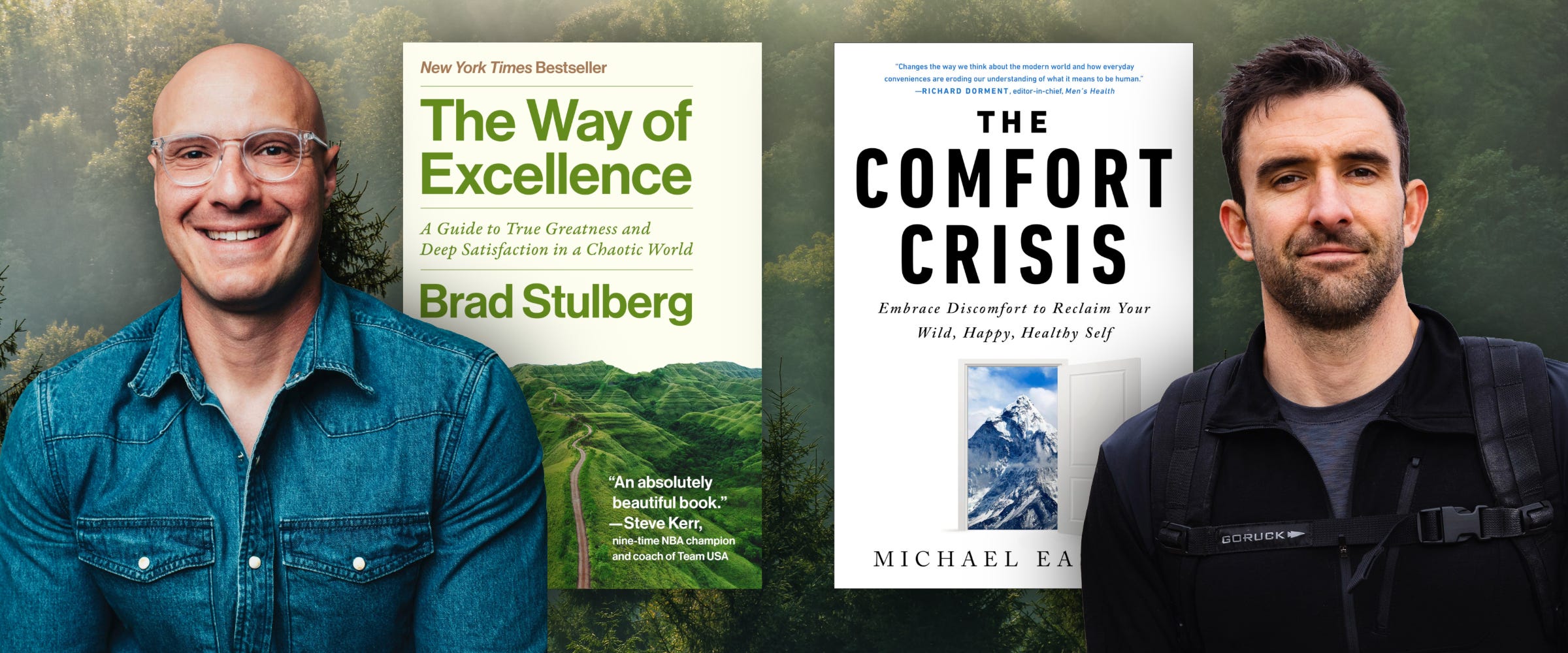
I was recently texting with Brad Stulberg, and we’d both observed that our work often gets mentioned together. Brad’s book, The Way of Excellence, came out earlier this year, and The Comfort Crisis over five years ago. But the books are very much in conversation, or so we’re told by readers. Brad had received a few messages:
Dude, The Way of Excellence is great! It goes perfectly with the Comfort Crisis!
I love these books because they are essentially guides for living well in a crazy world.
The Way of Excellence and The Comfort Crisis belong next to each other on every bookshelf.
I told my team Excellence and CC are required reading!
These are actual quotes from readers over just the past few weeks.
We were talking about this on Saturday, and I mentioned that we should do a joint Substack post. The idea was to lift that conversation off the page and tackle, together, some of the questions we’re most commonly asked.
What follows is that conversation, edited slightly for length and clarity.
Michael: P.S. Check out Brad’s Substack here.
Brad: And check out Michael’s Substack here.
10 Questions on Performance, Motivation, and Hard Things
What’s the Biggest Trap Most People Run Into with General Life Performance?
Brad: A lack of consistency. It’s never been easier to source information and ideas and habits and practices and protocols and on and on and on. As a result, it’s never been harder to stay consistent. When there are endless options for complexity and switching things up all the time, it becomes a shield against plain and simple accountability. It’s much more powerful to pick a few fundamentals and nail them day in and day out for a year than it is to chase the latest bright and shiny objects. The actual secret to greatness: Pick a thing. Pick a good system for your thing. Surround yourself with people who support you doing your thing. Do your thing for a decade.
Michael: Also—and this answer might be predictable, but it’s my best one—avoiding discomfort and quitting when things get hard. Anything that truly improves your life is going to be difficult—difficulty is the price of admission. If you avoid it, nothing changes. Humans are great at adapting to their surroundings. The problem is that we’ve built a world designed to make us the most comfortable species that has ever existed, and we’ve adapted to it completely. This has lowered our threshold for what counts as “hard” to the point that the slightest discomfort feels like an emergency. The good news: adaptation works both ways. Start doing hard things, and your threshold for what is hard and uncomfortable changes—and you change in the process.
What Do People Get Wrong About Doing Hard Things?
Brad: Two things. The first is that suffering for the sake of suffering is somehow valuable. It’s not! It’s actually quite dumb. What you want in your life is meaningful struggle. These are challenges that align with your values and goals and the person you want to become. Sure, for some people it’s a cold plunge. But for others, it’s training for a marathon. Or starting a company. Or adopting a dog. Or having a child. Don’t mimic other people. Find hard things that align with the qualities you want to develop. The second is that you can’t have fun, that you must be angry all the time. That’s nonsense! Having fun is one of the greatest competitive advantages there is. Intensity and joy can coexist, and in the best performers, they almost always do. I actually think the key to excellence could be boiled down to having fun while taking on meaningful challenges with good people.
Michael: Along those same lines, we assume hard things are always physical. They aren’t. The mental side can be even more impactful1. Ironically, we can get very comfortable in the hard things we like to do—so comfortable that they become a way to escape the real problem. For example, I know people who could run 100 miles without stopping, but they’d freak out if I asked them to sit alone with their thoughts for 10 minutes. Blaise Pascal said, “All of humanity’s problems stem from man’s inability to sit quietly in a room alone.” The takeaway, for me, has been to notice what I’m really avoiding. That’s usually the mental game—and in that space lies some of the most productive work.
What’s Your Take on Motivation?
Michael: I used to think motivation was some magical feeling that arrived spontaneously. So I’d wait around until I felt motivated—which got me exactly where I was. Then I talked to one of the world’s foremost behavioral scientists. He told me motivation isn’t a feeling. It’s the probability that you’ll take a certain action based on how much you value the result. For example, we become highly motivated to eat when we’re starving because food is extremely valuable at that moment. On the other hand, motivation to eat plummets after we leave a buffet because food has lost its value. So instead of waiting for the mystical feeling of motivation to arrive, a more useful question is, “How can I make this thing I’m trying to do more valuable?” His advice was to pair something you value with a habit that you struggle to do consistently. For example, I know that riding the spin bike gives me cardio without pounding my joints, which will help me trail better and longer. Yet I hate the spin bike—it holds zero appeal. But I do value watching Golden Knights hockey games. So I put a TV in my garage gym. When the Knights play, I watch while riding. The result: more spin bike workouts, better cardio, better joints. You can apply this to anything. Pair something you like with something you don’t. That raises the probability that you’ll do it. For example, listening to your favorite podcast only when walking, rewarding yourself with coffee only after you meditate, whatever.
Brad: I think that’s right. The phrase I’ve heard for what Michael is describing is “temptation bundling,” which I believe originated with the behavioral scientist Katy Milkman. I’ve also come to view motivation no different than any other emotion. It comes and goes. Sometimes this is a result of things within our control—the people with whom we surround ourselves; the books we read; the music we listen to—but other times it ebbs and flows on its own accord. When motivation is there, it’s incredible! Ride those waves. But when it’s not, don’t freak out. Just name it: Motivation is low today—that’s okay, let me get started and see what happens. So much research shows that we think action follows motivation but it’s actually the other way around; motivation follows action. I have pretty low motivation most mornings, to be honest. But once I get started on writing or my workout, I feel motivation returning. I call it activation energy. Some days I need more, some days I need less. Just get started and give yourself a chance.
Why Do You Think So Many People Read Your Books Together?
Brad: They circle around similar topics—essentially, how to live a good, high-performing, and perhaps even flourishing life—in a crazy and chaotic world that often feels rigged against us. We approach that topic from slightly different angles, but ultimately, the books are in conversation with each other trying to answer that question. I also think we both write (or at least we try) with a refreshing honesty. Something I’ve always appreciated about Michael is he is guided by the truth: not what is trendy, not what way the political winds are blowing, but what is true. I aspire to do the same in my work.
Michael: My guess is that Brad and I both appeal to readers with strong bullshit detectors. The self-help and performance space is built on books that make things easy and comfortable: three-step protocols, one-phrase rules, “the secret.” That approach can sell a lot of books, but life doesn’t work like that. Brad and I both do deep research and try to be honest about genuinely complicated topics. We’d rather give people answers that work—even if the reader has to work a bit to apply the answers in their life—rather than an easy quip that fails long-term. This is probably why Brad’s book The Way of Excellence is being read by a lot of professional sports teams.
What Do You Tell Someone Who Wants to Become More Confident?
Michael: Do something that scares you. Decades of research on exposure therapy show the best way to fix a specific anxiety is to face it. Avoiding it, on the other hand, makes it stronger. This is why I think the Misogi concept is so valuable. In Misogi, you take on one epic challenge a year, with a ~50/50 chance of finishing. That constraint forces you out of the safe zone. The task is legitimately hard enough to push you well out of your comfort zone, but not so hard that you blow up and fail miserably (which can actually backfire). You get out to your edge and realize you didn’t fall off it. Instead, the edge expands, and you grow to meet the terrain and change in the process. Humans have been doing some version of this for thousands of years—we used to call them rites of passage.
Brad: Yes! And give yourself the evidence! Self-belief only works if you have reason to believe it. Confidence comes from evidence. If you want to gain confidence about something you need to practice, accumulate the reps, and put in the work. It doesn’t mean you won’t still have some doubt (you will) but on the starting line—be it actual or metaphorical—you can remind yourself of your training. And then tell yourself to trust that training. This is true with a very particular task, such as running a marathon or writing a book or public speaking, but it’s also true for life as a whole. It’s the value of challenging yourself physically, intellectually, socially. You build a generalized sense of confidence, or what researchers call self-efficacy, across the board.
There’s All This Talk About the “Crisis of Masculinity.” What’s Your Take?
Brad: On average, men have more of the hormone testosterone than women. This is simply a fact. People think testosterone is associated with sex and aggression, but it’s actually most strongly associated with a drive for status. There are two broad paths to gain status: the first is via competence, respect, contribution, and belonging. The second is via rote power and domination. If men don’t see role models for the former, they become easy prey for grifters who sell them the latter. I think that explains a lot of what is happening. Men (and really, everyone!) need sources of mastery and mattering in our lives. We need to do real things in the real world with real people. We need to aspire toward intrinsic excellence. You can get mastery and mattering in work, in leisure, in volunteer coaching, in the gym—so many places. But where you don’t get mastery and mattering is watching some loser stream on the internet all day. So we need to show men (and again, everyone) a wide range of examples for how to attain mastery and mattering in their lives.
Michael: I’ll tread carefully here, because this topic has a way of inciting online mobs. I do think many men feel like something is missing. The world no longer requires many of the things that historically built male identity, like physical competence, navigating risk, and protecting and providing for others in a way that was real. There’s a vacuum, and a lot of bullshit has flooded in to fill it. Men searching for masculinity often find it through weird online groups telling them masculinity is found in their bank account, muscles, or a lifted truck or gun collection. It’s all symbolic—and it often doesn’t require the real work that builds competence and toughness. The most competent and toughest people I know earn it and don’t advertise it. The Special Forces guys who did the gnarliest missions are kind, thoughtful, and helpful. The outdoors people who’ve done the most extreme expeditions are goofy hippy dirtbags who don’t post online. In the past, you couldn’t fake competence and toughness. Everyone wore the same clothes, lived together, and knew what you’d actually done. Did you or did you not kill that tiger? We all knew, because you dragged its corpse back to camp. Today, you can fake it through online posts and purchases. That’s easier, but it can lead to misery. The answer is simple: Dudes need to go out and do real things—ideally things that help others—rather than display symbols of real things.
What Does Excellence Mean To You?
Michael: When I lived in a monastery with Benedictine Monks for my book Scarcity Brain, I came across a book written in the 1800s by an unnamed monk who lived in a cave alone for decades. One line hit me like a hammer: “You risk so much hesitating to fling yourself into the abyss.” To me, excellence is exactly that. Being willing to fling yourself into the abyss—entering the unknown and trying new things even when you feel unprepared, know you might look bad, and know you’ll stumble. And trusting that you’ll figure it out along the way. Today, it’s easier than ever to stand on the comfortable edge of the abyss and say no, wondering why nothing in life is changing.
Brad: Yeah, that’s exactly it. You have to be willing to step into the arena and actually care about something—it’s a prerequisite to excellence. It means throwing yourself into worthwhile projects and pursuits that align with your values and goals, and doing this in a way where you don’t just work on the goal but the goal also works on you, it shapes your character, the person you are becoming. The result is a sense of mastery and mattering in your life. Results absolutely matter; don’t listen to anyone who tells you otherwise. But it’s also true that there is no greater trap than thinking the accomplishment of some goal will change your inner life. What will change your inner life is the person you become along the way. Excellence is a philosophy of life that encompasses all of this.
The Comfort Crisis Has Been Out for 5 Years—What Do You Make of it Now?
Brad: Michael was right about everything and he was way ahead of his time? Haha! I’m not sure what else to say! I think we live in a bifurcated friction economy. Some people’s entire lives are full of needless friction—working three bullshit jobs just to get by, filling out forms for Medicaid all day, and so on. Their lives have very little comfort, but all the discomfort is useless and unnecessary. But there is also the other segment of the bifurcated friction economy: these are people whose days are characterized by ease and convenience. Order food, date, sell cars, buy cars, gamble, do everything with the click of a button. These people’s lives have little to no friction at all. As a result, life feels dull and empty. Michael saw this coming five years ago, and it’s only gotten worse since.
Michael: You are too kind, Brad. But, yeah, the book is probably more relevant now than when I published it. All technology is designed to make our lives easier—less physical work, less discomfort, less thinking. And technology only evolves, never devolves—so it’s ramped up significantly since 2021 (e.g., ChatGPT wasn’t around when I wrote that book). The Comfort Crisis is really about a mismatch between our evolutionary wiring and our technological environment. Humans evolved to seek comfort. We instinctually default to safety, shelter, warmth, extra food, and minimal effort. For all of history, that drive kept us alive in a genuinely hard world. Our common problem today is that our environment has changed, but our wiring hasn’t. Constantly seeking comfort in a comfortable world leads us to sit too much, eat too much, let a machine do our thinking for us, and avoid the experiences that make us healthiest and happiest.
“Agency” is Becoming a Buzzword. How Does Someone Exert It?
Michael: Agency is basically just the ability to act and see that your actions change things. For most of human history, it would have been absurd to ask whether someone exerted agency. We all lived in small groups and had roles where we could see, immediately, that our actions affected our environment and outcomes. Think: Finding food, keeping kids alive, etc. But today, agency isn’t so clear. Lots of jobs provide no clear outcome for employees—work goes into a black box for a corporation. We can also offload tasks to machines, so we don’t get evidence of our own capability. Many people also spend enormous energy engaging with problems they can’t solve: global politics, the economy, or other people’s behavior. That’s a reliable path to feeling helpless. The fastest way to build agency is to engage with problems you can solve, even small ones. When I spoke with researcher Leidy Klotz on my podcast, he pointed me to a nursing home study where residents given control over their rooms—like where to hang a photo, which plant to keep—were half as likely to be dead 18 months later compared to residents who couldn’t change their rooms. This suggests: 1. Agency is important; 2. We need to do more things where our actions have quick outcomes, and we see change. That could be growing a garden, exercise, building something, volunteering, whatever.
Brad: I think that’s all right. I also think discipline and agency go hand-in-hand. And not like a chest-thumping, machismo, look how tough I am version of discipline. But the ability to make choices that align with your goals and values and stick to them. I think so much of exerting agency comes down to choosing what is worth your time and energy and what is not, and then designing your own private little ecosystem to support those choices. What time do you go to bed? What apps do you have (and not have) on your phone? What people do you associate with? What books do you read? I guess what I’m saying is that in a world that is completely dys-evolved for flourishing, we need to create our own micro-environments that support flourishing. That’s what discipline means to me these days, and I think it’s the key to exerting agency. And there’s a reason I used the work skill above. Discipline is a muscle you build and it gets stronger with practice.
What Are The Habits That You Rely on Most, That Support Your Best Performance and Lives?
Brad: 60-90 minutes of exercise every day—which can range from a hard formal strength training session in the gym to a long walk with the dog. It all counts! Reading books—not on the internet, but actual books—for at least 30 minutes every day (usually first thing in the morning or in the evening when winding down). Setting aside an hour for deep-focus work. Not fighting evening sleepiness, which is to say, going to bed when I’m tired. Coaching my kids’ sports teams, which brings me more joy than nearly anything else. If I do those five things, I set myself up for success. Not every day is great, because of course. But it’s good enough.
Michael: Honestly? Not taking myself too damn seriously. I have a solid foundation of good habits: I write every day. I exercise and eat well. What saps my performance more than anything isn’t missing a workout or eating junk food or a bad night of sleep. It’s the stories I tell myself: Stressing about work and worrying over outcomes. As my readers know, I’m a big Deadhead. One of their singers once said: “ In eternity, nothing will be remembered of you. So why not just have fun?” I’ve found that approaching my life with that kind of lightness—treating it as something to enjoy and have fun with—has done more for my actual output and mental wellbeing than any other habit. If I miss a workout, the world keeps turning. If I misspell something in a Substackk post, life goes on. This is why I end each post with “have fun, don’t die.” It’s a reminder to me as much as it is to you.
Thanks so much for reading. If you haven’t yet, get the books. And read them! We promise they’ll help. Both are on sale.
Have fun, don’t die,
Michael and Brad Stulberg
I think I undervalued the mental side in The Comfort Crisis, which is why I’m writing a new book that comes out in March of 2027.
 | A guest post by
|
1. I need to read The Comfort Crisis again.
2. I need to buy The Way of Excellence and read it.
3. I like how (and where) you misspelled Substackk…nice!
Great post with things to ponder while I meditate for more than 10 minutes in a quiet room.
Thank you for putting this together. I am the director of our local EMS system and I frequently discuss the importance of mental and physical health. The team responds to numerous 911 calls that are often very challenging and have lasting effects. I try to get them to understand, if they don’t take care of themselves first, they will not be able to continue in this field very long. Keep up the great work.