

1,000 Ways to Get Disconnected
How the comfort and convenience of modern life is driving up loneliness and hurting our health

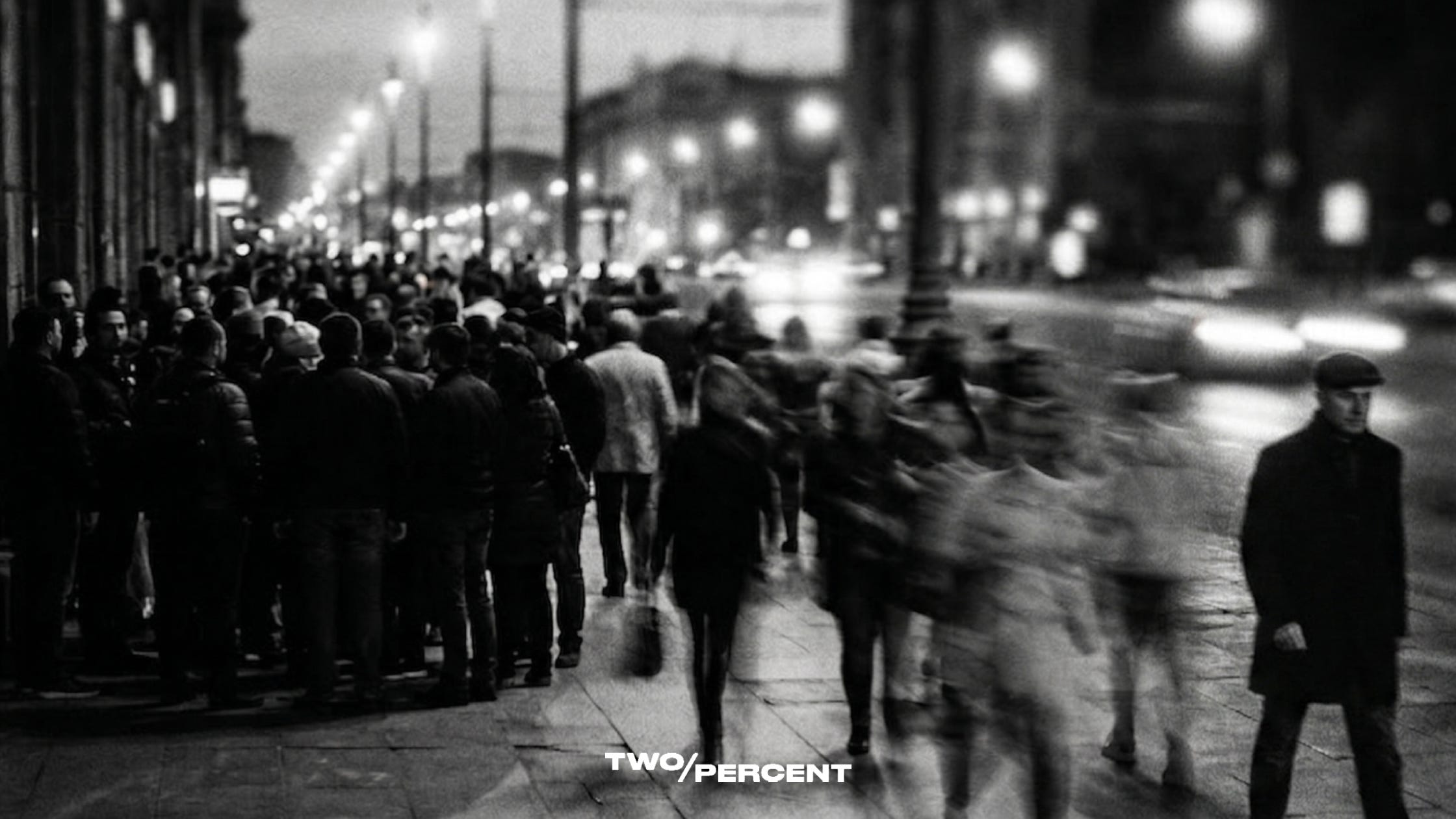
“I mingle with my peers or no one, and since I have no peers, I mingle with no one.” -Ignatius J. Reilly, A Confederacy of Dunces
The Two Percent podcast is out now (and we have a great episode coming tomorrow).
I started building the project about six months ago. Unlike my books and this newsletter, the podcast is not a solitary endeavor.
I work with a core team of about five people. And I’ve noticed something: daily interactions with the team have lifted my spirits and made me mildly less insane.
Becoming slightly more sane might be bad for my books (it takes a certain amount of madness to write a decent book). But I recently finished my next book, so I’m calling this a win.
We’ve all heard that people are lonelier, and that loneliness is bad for health. But numbers are useful to understand the trend and its impacts. The World Health Organization1 and US Surgeon General2 both recently released reports finding:
In the US, time spent alone increased by 24 hours per month over the last two decades.
In-person time with friends also dropped 20 hours a month.
Time spent with friends among people aged 15-24 dropped 70%.
A few of the health impacts:
Socially connected people tend to live significantly longer.
Loneliness and social isolation increase the risk for premature death by 26% and 29%, respectively.
Poor social relationships are associated with a 29% increased risk of heart disease and a 32% increased risk of stroke.
Chronic loneliness and social isolation can increase the risk of developing dementia by approximately 50% in older adults
The odds of developing depression are more than double for adults who report feeling lonely often compared to those who rarely feel lonely.
We tend to treat loneliness as a personal failing—like we need to get out more, call a friend, join a club, etc. That advice is good, but it misses a much larger phenomenon.
On a long walk last week, I listened to Chuck Klosterman on The Bill Simmons Podcast3. Toward the end of the conversation, Klosterman casually mentioned how a minor shift in sports broadcasting has reduced conversations with strangers. It was a unnoticed shift with a real cost.
Once you start looking, you see this everywhere. Thousands of technological and societal shifts have reduced the interactions we have with others. We adopted each advance because it made our lives more comfortable and convenient. But they’ve collectively eaten away at the small, everyday connections we used to take for granted.
That’s what today’s post is about: A list of ways we’re interacting with others less. And it just scratches the surface.
In most Two Percent posts, I give practical takeaways. But I’m not going to be prescriptive. I’ll just point out the change, and you can judge it for yourself.
Many of these shifts are reversible. You can alter your behavior to find more human contact.
Some we’re stuck with. As the French philosopher Jacques Ellul observed in his 1954 book, The Technological Society, most technologies develop as simple conveniences. But they often reach a point of mass adoption that makes it impossible to live without them, for better or worse.
Quick housekeeping
In case you missed it:
On Wednesday, we looked at a wild new study on a 269-mile endurance event and five lessons it can give us on performance.
Friday’s Gear Not Stuff looked at the top running gear recommended by elite coaches, runners, and doctors.
Check out our partners:
Maui Nui Venison, the healthiest meat on planet Earth. The research on axis deer is incredible, and Maui Nui might be the only company harvesting meat ethically. I’m a massive fan of their venison jerky sticks, and right now, Maui Nui is offering a free 6-pack of their venison jerky sticks with your first order. Go to here to grab yours.
David Protein Bars have the highest amount of protein per calorie of all protein bars. That makes them a great option for anyone who wants protein on the go without the excess sugar and fat of most bars. Visit DavidProtein.com.
Do epic endurance feats with Janji, an independent running brand making gear built for ultra-distance pursuits. They’re the only brand making gear specifically for 200-plus-mile adventures—my favorite kind. The 7” Multi Short 2-in-1 is my go-to running short. Find Janji at Janji.com and at REI stores nationwide.
Societal Changes
Drinking and bar attendance are down. Local pubs used to be important third spaces in communities where people would gather and talk. More on that here.
Attendance in organizations like Elks, Rotary, and Boy and Girl Scouts is down. In 1970, for example, there were 6 million Boy Scouts. Today, there are 1 million scouts (note: in 1970 the population in the U.S. was 200 million, whereas now it’s 340 million).
Similarly, unions are also down. They typically had community gathering spaces and a strong sense of community. In 1950, about 35% of workers were union members. That figure is now ~10%4.
Membership in a church, synagogue, or mosque dropped from 70% in 1999 to 47% in 20205.
People move out of their hometowns far more often. This has made it harder to develop deep bonds. (E.g., I’ve lived in 6 different states).
People are having fewer kids, leading to fewer in-person interactions and weaker social networks.
Air conditioning led people to spend more time inside rather than outside in their neighborhoods during the summer.
Homes are now designed with fewer street-facing front porches and more private back patios and yards.
Kids now play outside less often, and supervised, pre-scheduled play has replaced longer-duration spontaneous neighborhood play.
Smoking is down. This is obviously a net win for health. Still, people did converse with strangers more when smoking outside, bumming a cigarette, etc.
Cars have reduced the use of public transit and walking to get places.
Family dinners are on the decline for a variety of reasons.
A significant amount of education has shifted online.
Commerce
Goods are now replaceable. Instead of fixing things—which would require hiring and interacting with a tailor, cobbler, or repair person—we buy a new one.
We can buy pretty much anything online, rather than in a store with other people around.
Then, to return the purchases we don’t want, we print a label and drop a box into a mail bin rather than going back to the store and interacting with a clerk.
ATMs and mobile banking replaced visiting the bank teller.
Online bill paying replaced trips to offices.
Gas pumps no longer have attendants we’d chat with (unless you live in New Jersey).
Screen-based food ordering is now replacing in-person or phone ordering. E.g., apps let us avoid interacting with a restaurant worker to order or pick up food. And I recently visited a McDonald’s where I literally couldn’t order with a human. I had to use the ordering screen.
Online reservations replaced either calling the restaurant or showing up and waiting with others for a table.
Ticket kiosks replaced clerks at movie theaters, airports, train stations, museums, etc.
Grocery store self-checkout has killed chats with checkout clerks (my grandfather was the ultimate checkout clerk chatter).
Streaming has replaced going to the movies, waiting in line for a new record, or walking the aisle of Blockbuster with others (I miss Blockbuster).
Gaming is now online. This includes everything from betting on sports (which once required going to a casino or bookie) to video games. When I was a kid, if I wanted to play video games with a friend, that friend had to come to my house. Now it happens online. Arcades are now a novelty.
Getting tickets to events is now done online. (I also miss standing in line for concert tickets and speaking with other fans.)
StubHub and SeatGeek replaced buying secondary-market tickets from weird street-corner scalpers or newspaper ads where we’d have to meet up with the ticket seller.
Hotel check-in kiosks and mobile room keys replaced interactions with hotel clerks.
Drive-throughs—invented in the late 1940s—dropped interactions with workers at fast-food joints, banks, pharmacies, etc. It also dropped our interactions with other patrons.
Many customer service reps are now bots (no matter how many times you say “representative”).
Appointments for a haircut, medical or dental check-up, etc. are now made online rather than speaking to a receptionist.
Toll roads are now managed by EZPass rather than toll booth attendants.
Telehealth replaced in-person doctor visits—we no longer sit in a waiting room with other patients.
Mental health apps—ranging from Calm and Headspace to BetterHelp—are replacing community-based and in-person mental health support.
Venmo, Zelle, etc. eliminated the need to pay someone back in person and the brief exchange that came with it.
Information, Recommendations, and How-To
GPS killed asking a stranger for directions. Remember when the line, “men never ask for directions,” was relevant and funny because it was true? That joke doesn’t make sense anymore.
Online reviews replaced asking a friend or neighbor for a good babysitter, landscaper, restaurant, handyman, etc, etc, etc.
Online recommendations replaced asking a friend or an employee at the record store, bookstore, Blockbuster, etc, for a good album, book, or movie.
In that same vein, many jobs, such as travel agents and other knowledgeable store clerks, have declined.
YouTube videos and AI replaced asking a handy friend or family member how to fix something.
Google and AI have replaced asking a friend for information. Remember when you’d be at dinner and a dumb question popped into your head—“What song is this?” “How old is Ben Affleck?”—and you’d have to guess or ask someone? Now we just Google it.
Librarians were once like search engines, and libraries were community hubs. They’re now facing a “quiet crisis,” according to Publisher’s Weekly6.
Digital Work
A mass shift to remote work has led to fewer in-person interactions in the office.
But even in non-remote offices, there are fewer in-person interactions. E.g., Email and Slack replaced walking down the hall or picking up the phone to ask a co-worker or (insert anyone) a question.
Commutes on public transit were a pain in the butt, but we’d see the same strangers every day and often chat with them.
The work lunch hour was once a daily communal moment for many. Now, eating at our desks alone is far more common.
Many tasks are mechanized rather than done by groups of humans. For example, farming, factory work, etc.
Communication
Phones replaced more social ways to deal with boredom. For example, while waiting in line, at the doctor’s office, or on a flight, everyone is now on their phone. Because of this, chatting strangers happens less often.
Headphones and earbuds have become the universal signal of “do not talk to me.” Earbuds are particularly pervasive because they’re so portable.
Texting and email have led to a reduction in voice calls.
Personal cell phones reduced speaking to people other than the person you called to talk to. E.g., When I’d call my best friend as a kid, his grandma would usually answer, and I’d talk to her for a couple of minutes before she handed over the phone.
Group chats and social networking sites reduced the need to speak to others to get information. E.g., Facebook groups and sites like Nextdoor replaced having to meet with or call people to share information about a relevant topic.
Dating apps replaced having to go out into the world to meet people or meeting via an introduction from a friend or family member.
Canceling plans is now easier. Before cell phones and the internet, if you agreed to meet a person somewhere, you were more likely to show up, because there was no easy way to cancel. Now we can call or text the person and cancel 20 minutes before.
Insert Thousands of Other Examples
We could go on for days. The more you look, the more you see.
Back to that thing Klosterman observed: televised sporting events used to not post the game score at all times. It would flash randomly. But now, the score is always on screen. Klosterman said:
It used to be if you walked into a bar and the game was on, you’d have something to talk about with [another] person right away. You’d be like, ‘What’s the score here?’ They would tell you. Then you could tell if the person wanted to talk more because they’d be like, ‘Oh, it’s 21-14, but Steve Barkowski is hurt,’ or whatever. [That signaled the other person] wanted to talk ... You now have no reason to speak to the person.
Have fun, don’t die, what’s the score?
-Michael
World Health Organization. (2025). From loneliness to social connection: Charting a path to healthier societies: Report of the WHO Commission on Social Connection.
Office of the Surgeon General. (2023). Our epidemic of loneliness and isolation: The U.S. Surgeon General’s advisory on the healing effects of social connection and community. U.S. Department of Health and Human Services.
Romero, P. D., & Whittaker, J. M. (2023, June 16). A brief examination of union membership data (CRS Report No. R47596). Congressional Research Service. Congress.gov.
Office of the Surgeon General. (2023). Our epidemic of loneliness and isolation: The U.S. Surgeon General’s advisory on the healing effects of social connection and community. U.S. Department of Health and Human Services.
Jim Milliot. (2024, October 22). The quiet crisis facing U.S. public libraries. Publishers Weekly.
This really speaks to my micro-rant of advocating for everyone to once again participate in society. Like, in very simple and enjoyable ways. Eat at restaurants instead of getting half-cooled no-contact delivery that costs $12 more in fees. Go to movie theaters instead of streaming on your home set-up with such bad sound that you have to turn on subtitles to understand the dialogue. Volunteer to improve something small but tangible in your community, instead of complaining about it in your neighborhood Facebook group/NextDoor forum/instagram comment thread.
It's interesting the point on recommendations, certainly here in the UK staff at Waterstones,a big book chain, always seem to be recommending stuff at the till based on what I'm buying. Yes sometimes it's the "book of the month" but a lot of times it's something interesting, makes for a nice little micro conversation