

Don't Die: Do Pullups Part I
Why pullups are powerful and how to get your first one.

Last month, we explored why stepups are such a great exercise.
Today we’re doing the same for pullups.
There isn’t a study that’s tracked how many Americans can do at least one pullup—some info suggests roughly 17% of adult men and fewer than 5% of adult women can manage one rep. But it’s safe to say two things:
Most Americans can’t do a pullup.
We’d all be healthier if we could do even just one.
There are many reasons why building the ability to do even one pullup can make us healthier, and there are also plenty of misconceptions about who can and cannot do pullups.
Today You’ll Learn
Four reasons why the pullup is such a powerful exercise.
Why women can and should do pullups (plus a long-standing personal vendetta I have against the New York Times Well section)
How to do your first pullup. (If you can already do one, these tips are a good reminder of the basics).
This is Part I of a two-part series on pullups. Part II drops on Wednesday.
Quick Housekeeping
In case you missed it:
On the podcast, we had two episodes. We talked to Donnie Vincent from The Comfort Crisis, and covered marathon training and some surprising upsides of ultraprocessed food. Listen here.
On Wednesday, we covered why getting comfortable being alone is as important as human connection, and 8 ways to embrace solitude.
Friday’s Expedition covered 25 new ideas to enhance your life, including failures of longevity drugs, controversies in medicine, and exercise tips.
Shoutout to our partners:
Run or ruck far as hell with Janji, an independent running brand making gear built for ultra-distance pursuits. They’re the only brand making gear specifically for 200-plus-mile adventures—my favorite kind. The 7” Multi Short 2-in-1 is my go-to. Find Janji at Janji.com and at REI stores nationwide.
David Protein Bars have the highest amount of protein per calorie of all protein bars. That makes them a great option for anyone who wants protein on the go without the excess sugar and fat of most bars. Visit DavidProtein.com.
Momentous made me feel good about supplements again. Every single product is heavily tested for purity because Momentous has contracts with professional sports teams and the U.S. military. They also sell what works rather than offering a million fringe options that don’t offer benefits. I use Momentous’ Plant Protein Powder, Multivitamin, and Creatine daily.
Four Benefits of Pullups
1. Pullups are a “body fat test without the dishonor of a skin caliper”
That line is from Pavel Tsatsouline, the Russian trainer who popularized Kettlebells in the US. His point is that it’s hard to do pullups if you’re carrying excess body fat.
The more fat you have, the more you have to lift. Fat doesn’t pull you up, it drags you down.
Doing even one pullup suggests you have a healthy amount of body fat. A review1 in The International Journal of Obesity found that people with high body fat percentages were more likely to die due to any cause.
2. Pullups prove you’re strong for your weight—a key to not breaking Rule 2
Having enough strength and muscle for your body weight increases your odds of living a longer and healthier life.
Those most at risk of death often aren’t the heaviest people in the room. Rather, they’re “normal weight” but have the lowest levels of lean muscle. More on that below.
3. Pullups strengthen your grip
Even just hanging from a pullup bar builds your grip. And grip strength is important.
A massive study in The Lancet2 found that grip strength is one of the best predictors of longevity. The scientists wrote, “Grip strength was a stronger predictor of all-cause and cardiovascular mortality than systolic blood pressure.”
That’s worth pondering. Grip strength may be a more powerful metric than one of medicine’s most-watched vital signs.
It’s not that grip itself is magic. Rather, it’s a proxy for strength and activity. My takeaway: Be strong for your size and do exercises that have a high return on total-body strength. Like pullups.
4. Pullups can decrease pain
Many of us spend hours hunched over a screen, shoulders rounding forward. Over time, that can pull our heads and shoulders forward, which can alter the mechanics of our shoulder blades and increase the stress on our necks and shoulders, leading to pain.
Pullups help strengthen our upper-back and shoulder muscles, which can help fix the problem. Even just hanging from a bar can relieve some pain and make us less at risk of injury when we lift overhead.
That all said, there are a lot of misconceptions about pullups. Which brings us to the next section:
Yes, women can and should do pullups
Few stories have annoyed me more than a 2012 New York Times story with the headline, “Why Women Can’t Do Pullups.” Receipts:
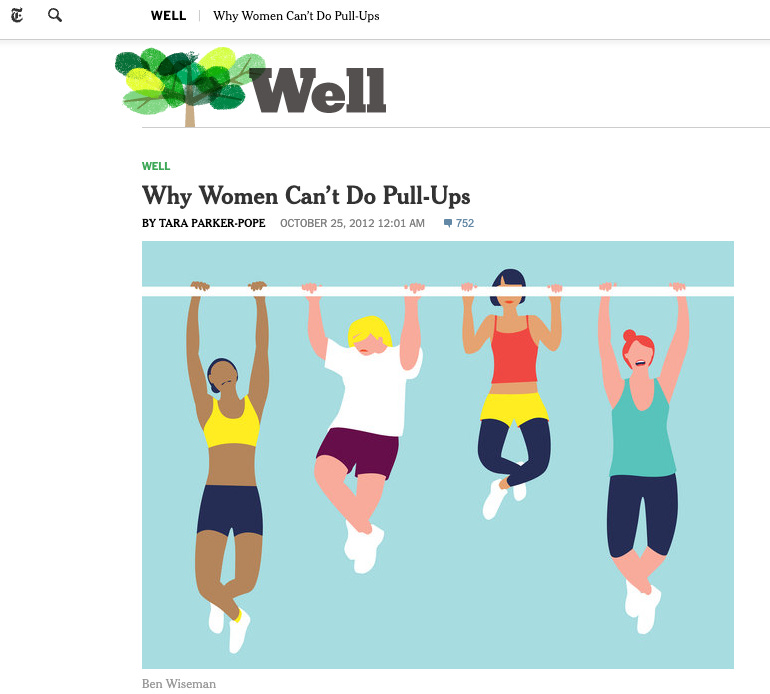
There are some physical tasks were—all things equal—most men will outperform women and others where women may have an edge. This is likely due to a mix of anatomical, biological, and cultural reasons.
But women can do pullups. Exhibit A:
Melissa Urban doing some really hard, purposefully-slow pullups.
Former Women’s Health Editor-In-Chief Liz Plosser doing 10(!) pullups.
I could blast out thousands more video links, but you get the point.
Notably, women may be better served than men by focusing on pullups, because the movement requires upper body strength, which women seem to be more likely to neglect.
One in five women3 over 60 suffer from dangerously low levels of muscle.
On top of that, a recent study4 of nearly 50,000 Canadian women aged 40 and older. It found that women at the highest risk of death had a “healthy” BMI but the lowest levels of lean muscle. The women with the least amount of muscle were, in fact, more likely to die compared to women with excess fat.
Again: The attempt makes us healthier.
How to do your first pullup
The more body fat you have, the harder pullups become.
If you have a high amount of body fat, start here to get your first pullup:
Focus on losing fat and doing exercises 1a and 1b (below) to start.
Big bonus: Do all kinds of other strength training as you lose weight—whatever you can do. As you lose weight, this will help you get rid of more fat than muscle, which improves your health far more.
(Looking for a good weight loss coach? We recommend the brilliant Trevor Kashey, who you’ll remember from The Comfort Crisis.)
If you’re lean, or at least lean-ish, but can’t do a pullup, jump right into these exercises:
1a. Hang from the bar
Everyone should do this exercise. It offsets sitting, improves your shoulder health and grip strength, and gets you ready to pull.
How to do it:
Hang from the pullup bar (when you start this, place a bench or box underneath for safety).
As you hang, squeeze your butt and abs so your body is in the shape of a very wide open C.
Breathe deeply. You should feel this in your abs. The area on the side of your ribs may also feel a stretch. If this feels too challenging, place your feet on a box or bench as you hang, as shown in the video.
(P.S., Try swinging across monkey bars if you want to level this up. Track and field coaches have noted that monkey bars keep javelin throwers injury-free.)
1b. Hollow holds
Knowing how to brace your core gives you a solid base to pull from. This exercise teaches that.
How to do it:
Lay on your back. Now lift your legs and shoulders and form your body into a wide open C while squeezing your abs and butt.
Breathe deeply. You’ll feel this in your core.
(P.S., if you want to level this up, do ab wheel roll-outs. Sounds weird, but it’s a similar movement to the pullup.)
Do each of these three times, a few times a week. Once you can regularly hang from the bar and hold the hollow holds for 30 seconds each, add exercises 2a, 2b, and 2c into your routine.
2a. Seated pullup
A 2018 study compared exercises that are supposed to help us with pullups. It discovered that the kneeling lat pulldown was the most effective. This exercise, the seated pullup, most closely mimics that exercise without machines (but if you can find a lat pulldown machine, go for it!).
How to do it:
Sit beneath a barbell, rings, or TRX handles that are slightly higher than you can reach if you’re sitting beneath them. (You can use a smith machine, a barbell anchored midway on the rack, or adjusted rings or TRX handles).
Grab the bar or handles and hang from it. Your butt should be just above the ground, and your legs splayed out in front of you with your feet on the floor.
Now slowly pull yourself up. If you can’t, move your feet into a position that allows you to, making sure that you still feel the exercise in your back.
That’s one rep. Do 5 to 10.
2b. Inverted row
This helps you progress into a pullup.
How to do it:
You can use a bar or TRX straps for this. The handles or bar should be about the height of your waist.
Lay below the bar or handles, reach up and grab them, hanging roughly parallel to the ground.
Now pull your chest up to the bar or handles. If this is hard, make your body more vertical by “walking” your feet a bit so you’re more upright. That’s one rep. Do 5 to 10.
2c. Slow lower
Leverages gravity to make you stronger at pullups.
How to do it:
Use a bench or step stool so you can easily step up and reach the top position of a pullup.
Grab the bar and get into the top position of a pullup. You may have to “jump” to get up.
Hold yourself at the top of the pullup, squeezing your shoulder blades together.
From there, slowly lower yourself until you’re hanging with straight arms. Jump back up and repeat. That’s on rep. Do 5.
Do those three exercises for their prescribed reps two to three times, two to four days a week.
On Wednesday, we’ll cover part II, which goes deeper into the power of pullups and how to do more once you have one.
Have fun, don’t die, pull up,
-Michael
Jayedi, A., Khan, T.A., Aune, D. et al. Body fat and risk of all-cause mortality: a systematic review and dose-response meta-analysis of prospective cohort studies. Int J Obes
Leong D, Teo K, Rangarajan S et al. Prognostic value of grip strength: findings from the Prospective Urban Rural Epidemiology (PURE) study, The Lancet, 2015; 386, 266-273
Berger, M. J., & Doherty, T. J. (2010). Sarcopenia: Prevalence, mechanisms, and functional consequences. In Interdisciplinary topics in gerontology (Vol. 37, pp. 94–114). S. Karger AG.
Raj Padwal, William D. Leslie, Lisa M. Lix, et al. Relationship Among Body Fat Percentage, Body Mass Index, and All-Cause Mortality: A Cohort Study. Ann Intern Med.2016;164:532-541.
Thanks for bringing this to my attention. I am 6 foot 3 and 290 and I doubt I can do a pull up so I will work on 1a and 1b until I can do 2 and progress from there. I have recently lost 10 lbs from rucking, strength training, and running. My goal is do do a pull up by the end of the year. 🤞🏻
I'm 64. My maximum is 9 at the moment because I was slacking. Trying to get back to 13.