

Don't Die: Walk
The step count that maximizes your lifespan, and why moseying won't save you.

One of my favorite applications of the Two Percent mindset comes from a reader who emailed me a few years ago.
She worked at a desk, taking phone calls all day. Her daily step count was around 3,000.
When she read about the Two Percent mindset—finding simple ways to embrace a bit of discomfort for long-term gain—she had a realization: I do have to take these work calls. I do not have to take them while sitting.
She started taking calls while walking—and got her step count past 10,000 a day. Research suggests that move alone could cut her risk of dying prematurely in half. And even without that benefit, she said, walking felt less soul-sucking than staring at her home office walls.
I thought about this because two events since November have made it harder for me to do strength workouts and long trail runs:
Needing to finish my new book, which I submitted to my publisher on Friday.
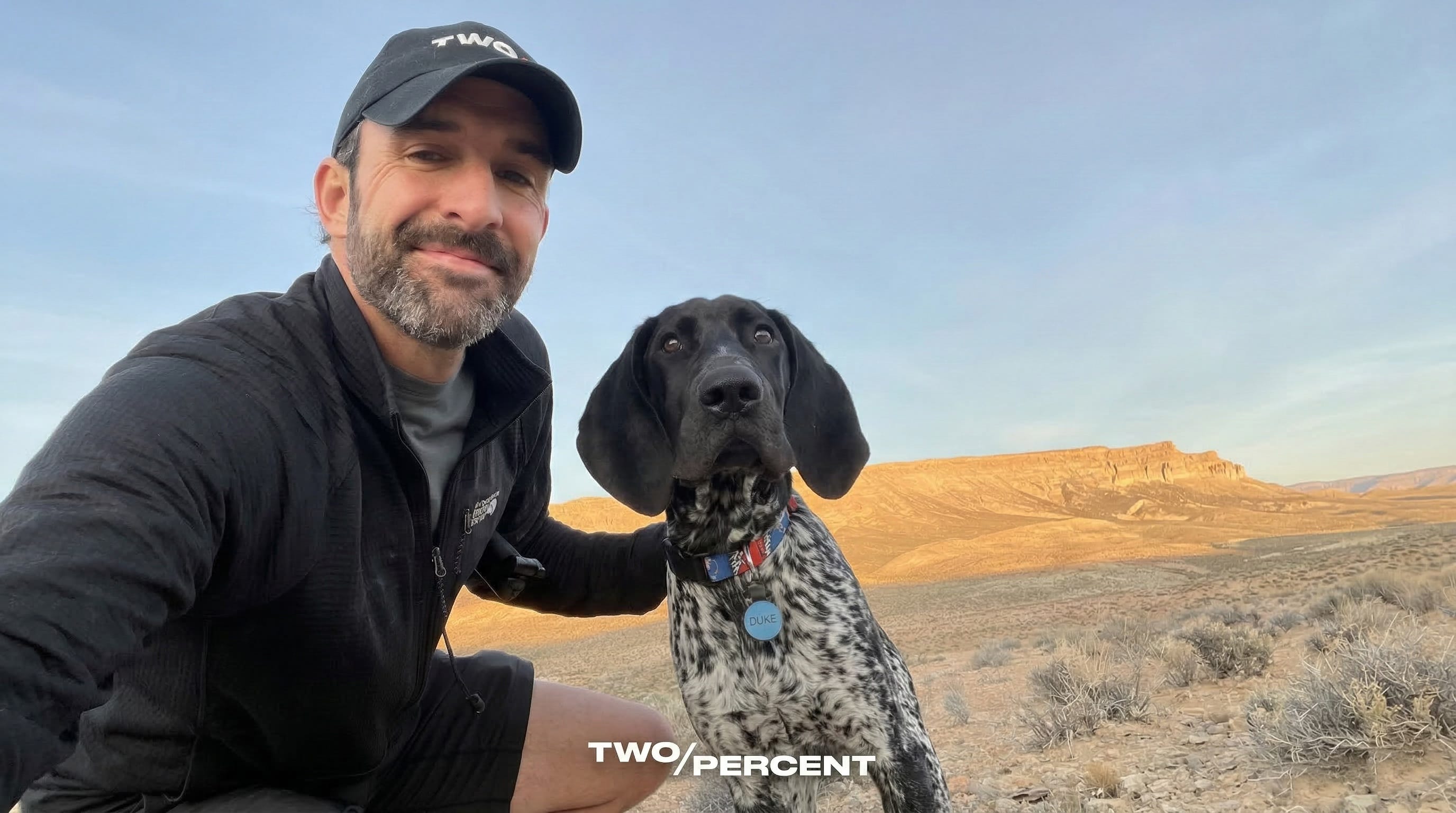
A new addition to the family: Duke, a German Shorthair puppy who requires a constant eye and many walks. (He recently pulled my 32” computer monitor off my desk, which is a story for another time.)
I’ve been taking far more walks lately and am averaging about 14,000 steps a day in 2026. Here’s what’s happened:
Weight: Down 3 pounds.
Strength: About the same.
Endurance: Largely unchanged, maybe better.
Headspace: Surprisingly intact, despite a book deadline and caring for a bat-shit hunting dog.
Today’s post is about the power of walking.
You’ll learn:
Why walking matters if you’re a human.
The daily minimum step count that saves you time and captures most health benefits.
The daily step count for maximizing the health benefits of walking.
Why a daily, dedicated walk probably beats scattered steps.
Why the speed of your steps may matter more than your total distance.
Why walking is good for people who have a brain and think with it. (That is to say, you).
Quick Housekeeping
In case you missed it:
On Wednesday, we covered 4 ways to be hopeful and why being hopeful is so important (especially when the world feels like it’s falling apart).
In Friday’s Gear Not Stuff, we covered the best purchase I’ve made in the last year (it helped me finish my new book).
Thanks to our partners:
David Protein Bars have the highest amount of protein per calorie of all protein bars. That makes them a great option for anyone who wants protein on the go without the excess sugar and fat of most bars. Visit DavidProtein.com.
Function Health, which offers 5x deeper insights into your health than typical bloodwork. You’ll learn critical information that can guide you into feeling better every day. It helped me identify a mineral insufficiency. Go to my page here to sign up, receive a discount, and pay just $340.
Let’s roll …
Why walking matters
Our earliest chimpanzee ancestors started walking upright about six million years ago. Earth was experiencing a global cooling period, and the chimps on the edge of the jungle faced shrinking fruit supplies.
Those who survived tended to have bodily quirks that enabled them to travel farther to find food. Over generations, natural selection favored bodies capable of covering long distances—with features like arched feet, angled knees, narrow waists, and long spines.
These animals, over millions of years, became a new species altogether: humans.
The famed paleoanthropologist Mary Leaky put it this way:
One cannot overemphasize the role of [walking] in [human] development. It stands as perhaps the salient point that differentiates the forebears of man from other primates. This unique ability freed the hands for myriad possibilities—carrying, tool-making, intricate manipulation. From this single development, in fact, stems all modern technology … this new freedom of forelimbs posed a challenge. The brain expanded to meet it. And mankind was formed.
Walking makes us human. Among the 2.17 million species on earth, few can travel long distances on two legs like us.
And for most of history, we used this uniquely human feature constantly. Anthropologists call early humans “societies of perpetual movement.” Estimates suggest our ancestors took 15,000 to 20,000 steps a day. That was the baseline for most of history.
Then the Industrial Revolution happened. We got cars, escalators, desk jobs—and systematically engineered walking out of daily life.
Some anthropologists argue that we’re still adapted to those high levels of walking. It may not be that movement makes us healthier. It’s that without it, our bodies go haywire. Think of it like a nutrient. If we don’t get enough, sickness tends to set in.
Which brings us to step counts …
Ideal daily step counts
Our ancestors weren’t logging 20,000 steps a day for the same reasons we do, like to avoid heart disease and diabetes decades later. They walked to avoid starvation today.
The good news: researchers don’t think we need to match our ancestors to get most of the benefits.
When scientists look at step counts and health—and many studies do this—they typically find that between 7,000 and 10,000 dramatically reduces the risk of dying early.
One analysis1 of 31 studies tracked the walking habits of 300,000 people and found that 7,000 steps a day captured most of the risk-reducing benefits.
Another study2 of about 5,000 people over age 40 found the following:
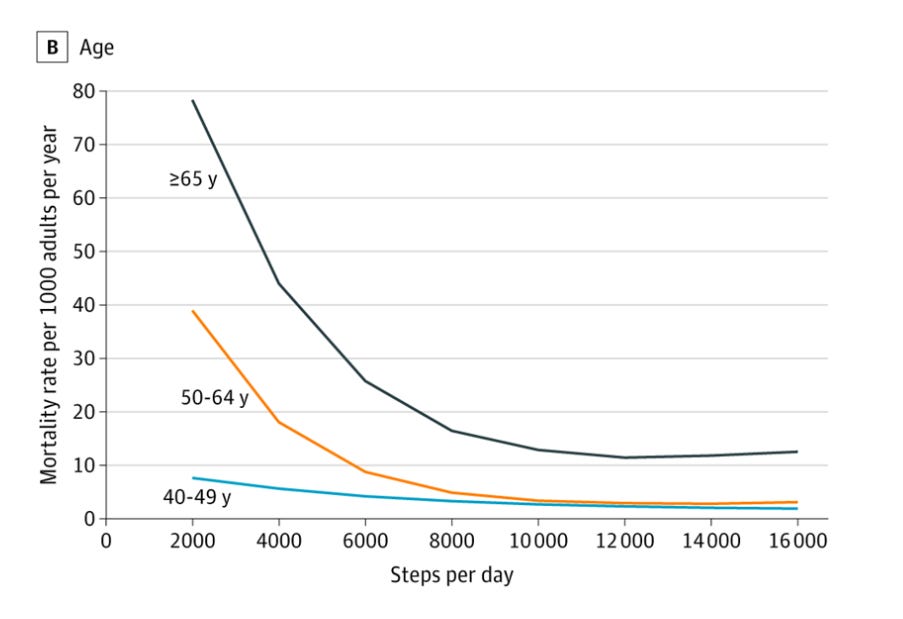
Two things to note about that graph:
The biggest benefits show up when you’re over 653.
When you’re young, your risk of dying is low, whether you take 2,000 steps a day or 16,000 steps a day.
But I see this as a case for building a walking habit now, so you don’t die too soon later.
It’s easier to take 10,000 steps a day at 70 years old if you’ve been taking 10,000 steps a day since you were 40. And some diseases that kill us at 75 likely begin to develop slowly if we’re inactive when we’re 40.
Both studies also found that getting 12,000 a day is likely where we lower our risk the most. We see it in the graph above, and the study of 300,000 found that those who got 12k steps a day were 55% less likely to die, while those who got 7k were 47% less likely to die.
Walking is both a marker of good health and a cause of it. It’s hard to know which comes first. But it doesn’t matter much—the prescription is the same.
Why you should take a dedicated daily walk
Getting 7,000 steps by moseying through daily life—grabbing the mail, walking the aisles of Target—is good. But it may not be the same as getting those steps from a dedicated walk.
Researchers who study walking often look at cadence, which is how many steps you take per minute. They find that faster steps—100 a minute or more—lead to additional benefits compared to slower steps4.
That is to say, the benefits of walking seem to come from both volume and intensity. Moving more overall matters, but moving briskly for some of those steps may amplify the effect.
When I covered The New Science of the Two Percent Mindset, I spoke with the wise Brady Holmer of the Physiologically Speaking Substack. We talked about a recent internet drama over a study, and Brady pointed out:
All steps are not created equal. If you get 10,000 steps that are vigorous versus 10,000 steps that are moseying around the house, those are vastly different in terms of how those are going to impact your health. I think it’s reassuring for people who find it hard to get 10,000 steps. You have to walk for 1.5 to 2 hours a day to reach 10,000 steps. So if you can’t get it, do brief, vigorous bouts where you’re walking fast across a parking lot or hustling up stairs. Those actually have a big impact on your health.
My takeaway: When we take a dedicated walk, we tend to walk faster.
So go for a daily walk at a decent pace. You don’t have to be an Olympic speed walker. One hundred steps per minute is considered a “moderate” pace for most adults. It’s about a 20-minute-mile pace.
If you don’t think you can take a dedicated walk, I suggest you check your phone screen time. Stare in horror at the number of minutes you spend on habit-forming apps. Then go outside.
Walking and your headspace (mood + ideas)
As I mentioned up top, I’ve been surprisingly mellow despite a looming deadline and a feral puppy. This tracks with the science.
Researchers at the University of Edinburgh studied5 the health benefits of walking and other forms of exercise and found:
No significant difference between the mental health benefits of cognitive behavioral therapy and movement (especially walking).
No significant difference between the mental health impacts of antidepressants and movement.
“Thus,” they concluded, “exercise appears to be as effective as other psychological or pharmacological treatments.” And if we walk outside, we tend to get even more benefits for our headspace, according to the research.
Then there are the ideas. The best ideas and lines in my new book came to me on my walks. I am not unique in this.
People who came up with far better ideas than I also found a connection between thinking and walking:
Darwin developed and sharpened his ideas on natural selection while taking walks on a loop outside his home, now called “Darwin’s thinking path.”
Philosopher Jean-Jacques Rousseau said sitting hindered his thoughts and noted, “My body has to be on the move to set my mind going.”
Nietzsche walked every day with a notebook and said, “All truly great thoughts are conceived by walking.”
Emerson and Thoreau were “walker-thinkers” who developed their philosophies on the move through the New England woods.
Virginia Woolf walked to develop her writing.
More recently, Steve Jobs took a walk anytime he was stumped, which led him to develop his most innovative Apple products.
There are a few theories around why walking seems to unlock thinking:
It seems to enhance blood flow and connectivity to regions of the brain involved in creative thinking.
It removes you from digital distractions, allowing your mind to wander. Ideas often come together when nothing interrupts them.
We may have evolved to walk and think. USC anthropologist David Raichlen points out that for all of time, humans had to come up with creative solutions while moving. “When you’re foraging for food, you are physically active, but you’re also cognitively active,” he said.
Putting it all together
Walk often. Walk far. Walk today. Walk tomorrow. Walk outside in the sunshine and rain, cold and heat. Walk alone or with someone. Walk like you mean it. Just walk.
Have fun, don’t die, walk,
-Michael
Daily steps and health outcomes in adults: a systematic review and dose-response meta-analysis; Ding, Ding et al. The Lancet Public Health, Volume 10, Issue 8, e668 - e681
Saint-Maurice PF, Troiano RP, Bassett DR, et al. Association of Daily Step Count and Step Intensity With Mortality Among US Adults. JAMA. 2020;323(12):1151–1160. doi:10.1001/jama.2020.1382
It could be that walking is simply a marker for function. Then again, walking maintains function.
This could be a marker of people who are healthier, but in my mind it seems to follow that good cardiovascular things happen when we work our heart a little harder.
Kelly, P, Murphy, M & Mutrie, N 2017, The health benefits of walking. in C Mulley, K Gebel & D Ding (eds), Walking. Transport and Sustainability, vol. 9, Emerald Group Publishing, pp. 61-79.
It’s amazing that something simple as walking can have long term benefits to your health. Especially if you add weight while you walk. I am an ER nurse and usually get 12k steps on the days I work. I also take the stairs and recently added weight and in my backpack I carry into work to make the 0.3 mile walk from the parking garage more beneficial. All thanks to your newsletters and books. Keep it up. Looking forward to the next book.
Reading Comfort Crisis really awakened me to the value of getting your steps and jump-starting your physical fitness engine via the intentionally long parking lot walk. For starters, it's been so much more relaxing to just pull immediately into the first spot I see at the back of a busy lot, instead of circling around waiting/hoping to find the perfect close-proximity spot. But especially on a day where I haven't been killing it fitness wise, that sneaky long/vigorous parking lot walk often jump starts my mood and inspires me to go further and do something more that day. Nature is king, but don't underestimate the impact that (formerly crappy) long parking lot walk can have!