

Why "Clean Eating" Sucks for Athletes
The Olympian junk food paradox

I published a version of this letter during the last Olympics, but the US Olympic Committee recently released a report that updates the science and makes the advice even more relevant. Enjoy.
I talked to hundreds of Olympians about everything from training to mindset back when I covered the Games for Men’s Health and Outside magazines.
But I’ve always been most fascinated by how Olympians eat.
We tend to picture elite athletes eating an impeccable diet—living on perfectly portioned salmon, quinoa, and vegetables. Clean, pristine, and Instagrammable.
The reality is much different. Many Olympians eat like teenagers—and it helps them win.
In this letter, you’ll learn:
Why elite bobsledders use Taco Bell to win Olympic medals.
The “Calorie Delivery” problem that makes “clean eating” a liability for athletes and highly active people.
Three reasons why ultra-processed food can help you perform better.
The hidden danger of “RED-S” that is currently eroding the health of thousands of amateur athletes.
A specific guide to how much “junk” you can include in your diet based on your daily movement.
Quick housekeeping
Become a Member to get full access to all three of our weekly posts.
In case you missed it:
On Wednesday, we covered a shocking new paper on longevity.
On Friday, we ran part II of our three-part mountain-ready Burn the Ships workout.
Check out our partners:
Run farther with Janji, an independent running brand making gear built for ultra-distance pursuits. They’re the only brand making gear specifically for 200-plus-mile adventures—my favorite kind. Check out the Circa Daily Long Sleeve, great alone or as a layering piece. Find Janji at Janji.com and at REI stores nationwide.
Maui Nui: Eat ethically. Maui Nui’s harvests wild Axis Deer, which are invasive to Maui. They’re also the healthiest meat on planet earth. Try the Stick Starter 6-Pack at $39 each. High-protein, low-calorie, and wildly clean.
David Protein Bars have the highest amount of protein per calorie of all protein bars. That makes them a great option for anyone who wants protein on the go without the excess sugar and fat of most bars. Visit DavidProtein.com.
Let’s start with a story.
Squats and Taco Bell
During the 2014 Winter Games, I spoke to Olympic bobsledder Chris Fogt. He was part of the famed Night Train team that won gold in 2010 and silver in 2014.
Fogt, however, almost didn’t make the squad. He was a hell of a runner—bobsled pushmen are basically 100-meter sprinters who shove a 450-pound sled down a starting track and then hop in for a ride.
But at tryouts, Fogt only weighed 170 pounds. Coaches saw a lot of talent, but not much of an engine.
“As a pushman in bobsledding, you need to weigh about 210 to 230 pounds to add weight to the sled,” Fogt told me. It’s physics: Heavier stuff moves faster downhill, and teams want the combined weight of the sled and crew to be as close to the 1,390-pound maximum as possible.
He needed to gain 40 pounds to make the team. And that 40 pounds had to be mostly muscle so he could maintain his speed and power.
His solution was lots of lifting and a very specific drive-through order:
1 Cheesy Gordita Crunch
2 Doritos Locos Tacos
1 Beefy Five-Layer Burrito
2 Soft Tacos.
That’s the “snack” Fogt would get from Taco Bell after his workouts.
The damage: ~1,700 calories, or roughly three-quarters of the average person’s daily caloric intake. It has 83 grams of fat, 166 carbohydrates, 70 grams of protein, and enough sodium to kill a lab rat.
But he made weight, made the team—and won a medal for the USA.
He summed up his approach like this: “Squats and Taco Bell, baby.”
Strange Olympian eating habits
Fogt isn’t an outlier.
Some Olympians run their nutrition as a meticulous spreadsheet. But many of the diets of the athletes at the 2026 Winter Games in Milan/Cortina would horrify internet nutrition purists:
The American Speed Skater Jordan Stoltz eats 3,000 calories of plain white rice before races.
Pizza is the most popular food at the athlete Olympic Village in Milan.
Foccacia, an oil-soaked bread, is also disappearing by the tray.
The Team Canada Hockey player Natalie Spooner—nicknamed “The Chocolate Monster”—is reviewing the Olympic Village desserts on social media.
The first rule of sports nutrition: Eat enough
I spoke with Brian St. Pierre1, a sports nutritionist who has worked with Olympians and consulted for pro teams.
He explained that elite athletes often don’t have a food quality problem. They have a calorie-delivery problem.
When you train 20 to 30 hours per week, you burn an absurd amount of energy. Some athletes can torch 600–1,000 calories per hour.
Take Fogt. “I have to eat about 6,000 calories a day,” he told me. Cross-country skiers and speed skaters might need as many as 8,000 just to break even.
When you need that much food, the nutrition advice that applies to the average person goes out the window.
The Olympian junk food edge
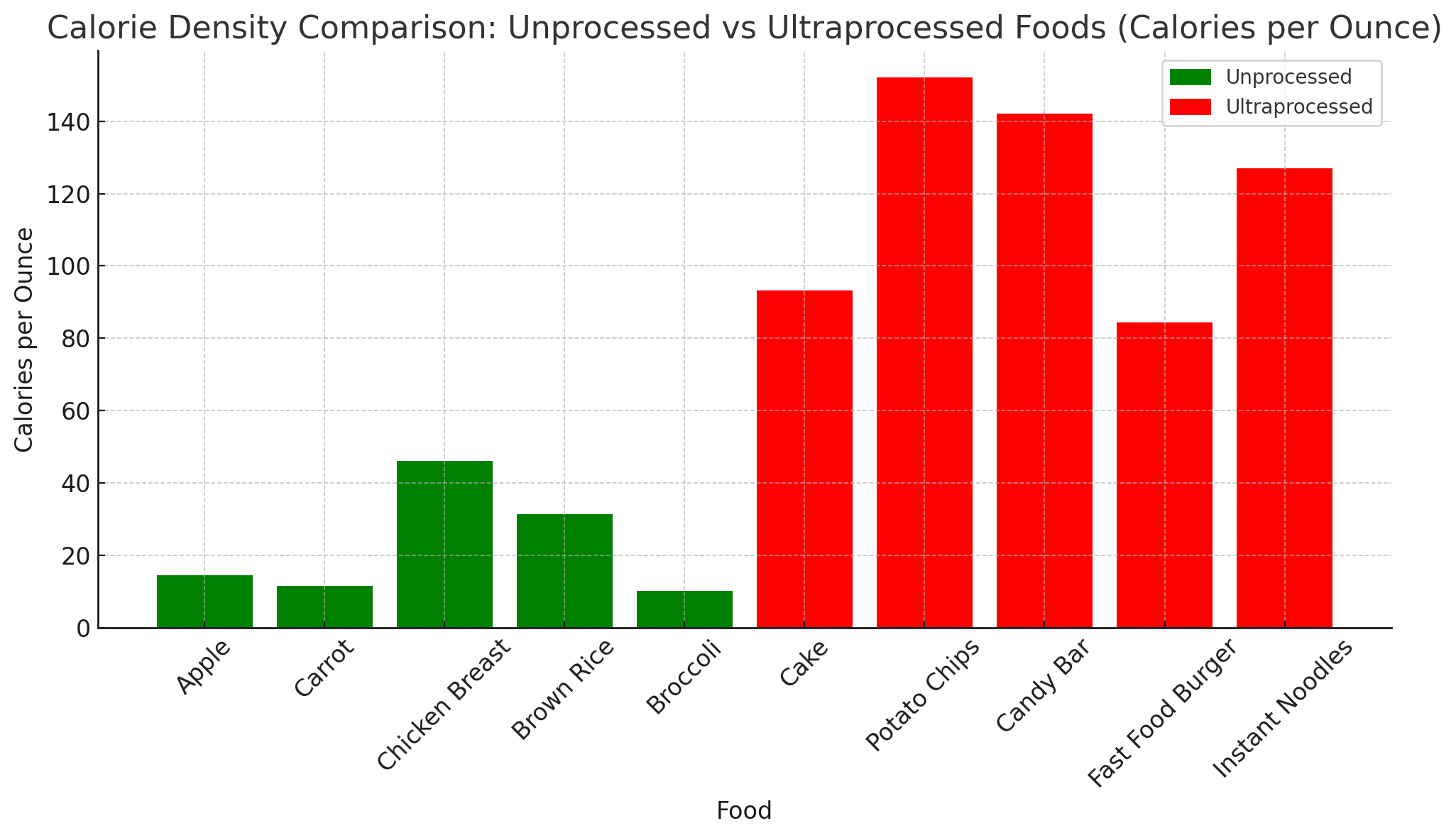
As a general rule, the more we process a food, the more we concentrate its calories.
Here’s a chart visualizing this. It shows the number of calories per ounce of different foods:
Athletes use processed foods to solve three of the biggest problems they face.
1. It gives them enough food
Processed foods give you more energy for less volume.
“If you tried eating 1,700 calories in chicken breast, broccoli, and potatoes, you’d fill up really fast because of high fiber and water content,” St. Pierre told me. “That doesn’t happen with 1,700 calories of Taco Bell.”
Using an example from the graph above: to get 140 calories from apples, you’d have to eat roughly 8 to 10 ounces of apples. A candy bar packs that same punch in just 1 once.
If athletes eat only “clean” food, their stomachs fill up before they get enough calories to fuel their bodies.
2. It helps them avoid the number one reason athletes drop out of competition
During hard exercise, your body prioritizes powering your muscles. It diverts blood to your working muscles and away from processes like digestion. That helps you exercise better, but it also gives your gut fewer resources to digest food and extract energy from it.
Ultraprocessed foods have been processed beforehand, meaning your stomach doesn’t have to do as much work breaking them down. Conversely, big and fibrous meals (like broccoli and potatoes) take more work to digest.
“If a food doesn’t require much digestion, your body can immediately start to absorb and use the nutrients from it, and that’s going to improve your performance,” said Dr. Trevor Kashey, who you might recognize from my book, The Comfort Crisis (which, for some odd reason, is only $11 on Amazon right now).
And because the foods require less digestion, they tend to result in fewer stomach issues during exercise, the number one reason athletes drop out of competitions.
Avoiding stomach issues is so critical that Team USA shipped in processed foods that their athletes were familiar with for competitions. That reduces the likelihood they’ll have a bad stomach on event day.
Go deeper into this topic: Read A Smarter Perspective on Sports Nutrition.
3. It’s more convenient
Because they’re so focused on training and competition, most athletes don’t have time to prepare perfect meals.
Processed foods are often ready-to-eat and take less time to consume.
“You’d have to put time into preparing chicken, broccoli, and potatoes, and it would take 45 minutes to eat,” St. Pierre told me. “Taco Bell just takes a stop at a drive-through and takes 10 minutes to eat.”
Finicky diets are also a distraction. To win gold, it’s more useful for athletes to focus on their sport rather than scrutinize every ounce of food they eat.
The lesson
None of this means “junk food is healthy.” It means that context matters.
For someone sitting on a couch, a 1,700-calorie fast food order is a ticket to type-II diabetes and heart disease.
For an Olympian training 20 to 30 hours a week, it’s rocket fuel.
The real danger isn’t junk food—it’s under-eating
Nutritionists at the Olympic training center say that being too finicky about food hurts athletes.
They get too restrictive and accidentally under-eat—and performance and recovery tank.
In 2023, the International Olympic Committee released a consensus statement2 on the topic. The problems associated with under-eating even have a name: Relative Energy Deficiency in Sports (RED-S)
They warned that not eating enough:
Impairs gains and performance.
Leads to bone loss.
Disrupts hormones and the immune system.
Hurts focus.
And much more.
Team USA Bobsledder and opening ceremony flag bearer Frank Del Duca told Today, “If I’m under-fueled, I can be lethargic and have brain fog,” Del Duca says. “Nutrition plays a key role in mental clarity on race days.”
Another review3 found that athletes who didn’t eat enough:
“were found to have decreased run performance, training response, endurance performance, coordination, concentration, judgment, explosive power, and agility relative to athletes with normal energy availability, as well as an increased likelihood of absence from training due to illness.”
In sports decided by a tenth of a second, eating enough is the difference between going home with a gold medal or nothing.
Interestingly, women taught us this lesson first. When female athletes under-fuel, their periods disappear, and their bones weaken—an obvious red flag. Men don’t get that warning light. Their hormones and performance quietly drop instead. It’s the same problem, but with less obvious symptoms. Which means under-eating hurts everyone. Some of us just don’t notice until it’s too late.
You also don’t need to be an Olympian to experience this. Recreational runners training for marathons, CrossFitters, and weekend warriors who restrict calories are all at risk. The symptoms are subtle: workouts feel harder than they should, you’re always tired, minor injuries won’t heal, you catch colds, etc. Most people think they need to train harder to bounce back. The real fix is eating more.
I learned this the hard way
During my recent 45-day thru-hike, I hiked nonstop for 12 hours a day. I was eating 5,000 calories a day of packaged junk. I still lost 15 pounds.
Before I left, the researcher Andy Galpin took a bunch of my biological measurements. When I got back, he retook the same measurements. The results showed that my system had crashed because I wasn’t getting enough calories, vitamins, and minerals to support all of my hiking.
I felt it too: I was slower, foggier, and more beat up.
I can’t imagine trying to win an Olympic medal in a state like that.
What this means for you
This is not a permission slip to go wild at Taco Bell. Probably only a handful of Two Percent readers exercise more than 20 hours a week.
But there are two useful lessons for the average active person:
1. Moving more buys you “more room for junk”
Our food environment is filled with ultra-processed foods that are hard to resist.
We inevitably eat them—and more movement can help us avoid their negative health impacts.
Dr. Trevor Kashey said this about type-II diabetes: “It’s more of a ‘too much couch’ rather than ‘too much carbs’ problem.”
The more you move, the less you have to worry about the health impacts of the less-than-perfect foods you eat.
Whether any one food is “good” or “bad” depends on a variety of factors—especially your activity level. Take added sugar:
For a sedentary person, added sugar is probably a net negative.
For an endurance athlete, added sugar is often a net positive, especially during training.
Here’s a rough guide of how much ultraprocessed food you can get away with eating based on your activity level. I’ve pulled these figures from various recommendations from dietitians.
Sedentary individuals can probably get away with 10 percent of their calories from “junk” foods.
Moderately active people are usually fine if 20 percent of their diet is junk.
Highly active individuals can get away with 25 percent.
Here’s what that looks like for a sedentary person needing 2,000 calories, a moderately active person needing 2,500, and a highly active person needing 3,0004.

2. “Junk food” is your friend on long workouts
If you’re exercising hard for more than an hour, eating processed foods can improve your performance and reduce gut issues.
They give you quick energy to power the workout and reduce the likelihood of stomach problems caused by “clean” foods.
A good rule of thumb: Eat 120 to 180 calories per hour during efforts lasting longer than one hour.
Keep in mind, these don’t have to be gross neon energy gels.
One of my friends, a top ultrarunner, loves Snickers bars on long runs. I love Uncrustables. Rice Krispie Treats have become a favorite of endurance athletes.
A rule: The more you enjoy it, the more likely you are to actually eat it during your workout.
The key is simple: Eat enough. Train hard. Don’t get too finicky with food if you’re active.
Have fun, don’t die, squats and Taco Bell,
-Michael
Audio Version
https://www.precisionnutrition.com/author/brian-st-pierre
Mountjoy M, Ackerman KE, Bailey DM, Burke LM, Constantini N, Hackney AC, Heikura IA, Melin A, Pensgaard AM, Stellingwerff T, Sundgot-Borgen JK, Torstveit MK, Jacobsen AU, Verhagen E, Budgett R, Engebretsen L, Erdener U. 2023 International Olympic Committee’s (IOC) consensus statement on Relative Energy Deficiency in Sport (REDs). Br J Sports Med. 2023 Sep;57(17):1073-1097. doi: 10.1136/bjsports-2023-106994. Erratum in: Br J Sports Med. 2024 Feb 7;58(3):e4. doi: 10.1136/bjsports-2023-106994corr1. PMID: 37752011.
Gallant TL, Ong LF, Wong L, Sparks M, Wilson E, Puglisi JL, Gerriets VA. Low Energy Availability and Relative Energy Deficiency in Sport: A Systematic Review and Meta-analysis. Sports Med. 2025 Feb;55(2):325-339. doi: 10.1007/s40279-024-02130-0. Epub 2024 Nov 1. PMID: 39485653.
These are rough estimates. Experiment and learn what works best for you.
There was no better reward when I was a young cyclist than donuts on Saturday after several hours in the saddle. And when Powerbars came out (dating myself...), they were magical because actual candy bars would melt. My issue, like most I suspect, was subtle as I settled into marriage/kids/actual job and kept eating the donuts.
I rebounded, but the rule now is don't eat the donuts unless you have earned the donuts. It's a great incentive to go for a ruck or ride!
Great piece.
I need to find the Olympic dessert testing! My brother, a Paralympic gold medalist in wheelchair rugby, raved about the desserts at the Sydney games.