

Death by Health Optimization
The co-author of Outlive admits our obsession with perfect health has gone too far.

I was chatting with the health journalist Jen Murphy the other day. She spent two decades writing the Wall Street Journal’s What’s Your Workout? column, which covered the exercise habits of high-profile people. Think: presidents, CEOs, and founders of major companies.
Some of these busy people trained hours a day for triathlons and other sports. They skipped meals with friends because the menu didn’t fit their nutrition requirements. They avoided social gatherings that might go too late and impact their sleep.
Jen told me there was often a fascinating tension to those pieces. “I regularly had spouses—or ex spouses—email me to say they wished their partner put as much energy into their relationship and family as they did into their workouts,” she said.
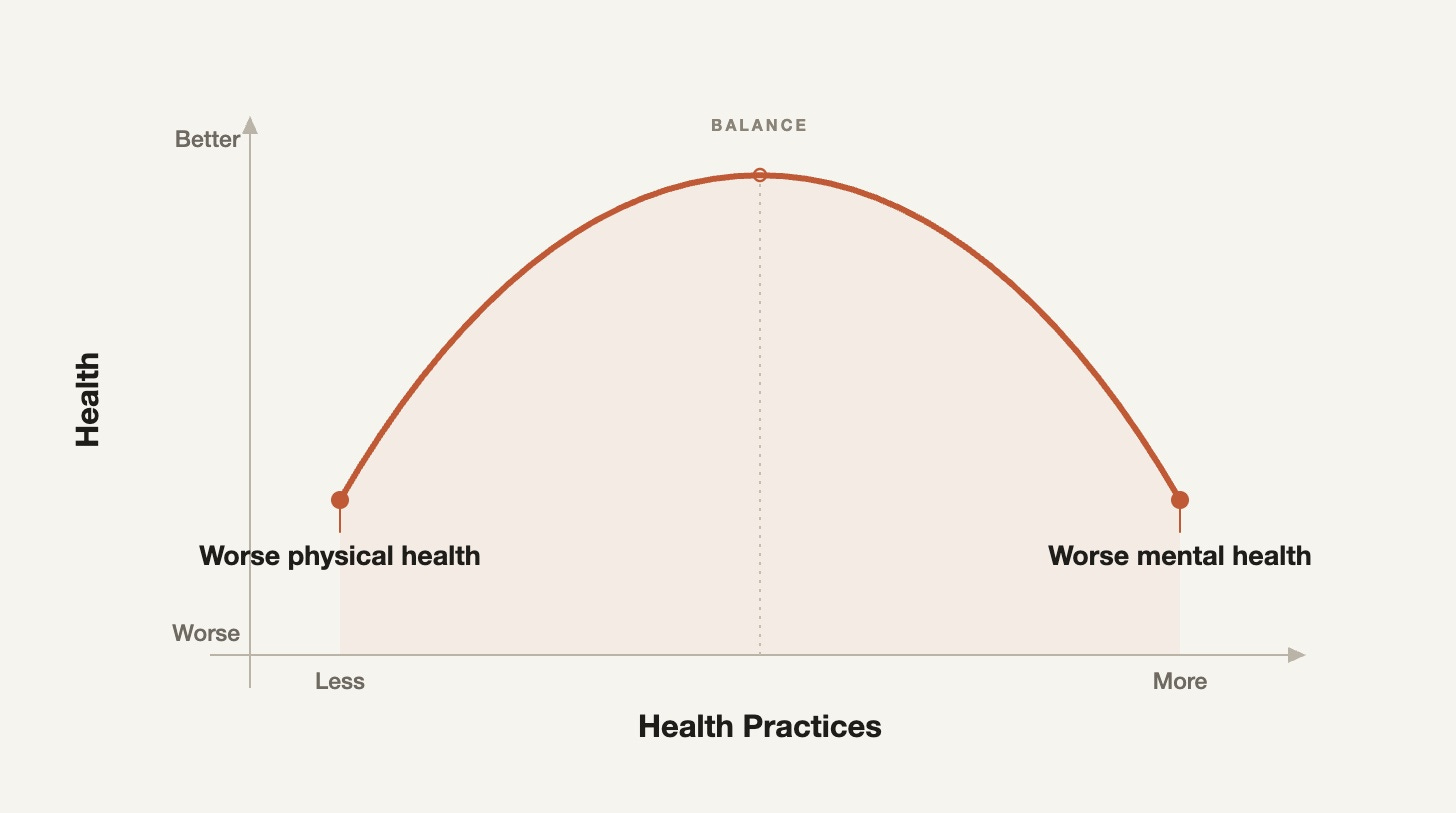
Health practices, pursued beyond a certain point, stop making your life better.
Your body fat percentage, VO2 max, and biomarkers may look perfect on paper. But the damage shows up between your ears. Anxiety rises, relationships suffer, life becomes robotic.
So, a question: How much is enough?
Health practices exist on an inverted U-shaped curve. Too few and physical health suffers. Too many, and life does.
Today’s post explores:
The inverted U-shape curve of health.
Why the coauthor of the most famous longevity book now believes the modern obsession with optimization has become “cult-like” and possibly destructive.
Underlying cultural reasons for the rise of health optimization (one ties directly into The Comfort Crisis).
Where your cardio minutes, daily step counts, and dietary restrictions stop yielding benefits, and two costs of overdoing health practices.
How I try to find the sweet spot, and a quote from a wise friend that can help anyone find it.
Quick Housekeeping
In our recent survey, many of you asked us to expand the Two Percent gear store. Ask and you shall receive. The new Two Percent shop is live.
We’ve got new hats, shirts, restocked patches, and even a Grateful Dead-inspired lot shirt. We’ll continuously add more gear. Let us know what you want to see in the shop, and we’ll make it happen.

Optimization as neurosis
Jen’s comment suggests this problem isn’t new.
Fifteen years ago, she wrote a WSJ piece titled, “A Workout Ate My Marriage,” covering the rise in marriages impacted by one spouse’s exercise obsession. She spoke to a therapist who noted, “Exercise is getting more and more couples into my office.”
But after COVID lockdowns, health optimization went mainstream. Longevity books became bestsellers. Podcasts spending hours in the weeds of health took off. Social feeds filled with people posting about their extensive health routines.
Far more people began adopting complex health practices: The right morning routine, hours of zone 2 cardio, and detailed diet plans timed down to the minute.
Some of the country’s top doctors have told me they’ve experienced an influx of healthy patients seeking fringe longevity treatments. In 2024 alone, longevity startups raised $8.49 billion in investment—a 220% increase from the year before.
This increased focus on health has been a great thing overall. After all, 70 percent of Americans are either overweight or obese, and researchers at UNC found that only 1 in 8 of Americans are metabolically healthy.
But as with any practice, some subset of the population will take it too far and experience downsides: health anxiety, orthorexia, isolation, social issues, health problems caused by preventative interventions, and more.
An example: A few years ago, I came upon a post from an MD and health influencer with millions of followers. He was frazzled. Things had gone completely off the rails.
He looked into the camera and explained that he was traveling and had missed one of his four 30-gram protein doses that day. He said this lapse stressed him out. He had to do better—we all had to do better—to plan for moments when we couldn’t eat a specific amount of protein at specific time intervals.
Imagine that: Psychologically yeeted because you (checks notes) forgot to eat some beef jerky at 3 p.m.
So what’s the underlying reason all of this is happening right now? It’s multifactorial, but two things come to mind:
The first is identity. For many, health practices have become an identity, rather than just a good habit. When your health practices are who you are, not just a thing you do, missing them becomes a personal failing.
The second is shifting anxieties in a safe world. Research shows that when real threats dissolve, we don’t relax. We find new things to worry about. This was a useful brain feature for our ancestors living in dangerous environments. But as the world has become safer and more comfortable, our threat-detection system still needs something to latch onto. Health became a logical target, because death is ultimately the final threat and something we can’t solve for.
Health neurosis: the research
To be clear, there isn’t much reliable research confirming a rise in psychological harm from health obsession. The optimization trend is rather new, the measurement tools are inconsistent, and health addiction isn’t a formal clinical diagnosis.
But the wellness industry has grown massively, and the number of people identifying as health-focused has skyrocketed. Meanwhile, social media and podcasting have turbocharged optimization culture, pushing health to its most time-intensive and quantified conclusion.
More people are now living in conditions that can produce these psychological patterns.
Observation is also the first step to starting a study. And what I’m observing—in my inbox, DMs, and social and podcast feeds—is a level of health neurosis that didn’t exist a decade ago.
People send me extremely long and in-the-weeds messages about obscure biomarkers, exactly how to stay in Zone 2 while rucking, and precisely how many grams of protein to eat (and from what sources and when).
The salient point is that these aren’t questions from sick people trying to get better. They’re from healthy people trying to be perfect.
When I spoke to Ryan Soave on the podcast—he’s one of the country’s top therapists, who started his career in addiction therapy—I asked him if he thinks people can be addicted to healthy behaviors, like exercise. His response:
Depending on how we define addiction, yes. I think exercise and other healthy behaviors can be an addiction. If we rephrase your question to something like ‘can people be harmed or can their lives be affected negatively by their relationship with things that everybody sees as healthy?’ Then 100%.
Of course we should exercise, of course we should eat right. But if you’re doing that at the expense of enjoying your life or the expense of the people you’re in relationships with. Or if you can’t exercise today, you become miserable, then there’s something to look at there.
As I was writing this post, Derek Thompson published a piece also arguing that health optimization has gone too far and is affecting broader wellness.
And here’s a doozy. In response to that piece, Bill Gifford, who co-wrote the book Outlive, which turbocharged the longevity trend, commented on X:
As coauthor of Outlive, I feel at least partly responsible for motivating this “cult (of health optimization)” …
I think it’s a good thing that more people are trying to take control of their health … But the obsession with “optimizing” every aspect of life, often by people who are already very healthy, is unnecessary, in my opinion. And possibly destructive. For some, the quest for perfection seems to be little more than narcissism by another name. If your wearable is sucking the joy out of your life, where is that getting you?
It’s not enough just to try to live longer and stay healthier—you need a reason, something larger than yourself. You need a Why. And, once in a while, maybe a drink with a friend.
The balance between health and health practices
Most scientists agree that there’s a rate of diminishing returns for lifestyle health practices.
We see it in the data on exercise. For example, going from nothing to 150 minutes of cardio a week is massively beneficial for health. But when you exceed 300 minutes, the benefits plateau. Same goes for strength training. Same goes for steps per day—going from, say, 3,000 to 8,000 is associated with a 50 percent decrease in all-cause mortality1. But exceeding 12,000 steps a day doesn’t seem to deliver more measurable benefits.
PhD nutritionists say the same about diet. Alan Aragon says that so long as your diet is, say, 80% “healthy,” you’re not losing a step by leaving 20% for what he calls “junky goodness.” In fact, he’s found that leaving room for indulgences seems to help people eat healthier over the long term.
But neglecting your health entirely has its own costs. These costs arise in the body, not the mind.
Recently, Leah and I were eating breakfast at a diner sitting next to two people who looked to be in their mid-70s. At least one of them smoked. Their orders were the answer to the question: “What on this menu could give me heart disease and diabetes ASAP?”
“Get the French toast,” the man told us with a smile. “You won’t regret it.”
They were having a wonderful time—laughing, lingering, and completely engaged with life. But when the check came and they stood up to leave, both of them limped out the door. They’d clearly found joy. They just couldn’t walk anymore.
And that might end their joyous run early: Data from the HUNT2 study suggests a sedentary lifestyle is linked to ~2x the risk of dying early compared to being active.
The costs of going all-in
I see two main downsides to excessive optimization: Stress and social isolation.
When a minor lapse in your health practices stresses you out—as we saw with that protein-starved MD—something has indeed gone off the rails.
Stress is one of the major drivers of heart disease. It also factors into metabolic syndrome, GI issues, immune system issues, pain, and more. I.e., optimization meant to protect your health could create a health threat.
Also: stress sucks. It makes our days worse.
Then there’s the social costs. Many of these practices can isolate people, removing them from social connections, which can be just as powerful as traditional health practices.
One study3 with half a million people found that frequent time with others had about the same effect on longevity as exercise.
Meanwhile, the Harvard Study of Adult Development4—which has run for 85 years—found, “Across decades of data, the people who stay meaningfully connected are happier, healthier, and live longer.”
We’re starting to see some health optimizers realize this. I recently spoke to Dean Stattmann on the Two Percent podcast. The guy has always been healthy—eats well, exercises consistently.
To further optimize his health, he cut alcohol entirely. He’d never been a problem drinker, and all of his health markers were solid, but he thought it would give him an edge.
A handful of months later, he found himself far unhappier. Borderline depressed.
He realized that he’d drink in the context of being social: Going to the bar with friends after playing pickup soccer. Or out on the town with his wife, where they’d spontaneously check out new places and meet with friends.
He resolved to start drinking again. And he wound up healthier and happier. Light drinking was simply a path to the power of social connection.
How I think about this
An admission: I’ve fallen into this trap. Right after I got sober—more than a decade ago—I leaned fully into health practices.
But it was often at the expense of other important parts of life. I’d have to work out at certain times as Leah waited around for us to do something together. I’d get annoyed with myself if I missed a workout. I’d say “no” to certain restaurants if the food was unhealthy.
Luckily, I noticed I’d overcorrected rather early, after about a year sober—and chilled TF out.
Since then, I try to hit 5-ish hours of exercise a week. Sometimes I don’t reach it. Sometimes I exceed it. Whether I do or don’t isn’t a big deal.
I try to eat healthy when I’m at home, but I don’t worry about “junky goodness” when I go out to restaurants a couple of times a week.
Once a year, I do something big, a “Misogi.” Mostly for my brain, not my body.
I don’t always get the balance right. Nor do I claim my approach works for everyone.
To determine whether a behavior is helping or hurting, Ryan Soave tells his clients to ask themselves, “Does it have me, or do I have it? Do I continue to do this even though it harms me physically or psychologically?”
As that couple left the diner, I griped to Leah. “Why am I like this?” I said. “I wish I could smoke and eat French toast every day and not care about the consequences.”
“Sure,” she said. “But you can walk. And that can take you a lot further.”
Have fun, don’t die,
-Michael
Paluch A, Bajpai S, Bassett D et al., Daily steps and all-cause mortality: a meta-analysis of 15 international cohorts, The Lancet Public Health, 7, e219-e228
European Society of Cardiology Congress Conference presentation. (2019, August 31). Sedentary lifestyle for 20 years linked to doubled early mortality risk compared to being active.
Foster HME, Gill JMR, Mair FS, Celis-Morales CA, Jani BD, Nicholl BI, Lee D, O’Donnell CA. Social connection and mortality in UK Biobank: a prospective cohort analysis. BMC Med. 2023 Nov 10;21(1):384. doi: 10.1186/s12916-023-03055-7. PMID: 37946218; PMCID: PMC10637015.
Waldinger, R., & Schulz, M. (2023). The good life: Lessons from the world’s longest scientific study of happiness. Simon & Schuster.
Michael, this one was a 490 foot home run… and something i’ve talked privately about for a few years. running parallel to this is the wealth of information now available to everyone (which is parts good, decent, or horseshit), and more importantly is the inability of most of our species to discern what is good, decent, or horseshit (me included. i’m not above it). if somebody’s screaming their “truths” on one end, somebody else is almost guaranteed to be screaming the contrary.
a society of paralyzed neurotics isn’t likely to end well; BUT if a robot can do our dishes, i guess we’ll have more time for… new and exciting neuroses.
For me, all the health directives and advice trigger some sort of “good girl syndrome”. If I follow all the rules and advice, if eat the right things and put enough muscle on and keep running 10K every Sunday then I’ll be “good” in some nebulous way. That keeps me feeling calm and centered. It’s just a ritual for me. But I don’t wear trackers for sleep or anything else. I don’t buy expensive labs or esoteric medical tests. So I think I have a pretty good balance. I’m way into fitness unlike my immediate family, but it’s easy to get up in the early morning and workout while they are still asleep.