

Introducing WalkFully
The company I helped found to get more people walking with weight. Built for everyone.

Quick note: There’s a poll at the bottom about your inbox and the podcast. It takes two seconds and will help us improve Two Percent.

A bit over a year ago, I got a DM on Instagram.
“I have a business proposition that I would like to talk to you about. Specifically to see if there’s interest and curiosity, and partnering with you in a founding role. It’s right in your core passion arena and wheelhouse.”
I get a lot of DMs with far-out propositions. Most are from bots. The rest are from wackos.
But the sender was Christopher Gavigan. I was familiar with him. In fact, my house was filled with his products. In 2011, he co-founded the Honest Company with Jessica Alba—the brand that kickstarted safer home items like soaps, cleaners, kids’ products, and more.
Christopher was thinking about a company built around walking with weight, using lessons he’d learned from the Honest Company.
The gear would be ergonomic and adapted for everyone, especially women. It would be functional and approachable—and not hardcore.
This was an issue I’d spotted in the rucking world. When I told people about “rucking,” they’d Google the word and see Special Forces types hauling huge loads.
Some people thought that was cool. Others immediately said, “Not for me.”
Walking with weight was adopted by the military because it’s necessary for combat and the most effective way to prepare a body for warfare.
But humans carried weight long before we had organized militaries. And it’s one of the most effective ways to improve any body—health, mindset, durability, and much more. No matter your age, sex, fitness level, background, or anything else. The first backpacks, for example, were invented by women to carry children.
I was worried that rucking’s hardcore military angle was scaring a lot of people who’d benefit from walking with weight.
Christopher and I started talking. I eventually said yes. And now here we are: WalkFully is live at Walkfully.com.
(P.S., get a 30% discount with code: EASTER30)
WalkFully, and why carrying weight matters
You may already be familiar with the backstory of how I helped popularize rucking/walking with weight.
Quick reminder: in 2019, I spent a month in the Alaskan Arctic reporting The Comfort Crisis. I was familiar with the research on running and how humans evolved to be uniquely good at long-distance running so we could hunt.
But after successfully hunting a caribou, I found myself carrying about 120 pounds of meat across the tundra. And a question popped in my head: What would we do after we hunted? We’d have to carry the meat back to camp. And I couldn’t name any other species that could pick up weight and carry it for distance. That seemed like the missing, and perhaps more important, side of the equation.
After the Arctic, I visited Daniel Lieberman, the Harvard anthropologist behind the famous “Born to Run” research.
He confirmed that carrying shaped our physiology and health, and his lab was even beginning to study it. We’re adapted to carry. Carrying gave us a unique advantage that helped us conquer the globe. And for all of time, we walked the earth on two feet, carrying items.
Then we invented grocery carts, roller bags, and cars—and engineered carrying out of our lives. We’re now paying for it with our strength, endurance, bones, and brains.
I wrote two chapters in The Comfort Crisis: One covering all the benefits of carrying. Another covering how loading a pack with some weight and walking is one of the most practical ways to add carrying back into your life and get the benefits. I told that story through the military’s history of rucking.
What ensued was a bit of a boom. Then a problem arose.
The gear problem WalkFully solves
Most weighted gear—rucks, weight vests—descends from the military. I love that history.
But I started hearing from people who told me the gear didn’t work for them. They said the gear was rubbing them raw and bloody, trapping heat, making breathing harder, and was impossible for many women to wear comfortably, due to their anatomy.
I went on a fact finding mission.
After speaking with military researchers, I learned the packs are designed around the anatomy of large men who need to carry more than 100 pounds. Many weight vests are based on body armor.
For example, when I interviewed Kelly Starrett, the physical therapist who consults for pro teams and the military, he pointed out that weighted vests “were originally designed to protect people if they got shot.” Not to walk efficiently for health.
Because many rucking pack and vest designs are built for men in combat, they don’t always transfer over to those who want to improve their fitness and health, leading to problems.
The aesthetic of military-inspired gear also says, “I’m staging a coup against the HOA.” Some people dig that. Some don’t.
And the people who arguably have the most to gain from walking with weight—women, older adults, beginners, or anyone else who wants to add load to a dog walk or stroll with friends—look at the military options and aura and reasonably say “not for me.”
That’s the gap Christopher and I noticed.
He had an idea and a business mind. And I’d spent more time than anyone researching walking with weight for the average person. I could weigh in on gear designs, science, and messaging. Now here we are.
WalkFully’s mission is simple: Get more people out walking, ideally with weight and gear that works for them.
Mike Fischer is also on board. He’s a top pack designer and built gear around real bodies—especially female bodies. Martha Stewart (yes, that Martha Stewart), Milica McDowell DPT, and Dr. Melissa Sundermann are also part of WalkFully.
The science, briefly
The research-backed benefits of walking with weight can fill a book. (Trust me, I wrote it.) The easiest way to think of it: Walking with weight helps you get more from every step.
Here’s a brief rundown of benefits.
1. It burns more calories
In 2024, David Looney, a physiologist who researches with the US Army Research Institute of Environmental Medicine, published the best data we have on calorie burn from walking with weight. He found that it burns anywhere from 20 to 133 percent more calories per mile compared to running or walking an equivalent distance, depending on the load and other factors.
2. It burns fat while preserving (and, in some cases, building) muscle
This has been my experience—after long backpacking trips, I lose fat but not muscle. A study of backcountry hunters backs my observation. It found that over 12 days, hunters who carried packs all day lost about 10 pounds, reduced their body fat by 14 percent, maintained their muscle, and improved their VO2 max by 8.4 percent. That’s unique. When we lose weight, we usually lose a mix of fat and muscle. If you can maintain muscle as you lose weight, that’s far better for health.
3. It helps your bones
Everyone starts losing bone density around age 30, and postmenopausal women lose it fastest. Aging women in the US are 2, 5, and 8 times more likely to break a bone than to have a heart attack, get breast cancer, or have a stroke, respectively. About a third of people who break a hip after age 60 will be dead in six months. Bones respond to load, and weighted walking seems to maintain or even improve bone density.
4. It’s safer than running
The injury rate of running is anywhere from 20 to 79 percent, depending on which study you read. The rate for walking with weight is much lower. A University of Pittsburgh study tracking 451 soldiers. It found they were 6 and 2.3 times more likely to get injured while running or lifting (respectively) compared to walking with a weighted pack. And those soldiers were using loads much heavier than the average person would.
Big picture: walking with weight delivers a cardio and muscle effect—safely.
5. It’s approachable
It requires no gym, no monthly fee, and sometimes no shower afterward. Just wear some weight and take a walk. Do it while walking the dog, getting the mail, or taking a work call.
That’s just a handful of examples. Read Walk with Weight to go down the rabbit hole.
What we built: the packs
We launched WalkFully starting with two pieces of gear, both built around one unique design decision. Think of our first two items as weighted fanny packs. (We’ll release a weighted vest and weighted pack later this year.)
Why put the weight on your hips? That’s your body’s natural center of gravity and load-bearing area. This is exactly why packs have hip belts—to distribute the load to your strongest area.
Weighting the hips helps you maintain your natural gait, keeps strain off your spine and shoulders, runs cooler than a vest or pack, and works for all body types.
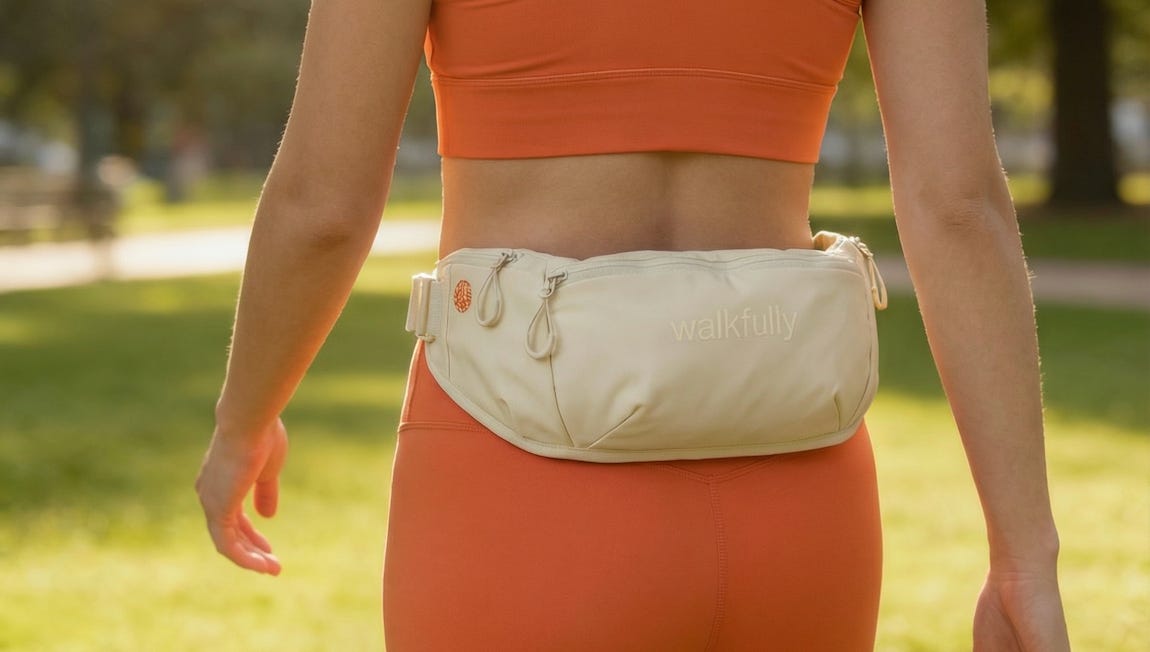
The Ritual Belt goes up to 10 pounds
Wear it on walks, errands, and around the house. It has a pocket for your phone, keys, and a water bottle—and a low-profile look that doesn’t scream fitness gear.
One early customer wears hers to clean the house, grocery shop, or walk her dog. It’s on her for a lot of the day, and that’s the point. It allows her to wear a normal fanny pack but get more out of it for her health.
The Wander Pack goes up to 16 pounds
It has a similar design, but allows for more weight.
You can carry more items in it. It’s good for longer or harder walks, or for when your body has adapted and wants more.
Two notes on the weighted hip packs:
They’re light enough and practical enough to wear all day. That makes them good options for people who want to leverage the gravitostat hypothesis. It suggests that prolonged loading of our skeletal system curbs appetite, leading to weight loss and other benefits. Read a deep dive on the gravitostat hypothesis here.
The Ritual Belt is light enough and secure enough that you could run with it. It sits at your hips, which improves biomechanics. That said, don’t run with any weight if you’ve had recent running injuries.
And I’ll note: Christopher and Mike have a hell of an eye for design. The products turned out incredible. Both use magnetic buckles, safe fabrics and plastics, and inserts so you can add load as you get stronger.
We’re releasing the belts first, because we think they’re unique—and a missing component of walking with weight.
Later this year, we’ll release a weighted vest and a pack. Both will be heavier than the hip belts and have easily modifiable weights. And they’ll fix the issues caused by military vests and packs.
Get a 30% discount with code: EASTER30
Check out the free 14-Day Walking Reset
Part of what we’re trying to do at WalkFully is remind us all that walking is important, weighted or not. I’ve written about this extensively.
You don’t need our gear or any gear to start walking. I helped create WalkFully’s free 14-Day Mind & Body Reset.
It’s two weeks of daily walking prompts designed to build a sustainable walking practice. Each day pushes you in a different direction, with new ways to think about pace, attention, terrain, and what a walk can do for your head, not just your body.
There’s no pressure to perform—just two weeks of walking with a bit more intention than usual.
Fitness doesn’t need to be a fast-paced grind to work. In fact, that can backfire. It’s worth slowing down and taking back the mental side of it.
Sign up for the 14-Day Reset here.
And if you want to see the gear, the science, and the rest of what we’re building, head to WalkFully.com.
Before we end, a quick poll about the podcast:
You’ve always received 3 emails from me a week (Mondays, Wednesdays, and Fridays). Since April, you’ve also been getting podcast emails on Tuesdays and Thursdays, for a total of 5 emails a week. I want to make sure this works for you. Tell me how you’d like to receive podcast updates:
Change nothing. I’ll keep sending each podcast (description, takeaways) as its own email on Tuesdays and Thursdays. (5 emails a week.)
Create a once-weekly podcast digest. Sent on Saturdays, with links and takeaways from both podcasts that week. (4 emails a week.)
Fold the podcast into our Wednesday and Friday letters. Think: a brief section with the guest, topic, key takeaway, and links. (3 emails a week.)
Have fun, don’t die, walk with weight.
-Michael
I loved this line: "The aesthetic of military-inspired gear also says, “I’m staging a coup against the HOA.” Some people dig that. Some don’t." It made me laugh out loud!! I live in a neighborhood with a very chill HOA, but some HOAs need a coup de etat!!
I love the new addition of all the key takeaways after the show notes. I don't always listen to the podcasts but I read the info every time.